
Introduction
You probably have heard of the term customs broker, but you most likely only have a vague understanding of what a licensed customs broker does.
Moreover, you probably don’t know how to become a licensed customs broker.
What are the basic requirements?
How much education must you have?
How many years in the industry must you possess?
How do you go about pursuing a customs broker license?
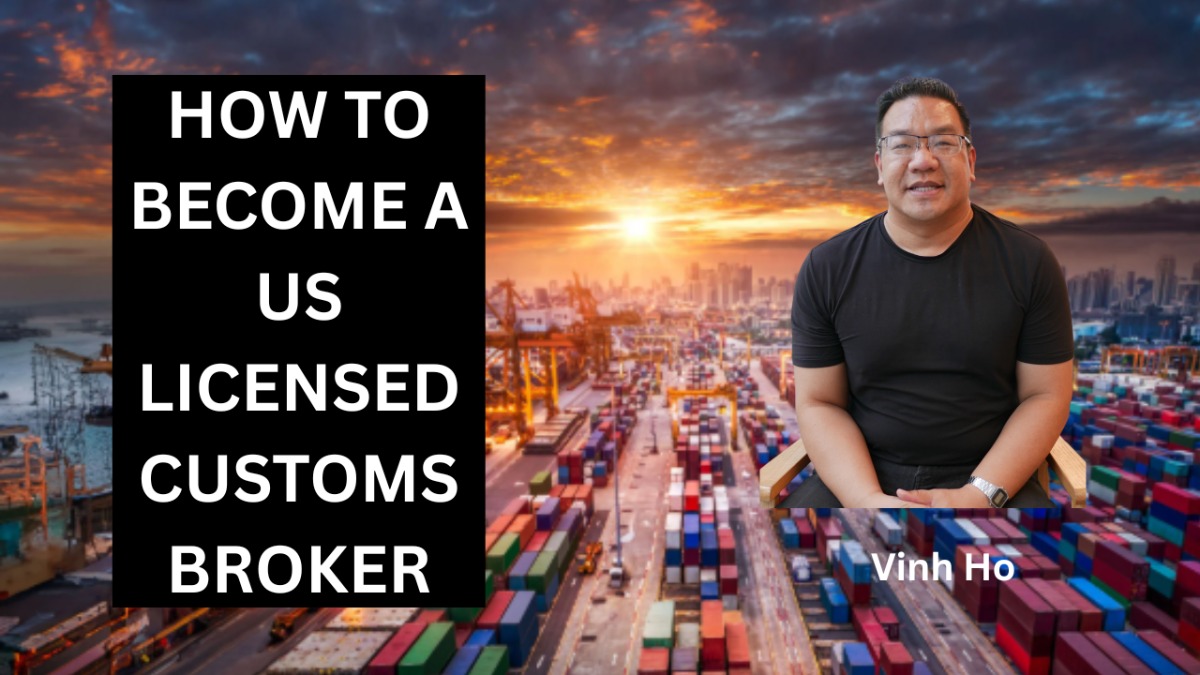
In this article, I cover what a licensed customs broker is, what the requirements are, and the journey to become one.
What is a US licensed customs broker?
In simplest terms, a US licensed customs broker is an individual who is licensed by the United States government to assist individuals, importers or companies import their goods into the United States territory (including Washington D.C. and Puerto Rico).
Customs brokers work for large, multi-national companies, freight forwarders, logistics companies and wholesale importers.
Since US customs laws pertaining to the import of goods are often complex and forever changing, a customs broker is often needed to assist importers navigate the laws and complete paperwork necessary to meet federal regulations and to avoid penalties.
Technically, companies aren’t required by law to use a customs broker, however, many choose to do so because of the potential cost savings, time savings, and avoiding product seizure and possible penalties and fines.
Consider the “Liberation Day” April 2025 tariffs levied by the Trump administration.
Nearly every country the US trades with---including heavy weights China, India and Vietnam---were slapped with exorbitantly high tariffs (duty) for products coming from these countries to be imported into the US.
Trump’s on-again off-again tariffs---often announced via Truth Social posts---wrecked havoc for anyone importing products from abroad.
A customs brokerage with knowledgeable customs brokers would be needed to help these companies navigate the often abrupt changes to make sure they are up-to-date and paying the correct duty on imported goods.
How do I become a customs broker?
Unlike many professions that require a certain years of education, training, and experience, becoming a US licensed customs broker is fairly straightforward.
You don’t need to be working in the industry, but doing so certainly helps, and you don’t need to have a four-year college degree, though most trade compliance jobs require one.
Other than being able to pass an exam, here are the only other requirements.
- Must be a U.S. citizen
- Must be 18 to sit for the exam (21 to become licensed)
- Must not be a government employee.
For more information on requirements, see: www.CBP.gov
In sum, becoming a licensed customs broker is as simple as passing an exam, sitting for an interview, and passing a background check.
There is only one caveat: The customs broker license exam is notoriously difficult to pass, often requiring 2-3 attempts and averages about a 15% pass rate nationally.
All-about the licensed customs broker exam
The first step in obtaining your customs broker license is to register and sit for the exam, which is administered twice-a-year, April and October.
To register, go to www.CBP.gov well in advance of the two testing days.
Today, the exam is administered by a third-party exam proctor and is usually held at a major city or port nearest to you.
For example, since I am living in Southwest Florida, Tampa Bay and Miami are my closest ports, being roughly a 2.5 hour drive to either city.
Likewise, if you are living in a large city such as Denver, Los Angeles, Seattle, Minneapolis, Atlanta, Detroit, Washington D.C., New York City, etc., the exam should be available to you.
You can confirm the closest exam locations nearest you by checking out www.CBP.gov.
What is the exam like?
The exam environment is different for each location and region but, generally, you will be sitting for the exam at a hotel conference room, an educational testing center, or a college campus testing environment.
Most likely you will be sitting at a long table with a laptop or a cubicle and a computer to
take your exam.
The exam is 80-question, 4.5 hours, and is open book, meaning you can take any and all of your study materials with you for the duration of the exam.
What are you tested on?
The exam is based on the 19 Code of Federal Regulations, the Harmonized Tariff Schedule (HTS), as well as other Customs and Border Protection (CBP) material.
You are tested on topics including: duty-drawback, classification, valuation, broker compliance, penalties, record-keeping, free trade agreements, free trade zones, country of origin, intellectual property rights, entry process, etc.
The exam is more of a test of where to locate information, as opposed to certain trade compliance knowledge.
The reason for such a historically low pass rate is because of the sheer amount of material to be familiar with, the tricky wording CBP often crafts their question, and the imposed time-limit to be able to look up the exact information in an efficient manner.
A 75% or above passing grade is required.
How to study and prepare for the exam?
It goes without saying that you will need to purchase a customs broker exam study prep course and devote about 4-6 months of dedicated study.
There are about a half dozen programs to choose from, and I have heard good things from two in particular: Tom O’Leary and Logistics Training Systems (LTS).
Here is a customs broker exam prep list to choose from:
What's next?
After you receive your passing grade by CBP via email, you will need to submit your application along with a $100 processing fee and your fingerprints to the port director of the port where you wish to conduct Customs business.
In about a month, the port director will call you in for a 30-minute interview where he will ask a few "get to know you" questions to judge your character and to make sure everything checks out.
After your background check, your application will be sent and reviewed by an official CBP governing board in Washington, D.C.
From your initial interview to receiving your official Customs broker license by mail could take from six to eight months.
Should you pursue an LCB?
Possible salary increase, industry respect, and future job opportunities are the main reasons why most people decide to get their customs broker license.
The job outlook for customs brokers is quite promising and the industry has been growing 5% every year since 2004.
One study suggests that by 2029 there will be more than 25,000 new jobs for Customs brokers.
In a globalized world where manufacturing, procurement, and design continue across borders at lightning speed, there will always be a need for those who can assist companies with their merchandise importation and shipments.
Conclusion
If you are interested in international trade, import-export and logistics then a career in trade compliance may be for you.
Obtaining your customs broker license will only solidify your career path.
It signals to job recruiters and hiring managers that you possess a certain level of trade knowledge and are dedicated to the profession.
My customs broker colleagues have been promoted faster, have taken on managerial roles, and are leading compliance departments at their respective companies.
Becoming a licensed customs broker, when compared to other professional fields such as law, medicine, dentistry and the trades such as plumbing and electrical, is fairly easy.
You just need to make sure you qualify and be able to pass an exam, albeit a difficult one at that.
For more information on becoming a customs broker:
For more resources on how to prepare for the exam:
0 comments