, Welcome to Day 2!
Yesterday, you assessed your starting point and learned the breathing and bracing mechanics that protect your spine under load. Today, we're building the movement pattern that everything else sits on.
Here's the truth most people skip: You can load what you haven't learned, but you can't load it safely or sustainably.
Stage 1 is where we teach your nervous system the hip hinge — the fundamental movement that powers every deadlift variation. Some of you will spend a single session here. Others will spend weeks. Either way is fine.
What matters: Can you perform these movements with perfect form, consistently, without thinking about it?
If yes, you're ready to add load. If not, you're exactly where you need to be.
Let's build your foundation.
The Learn-Load-Lift Deadlift Progression System
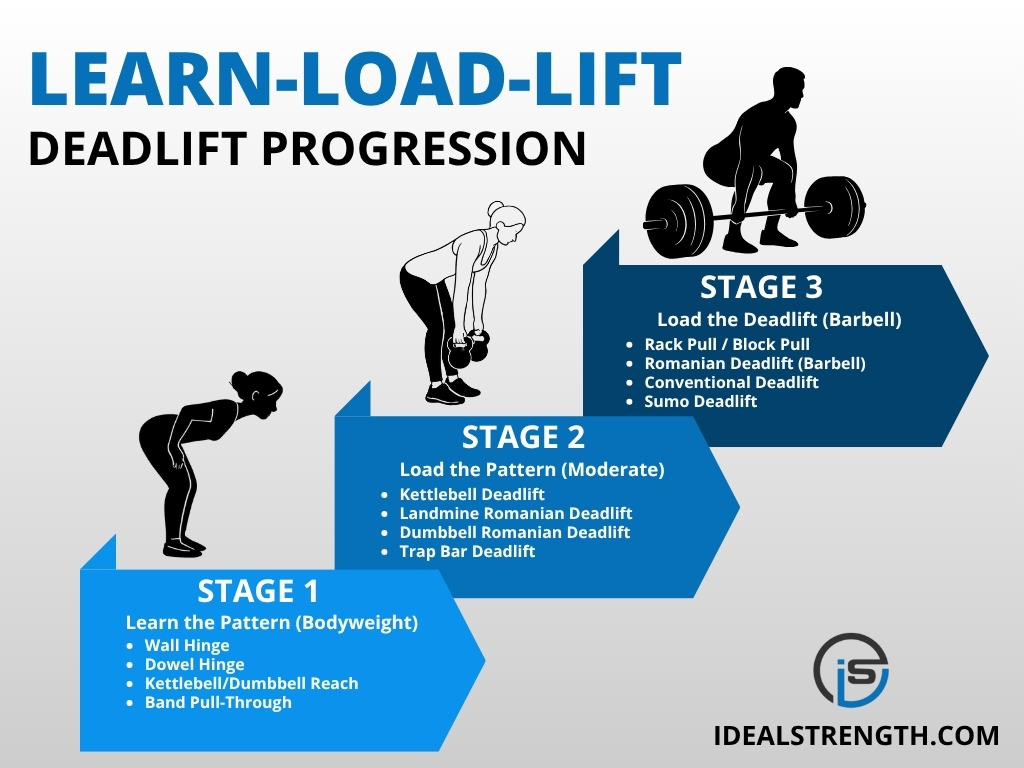
The following three-stage system takes you from learning the basic movement pattern to confidently handling heavy loads. Each stage builds essential qualities that transfer to the next:
- Stage 1 develops motor control and body awareness
- Stage 2 adds external load while maintaining quality
- Stage 3 transfers the skill to barbell variations
This isn't a rigid timeline — it's a framework for intelligent progression based on your current abilities and how quickly you adapt.
This progression is a framework, not a prescription.
Some clients will start at Stage 1 and need weeks to own the pattern. Others will breeze through it in a single session and move straight to loaded work.
The stages exist to show logical progression — not to force everyone through the same sequence.
What matters is that each stage builds the foundation for the next:
- Stage 1 teaches the motor pattern
- Stage 2 adds load while maintaining quality
- Stage 3 transfers the skill to barbell work
Where you start depends on your movement screen. How fast you progress depends on how well you own each stage.
Use these stages as a diagnostic tool — not a checklist.
Typical Timeline Expectations:
- Stage 1: 1-4 weeks (depending on movement experience)
- Stage 2: 4-8 weeks (building load tolerance and strength)
- Stage 3: Ongoing (continuous refinement and strength building)
Stage 1: Learn the Pattern (Bodyweight)
Goal: Establish the hinge motor pattern with perfect form and zero load.
Wall Hinge: Learning Hip Movement with Instant Feedback
- Stand arm's length from a wall, facing away
- Hinge back until glutes touch the wall
- Keep shins vertical, chest long
- Return to standing by driving hips forward
Why it works: The wall gives instant feedback — you can't cheat the pattern.
Dowel Hinge: Building Neutral Spine Awareness
- Hold a dowel or PVC pipe along your spine (one hand on low back, one on upper back)
- Maintain three points of contact: head, upper back, tailbone
- Hinge back, keeping the dowel in place
- Focus on hip movement, not spine movement
Why it works: Teaches neutral spine awareness under movement.
Kettlebell/Dumbbell/Cable Reach and Counterbalance: Adding Light Load
- Hold a light weight in both hands or a cable with the pulley set down and in front of you
- Hinge back, letting the weight travel down your shins or slightly forward
- Keep the balance even through the feet, shins vertical
- Drive through heels to stand
Why it works: Adds light load while reinforcing the hinge pattern.
Band Pull Through
- Anchor a resistance band low behind you (between your legs)
- Face away from anchor, hold band between your legs
- Walk forward to create tension in the band
- Hinge back, letting the band pull you into deeper hip flexion
- Drive hips forward explosively to stand, squeezing glutes at the top
Why it works: The band pulls you into the hinge position, teaching you to resist and drive your hips forward powerfully. This creates a clear feedback loop — if you don't drive your hips through, the band pulls you back. It's excellent for learning the hip snap and glute engagement at lockout.
Mastery checkpoint:
✅ 3 sets of 10 reps with perfect form
✅ No lower back rounding or hyperextension
✅ Movement feels smooth and controlled
Ready to Progress to Stage 2?
Stage 1 built your movement foundation — now it's time to challenge that pattern under load. But remember: adding weight amplifies everything. Good patterns get stronger; poor patterns get dangerous.
Before moving forward, ensure you've truly mastered the prerequisites below. If you have, Stage 2 will feel like a natural evolution. If you haven't, a few more sessions at Stage 1 will save you months of fixing compensations later.
You should be able to:
- Perform wall hinges and dowel hinges with perfect form for 3x10
- Maintain neutral spine throughout the movement without external feedback (no dowel needed)
- Demonstrate the pattern consistently across multiple training sessions
- Explain and feel the difference between a hip hinge and a squat
- Complete a set of band pull throughs with explosive hip drive and clear glute engagement
If you can do all of the above, you're ready to add load.
If you're still working on any of these checkpoints, stay at Stage 1. There's no rush — building a solid foundation now saves months (or years) of fixing compensations later.
Your Assignment for Today:
- Choose 2-3 Stage 1 exercises and perform them with perfect form
- Film yourself doing the wall hinge and dowel hinge — does your pattern match what we described?
- Practice the band pull through if you have access to a band — feel that explosive hip drive at the top
Tomorrow, we add real load. You'll learn the exact progressions for introducing external resistance without sacrificing the pattern you just built.
These exercises might feel "too easy" if you're already lifting. That's the point. Mastery isn't about making simple things complicated — it's about making complicated things simple.
Questions about any of these movements? Reply and let us know what's clicking (or what's not).
See you tomorrow for Day 3, .
– The Ideal Strength Team
0 comments