Phase Potentiation: The Secret to Long-Term Training Success
Why Your Clients Plateau (And How Smart Phases Fix It)
You've seen it happen. A client comes in motivated, follows the program religiously, and sees incredible results for the first 8-12 weeks. Then... nothing. The weight on the bar stalls. Body composition plateaus. Energy drops.
Here's what most trainers do: add more volume, throw in some "muscle confusion," or switch to an entirely different program. But the real problem isn't the program itself—it's the lack of strategic phase progression.
Understanding how training phases build on each other unlocks something powerful: years of continuous progress instead of endless cycles of starting over.
The Universal Framework: One System, Infinite Applications
Here's the truth that will simplify your entire programming approach: "The emphasis changes based on the goal. The system does not."
You don't need a different programming system for every client type. You need one solid framework that adapts to different goals. That framework is the 4-Phase Periodization Model:
- Foundation/GPP (General Physical Preparation) - Prepares the foundation
- Accumulation - Builds volume and capacity
- Intensification - Increases intensity of your primary goal
- Peak/Realization - Reduces fatigue to express performance (optional for most)
This works for everyone. The powerlifter, the marathon runner, the general fitness client—they all use this same structure. What changes isn't the framework itself, but what you're emphasizing within each phase.
A powerlifter emphasizes maximal strength in intensification. A runner emphasizes high-intensity intervals. A general fitness client might build muscle in accumulation, then shift emphasis to conditioning in the next intensification block.
Same structure. Different emphasis.
Supporting the Cycle: Deload and Transition
Beyond the four primary phases, smart programming includes two supporting elements:
Deload phases (1 week, as needed) reduce accumulated fatigue by dropping volume/intensity 30-50% without losing adaptations. Use these when performance declines or recovery becomes difficult.
Transition/Testing phases (1-2 weeks) happen between cycles. This is when you reassess progress through benchmark testing and set new goals before beginning the next Foundation/GPP phase.
These aren't separate "phases" in the model—they're practical tools that support the four-phase progression.
Breaking Down the Core Phases
Foundation/GPP: Building Your Base
Foundation/GPP prepares your body for harder training ahead. You're building work capacity, improving movement quality, and preparing tissues for progressive stress.
Key characteristics:
- Duration: 2-12 weeks (longer for beginners)
- Strength: Movement patterns, moderate loads, controlled tempo
- Conditioning: Aerobic base, low-moderate intensity
- Focus: Quality over intensity
Who needs it: Everyone—especially beginners, post-rehab, or anyone starting a new cycle.
Accumulation: Building Capacity
You're accumulating training stress to build muscle mass and volume tolerance (strength clients) or aerobic capacity and mileage (endurance clients).
Key characteristics:
- Duration: 4-12 weeks
- Primary driver: Volume
- Strength: Hypertrophy methods, 6-12 reps, moderate-high loads
- Conditioning: Longer intervals (2-5 min), aerobic tempos
- Focus: Teaching your body to handle more work
Intensification: Turning Up the Dial
Critical point: Intensification means different things for different goals.
Strength-focused clients:
- Heavy loads (3-6 reps), longer rest
- Volume decreases, intensity increases
- Conditioning becomes minimal
Conditioning-focused clients:
- High-intensity intervals (30-90 sec), anaerobic work
- Strength shifts to maintenance (2x/week)
- Focus on power output and pace
Hybrid clients:
- Choose ONE quality to emphasize: strength or conditioning
- Maintain the other at lower volume
- Duration: 4-8 weeks
Universal principle: As intensity goes up in one domain, volume comes down.
Peak/Realization: Express Performance (Optional)
Most clients don't need this phase, but understanding it is important. The purpose of peaking is to dramatically reduce training volume to dissipate accumulated fatigue while maintaining enough intensity to preserve your adaptations. This allows all the work from previous phases to express itself without fatigue masking performance.
Key characteristics:
- Duration: 2-4 weeks
- Focus: Reduce volume by 40-60%, maintain or slightly increase intensity
- Application: Competition prep, testing scenarios, specific events
For a powerlifter, this means dropping from 15 working sets per week down to 6-8 sets while keeping loads heavy. For a runner, it's reducing weekly mileage significantly while maintaining race-pace work.
Who needs it: Athletes with competitions, testing deadlines, or specific performance events
Who doesn't: General fitness clients, fat loss programs, muscle building goals
After intensification, most general population clients cycle back to
Foundation/GPP. That's the natural rhythm that builds continuous progress without the need for a formal peak phase.
Phase Potentiation: How Phases Set Up Future Success
Here's the concept that changes everything: each phase creates conditions that make the next phase more effective.
Foundation/GPP builds work capacity → Enables you to handle accumulation's higher volume without breaking down
Accumulation builds muscle and tolerance → Gives you the structural foundation to handle intensification's higher intensity
Intensification maximizes adaptations → All the capacity you built now expresses maximum output
Well-sequenced phases build from higher baselines → Each cycle lifts you to the next level
This is the staircase effect. After your first complete cycle, returning to Foundation/GPP doesn't mean starting from zero. You're building the foundation at a progressively higher level. Then you accumulate more capacity. Then you intensify to new peaks. Repeat.
This is how you create years of progress instead of spinning wheels.
Want to see how other coaches apply this in the real world?
We just opened the Trainer Edge Discord — a place for coaches to break down programming decisions, share examples, and pressure-test ideas like phase sequencing, hybrid training, and long-term planning.
- Free tier available
- Early access while we build it out
- Tables, examples, and live discussion
👉 Join the Trainer Edge Discord here:
https://traineredge.idealstrength.com/community/trainer-edge-membership
The Logic of Phase Sequencing
The typical flow—Foundation/GPP → Accumulation → Intensification → back to Foundation/GPP—makes logical sense:
- Hard to build high volume without work capacity
- Hard to handle high intensity without structural foundation
- Each phase creates favorable conditions for the next
But sequencing can adapt. An experienced lifter returning from vacation might only need 2-3 weeks of Foundation/GPP. A post-rehab client might spend months cycling between Foundation/GPP and early accumulation. The phase should match what your client needs RIGHT NOW.
Common Sequencing Mistakes
- Jumping to intensity without capacity: Setting up for injury and plateaus
- Staying in one phase too long: Diminishing returns and staleness
- Never cycling back to Foundation/GPP: Accumulated fatigue, degraded movement quality, increased injury risk
- Trying to maximize everything simultaneously: You can't be in accumulation for strength AND intensification for conditioning at once
Three Lenses, One Framework
We've provided three phase progression tables (see below):
- Table #1: Resistance Training - How to progress strength and hypertrophy through the phases
- Table #2: Conditioning - How to progress cardiovascular and metabolic training through the same structure
- Table #3: Hybrid Training - How to blend both for general fitness, fat loss, or athletic performance clients
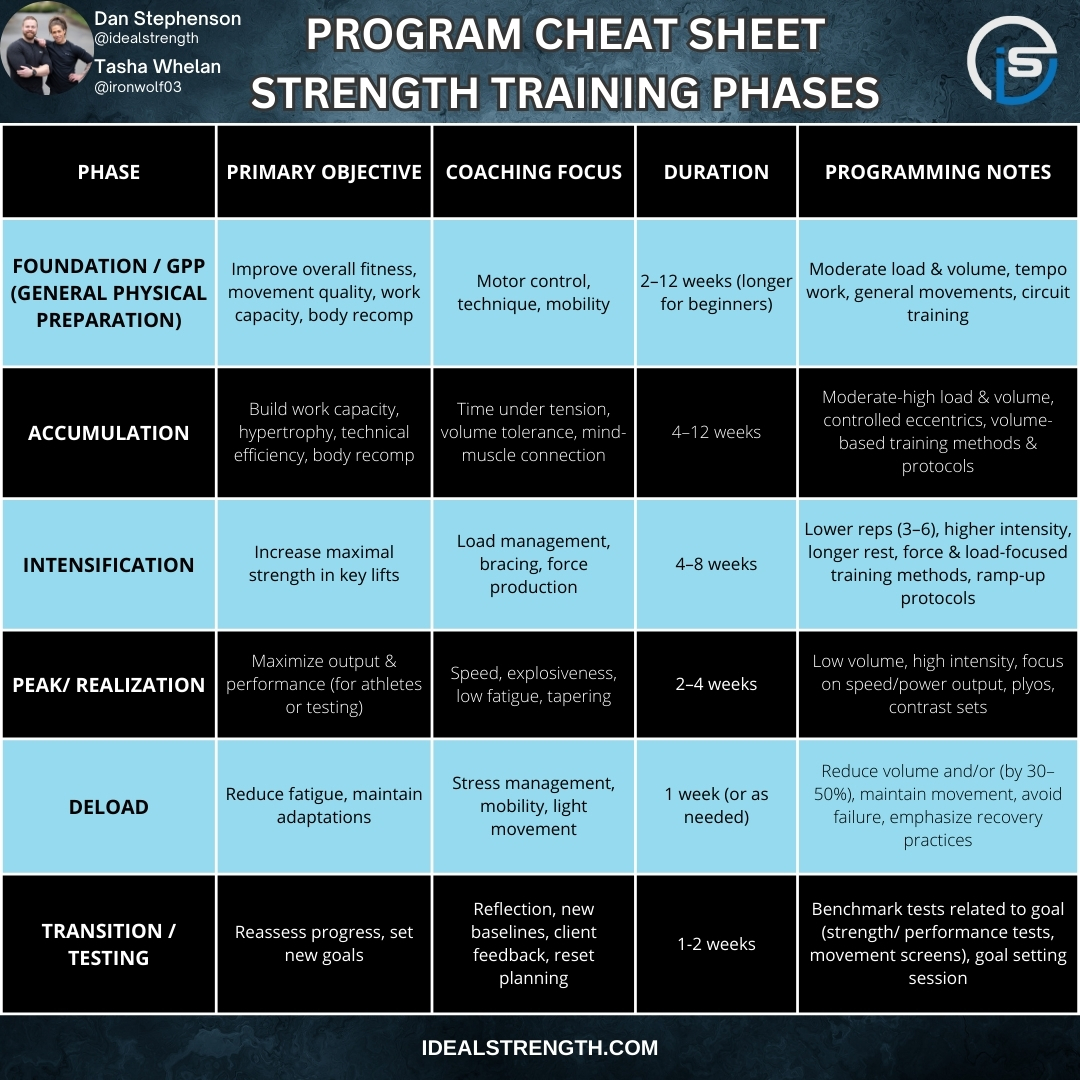
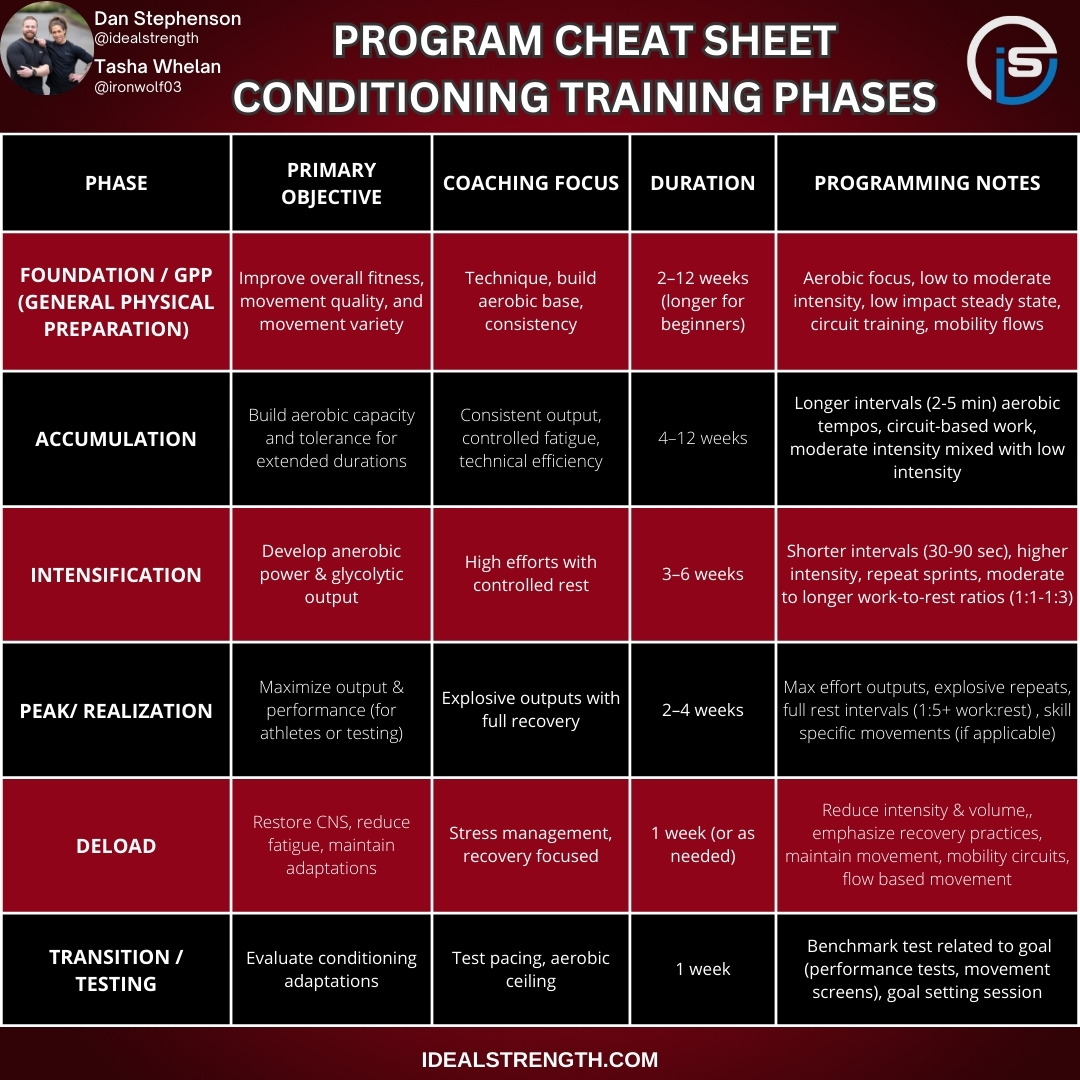
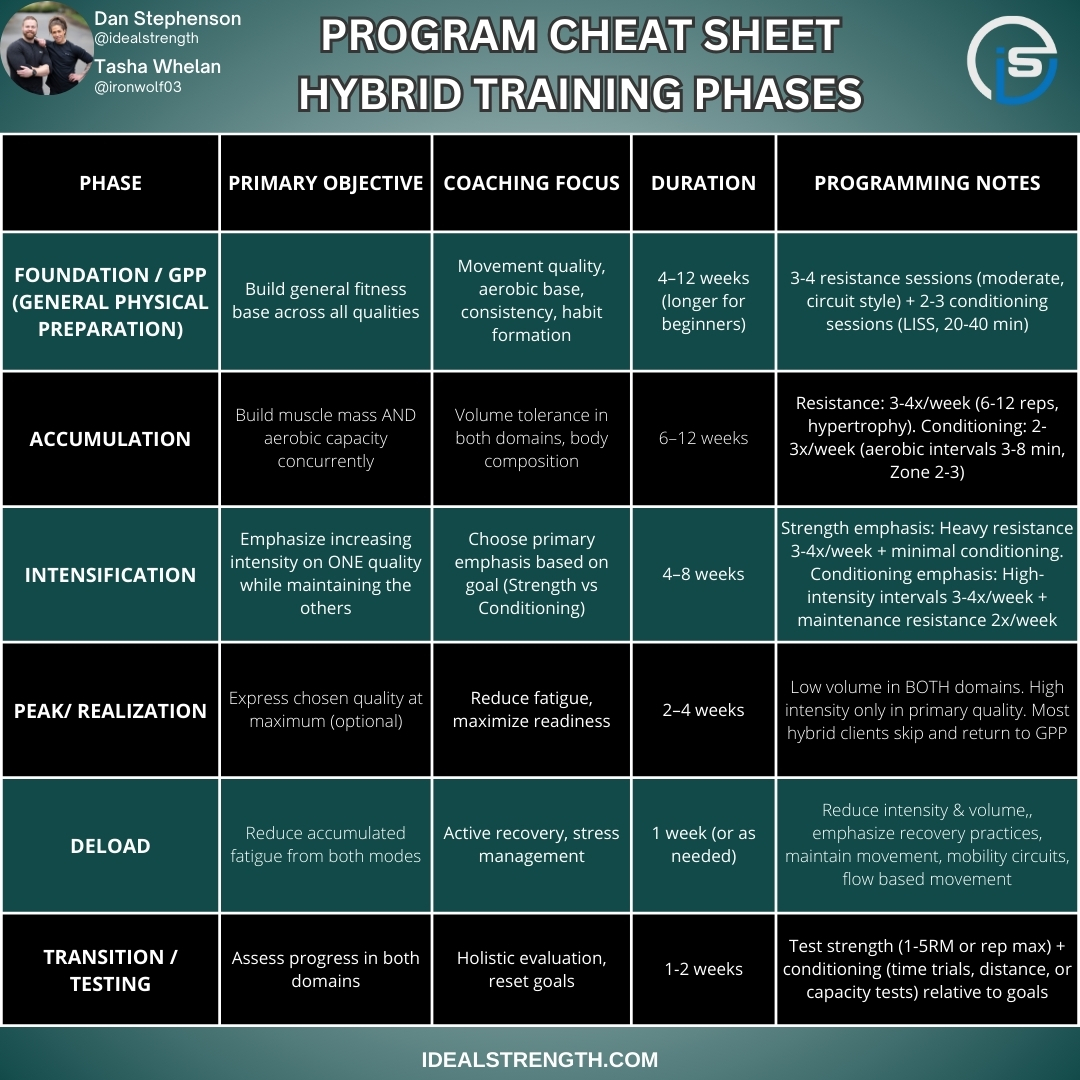
A powerlifter primarily uses Table #1. A marathon runner primarily uses Table #2. Most of your general population clients use Table #3, balancing both qualities.
The framework doesn't change. The application does.
Understanding the Hybrid Approach
Most clients aren't single-sport athletes. They want to be strong AND have good conditioning. This is where the hybrid model becomes essential.
The core principle: You can't maximize everything at once. The question becomes: what are you emphasizing, and what are you maintaining?
In Foundation/GPP and Accumulation: You can develop multiple qualities simultaneously at moderate levels.
In Intensification: You must choose your primary emphasis.
- Strength Emphasis: Heavy resistance 3-4x/week + minimal conditioning (1-2x/week, low intensity)
- Conditioning Emphasis: High-intensity intervals 3-4x/week + maintenance resistance (2x/week)
The Pendulum Approach
For hybrid clients, swing between emphases across cycles:
Cycle 1: Foundation/GPP → Accumulation → Intensification (strength emphasis) → Deload
Cycle 2: Foundation/GPP → Accumulation → Intensification (conditioning emphasis) → Deload
Over a year, your client alternates emphasis while always maintaining the other quality. This prevents getting strong but deconditioned, or fit but weak.
Pro Tip for General Population Clients: For clients with general health and appearance goals (not specific performance targets), align your emphasis cycles with the seasons:
- Fall/Winter emphasis: Strength and muscle building (September–February). Clients are typically more comfortable in the gym during colder months, wearing more layers, and less concerned about immediate "beach body" appearance.
- Spring/Summer emphasis: Conditioning and body composition (March–August). As weather improves and clothing becomes lighter, clients naturally become more active outdoors and want to look leaner.
This seasonal approach aligns with natural behavior patterns and motivation cycles, making compliance easier and results more satisfying. Your client builds muscle through the winter, then reveals it through spring and summer conditioning phases.
Practical Application Examples
General Fitness/Fat Loss Client:
- Foundation/GPP: 4-6 weeks building habits and base
- Accumulation: 8-10 weeks building muscle AND aerobic capacity
- Intensification: 6 weeks with strength emphasis OR conditioning emphasis
- Return to Foundation/GPP, then alternate emphasis next cycle
CrossFit/Functional Fitness Athlete:
- Foundation/GPP: 4 weeks post-competition
- Accumulation: 8-10 weeks building both muscle and aerobic engine
- Intensification: 6-8 weeks with concurrent approach (moderate intensity in both)
- Peak: 2-3 weeks before competition
- More frequent deloads due to training demands
Masters Athlete (40+):
- Foundation/GPP: Extended (6-10 weeks) for mobility and movement quality
- Accumulation: Shorter (6-8 weeks) due to recovery demands
- Intensification: Brief (4-6 weeks), choose ONE quality only
- More frequent deloads (every 4-6 weeks)
- Spend 40-50% of annual training in Foundation/GPP
Methods Are Flexible, Context Is King
Training methods aren't locked to specific phases. The same method can serve different purposes depending on application.
Tempo training: Primarily Foundation/GPP for movement quality, but also useful in Accumulation for hypertrophy
Cluster sets: Can build hypertrophy (moderate loads, short rest) OR strength (heavy loads, longer rest)
Circuit training: Foundation/GPP for work capacity, Accumulation for conditioning, or Deload for active recovery
Instead of asking "What phase does this method belong to?", ask:
- What is this client's current goal?
- Where are they in their training phase?
- What am I trying to accomplish right now?
You're learning to think systematically, not memorize formulas.
Practical Takeaways
Key Principles
- One framework serves all clients - Adjust emphasis, not structure
- Build from a strong base - Foundation/GPP isn't wasted time
- Each cycle builds higher - You're not starting from zero each time
- Choose your emphasis - You can't maximize everything simultaneously
- Most clients don't need Peak phases - They cycle back to Foundation/GPP after intensification
Action Steps This Week
1. Audit 2-3 client programs
What phase are they in? Does their program align with an appropriate phase?
2. Map out one client's next 6 months
Plan two complete cycles with clear phase durations and emphasis
3. Adjust conditioning for phase alignment
If a client is in strength intensification but doing high-volume HIIT, reduce conditioning to maintenance levels
4. Identify who needs Foundation/GPP
Which clients have been pushing hard for months and need to cycle back to rebuild their base?
5. Clarify emphasis for hybrid clients
For any client training both strength and conditioning, clearly define what you're emphasizing THIS phase
Think in Phases, Train for Years
The difference between amateur and professional programming comes down to time horizon.
Short-term thinking: "What workout will make them sore today?"
Long-term thinking: "What phase is this client in, and how does today's session set up next month's progress?"
Random training gets random results. Strategic phase progression creates predictable, sustainable progress.
The phases aren't rigid rules—they're a logical framework that guides smart decisions while giving you flexibility to adapt to individual needs.
Master this approach, and you'll stop programming workout-to-workout. You'll start programming for years of continuous client success.
Your Next Step
Review the three phase progression tables. Identify where your current clients fall:
- Pure strength clients (Table #1)
- Endurance-focused clients (Table #2)
- Hybrid clients - most general population (Table #3)
Then ask: Does their current training align with where they should be in the phase progression?
Map out the next phase for just one client. Make it logical. Make it build toward something.
The framework is simple. The application is where you demonstrate your expertise.
Continuing the conversation
If you want feedback on how you’re applying these phases—or want to see how other coaches are sequencing blocks—we’re discussing this exact framework inside the Trainer Edge Discord.
👉 Free + paid tiers available. Join here.
What phase do you find most challenging to program? Hit reply and let us know—we read every response.
About Trainer Edge Newsletter
Education for Fitness Professionals by Ideal Strength. Practical programming principles, training methods, and coaching strategies to help you build better programs and drive better results.
Ready to dive deeper? Check out our Training Methods course where we break down exactly how to apply different methods within each phase of this framework. Respond "METHODS" if you would like more information and would like to host this course at a facility near you.
0 comments