
Hi Team, Happy Friday,
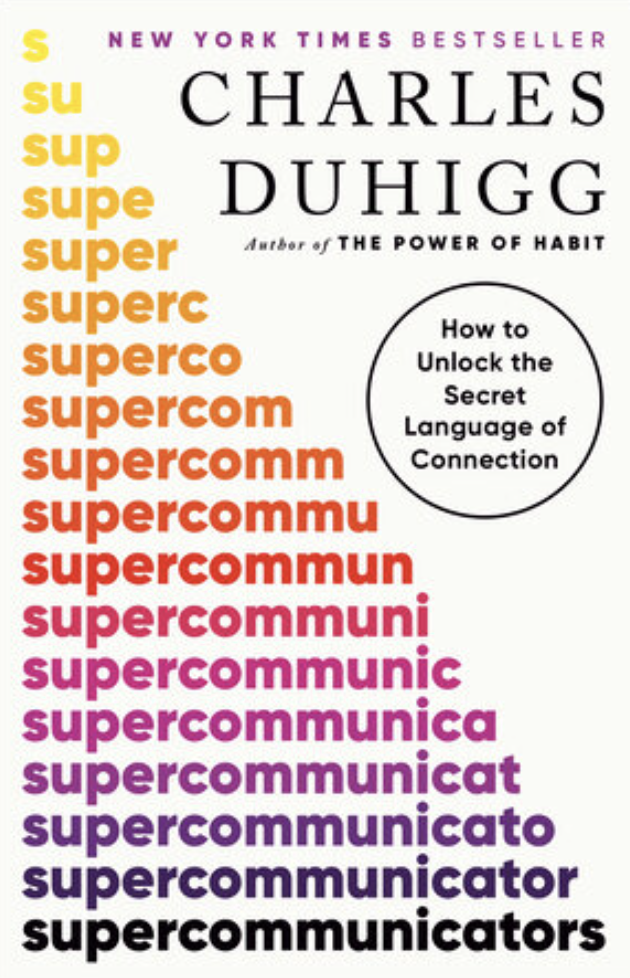
I've been reading Supercommunicators by Charles Duhigg recently and am always excited to share things that totally shift my thinking.
Let's get right in!
-If I asked you to take a deep breath in and think of the last 3 conversations you had with people you care most about:
Out of 10, how would you rate the connectedness?
Did you understand what they were saying and why they were saying it?
-Do you think they'd rate it the same?
Truth is, we're not taught how to communicate. It's bloody hard. And when I think about how little time I get to see the people I love the most, I can't stand the idea that we might walk away not 100% sure what the other was trying to share.
To put it a different way. Imagine you're a soldier on the battlefield with a radio - but it's only picking up 70% of what the other side is saying. You've got no choice to either fill in the blanks and risk getting their message wrong, or waste more time asking them to re-confirm.
Think how frustrated you'd be: 30% is a lot to guess.
Think how isolated you'd feel.
When I was studying my International Coaching Federation course - it became ingrained in us to ask one thing at the beginning of each call:
What do you want to get out of this call?
This felt very alien to me, and quite cold...
Especially when people weren't sure.
But, it changes the hour. People feel able to say - once they've worked it out - what they want from our time:
-"I just want clarity in what to do now"
-"I'm just looking to process how that's made me feel"
-'I want you to understand why this matters so much to me.'
You shouldn't need to be an ICF coach to give people this space, or ask these questions.
And Charles isn't talking about coaching - but how you should interact with anyone.
When someone speaks with us, he suggests we think:
'Do they want to be helped, hugged or heard?'
Three very different outcomes.
And here's the issue. If you're struggling to connect with someone, chances are you're speaking in different lanes.
Let's explore the three types of conversations people look for:
- The Practical ('Do you want to be helped'). We're looking to talk to someone about logical, empirical things.
-"I just want clarity in what to do now"
- The Emotional ('Do you want to be hugged'). We're looking for empathy and emotional reassurance.
-"I'm just looking to process how that's made me feel"
The Social ('Do you want to be heard'). We want to share how we experience the world
-'I want you to understand why this matters so much to me.'
You might think it's easy to tell the differences between these. But chances are you're getting some wrong every day.
For fear of turning this into too long an email (go read the book), I'll share three quick thoughts and end on a story.
The practical looks the most obvious. Context helps. If you're talking about what flight to book, or which wifi provider to buy, you're in practical territory and shouldn't find this too hard. However, don't be surprised how quickly people move to emotional/social levels.
Emotional and Social conversations, to me at first, sounded like the same thing... But here's the rule of thumb difference between them. If someone's looking for an emotional conversation - questions, if they're needed, should help them process what they're feeling.. But a social conversation should be asking questions to understand the other person and how they see or experience the world.
People will chop and change all the time of course. It's unlikely a conversation stays within one lane and you have the ability to continually steer and respond.
Why care:
A few days back, I shared something quite challenging to someone and they responded on a practical level 'well that's not a good idea.'
This was frustrating: I was sharing something to be heard and understood, maybe also hoping for a little virtual hug too. The last thing I wanted was practical answers - which made me feel unheard and disconnected.
With this framework, however, I can explain slightly more explicitly what I want:
-'I guess it's just made me feel upset....' (Hug)
-or 'But to me, you've got to understand that....' (Heard)
Anyway rather than read this and close it, remember to think helped, hugged or heard the next time you speak with someone today, it's a great tool.
Cheers
Live by design, not default.
James - humans BEING
Found this useful?
Or want to learn how to apply these tools to your own routines?
→Book an Exploration Call (30 min call)

Disclaimer:The information I share is for education and general interest only. It is not medical advice, diagnosis, treatment, or a substitute for professional care. Please do not start or stop any medication or supplement without guidance from a qualified health professional who knows your personal history.
The views expressed are my own, based on sources available at the time of writing. Logos, images, and short excerpts may appear for identification, critique, or educational purposes; all trademarks and copyrights remain with their owners. I aim to be accurate, and if you believe something here is incorrect, please let me know so I can review and, if needed, correct it.
humans BEING Humans BEING network LTD,
167-169 Great Portland Street
5th Floor
London
W1W 5PF
Use this template
0 comments