Hi
When it comes to treating water contaminated with hydrocarbons, selecting the right separation technology is crucial for both environmental compliance and operational efficiency. Two commonly used technologies are API (American Petroleum Institute) separators and CPI (Corrugated Plate Interceptors) separators. Understanding the differences between them and knowing when to use each can significantly impact your facility's performance and environmental footprint.
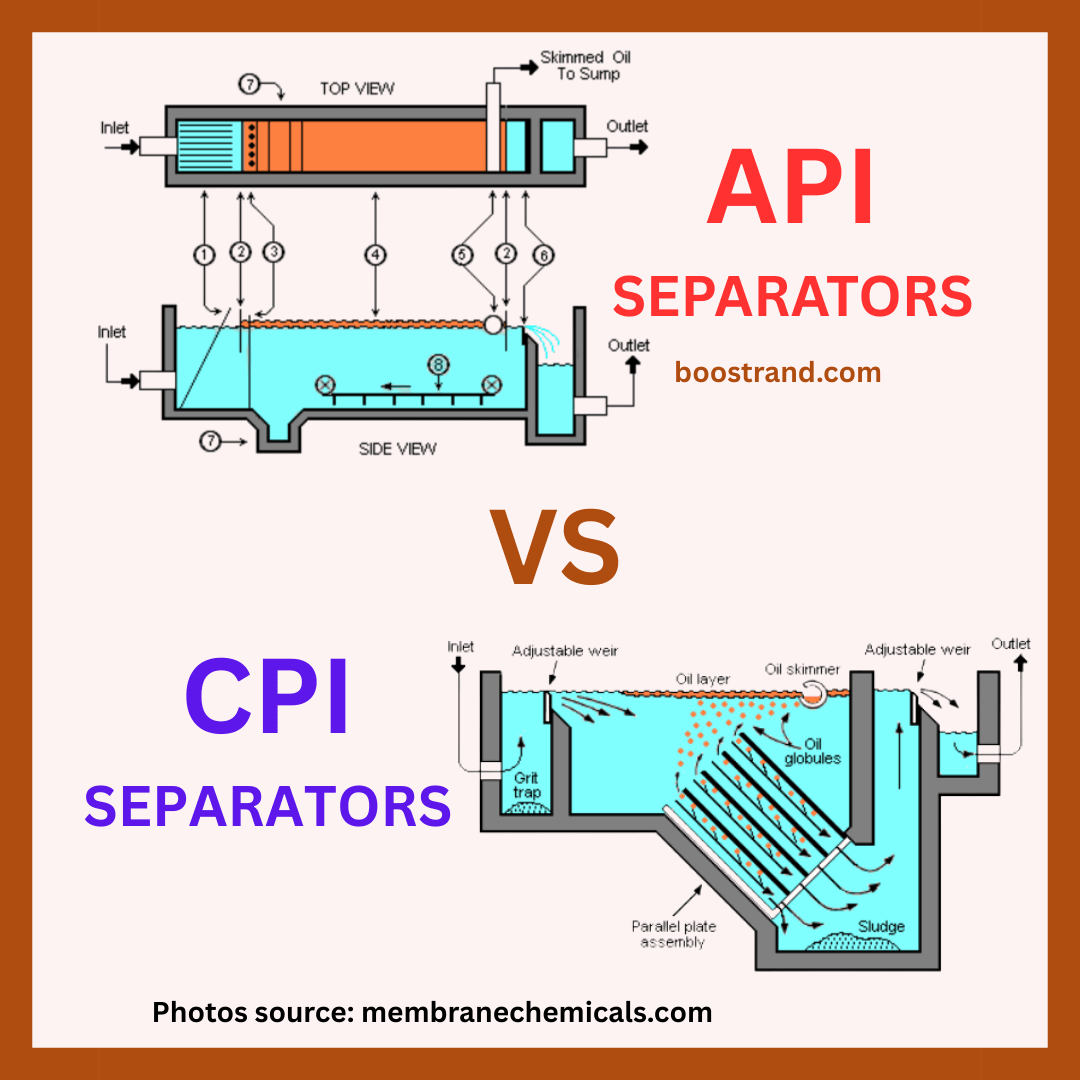
API Separators:
Traditional gravity-based settling tanks that remove free oil from water. They are cost-effective, simple to maintain, and suitable for primary treatment onshore applications with ample space.
CPI Separators:
Compact designs with tilted plate packs that enhance separation efficiency. They are ideal for space-constrained environments, including offshore platforms.
Key Performance Differences
Footprint and Location: API separators are large and bulky, suitable only for onshore applications where space is abundant. CPI separators offer a compact design that works both offshore and onshore, making them ideal for space-constrained environments.
Oil Removal Efficiency: While API separators remove oil droplets down to 150 microns, CPI separators achieve finer separation, capturing droplets as small as 60 microns. This translates to better effluent quality from CPI systems. If you'd like to understand more about separation performance criteria, you can check out the article How Two Phase and Three Phase Separators Work?.
Solids Handling: API separators handle high solids content better due to their simple design. CPI separators may require an upstream settling tank when dealing with high solids content to prevent fouling of the plate packs.
Application-Specific Selection
- API: Primary treatment for high-oil-content wastewaters where space is available.
- CPI: Applications requiring high efficiency, compact footprint, and minimal maintenance.
- Sometimes we may use a combination, API for primary treatment to remove most oil and sediments, then CPI is used to even enhance the separation efficiency.
- It all depends on the required separation regulations and the downstream unit receiving the treated water.
Conclusion
Choosing between API and CPI separators involves evaluating performance requirements, space constraints, economic factors, and operational considerations. Understanding these differences will help you make informed decisions for your water treatment needs.
If you like to discover more about the separator sizing and performance criteria, you can check out the article below:
How Two Phase and Three Phase Separators Work?.
Have a nice weekend!
Mohamad
0 comments