
Hey there,
Once upon a time I had a client.
She told me three times on the first call:
“My people won’t pay ₦1m.”
“My audience is different.”
“They don’t have that kind of money.”
And on the surface, she had evidence.
She had tried to sell at higher prices before.
People hesitated. Some disappeared. Others negotiated. A few acted like she was asking for too much.
So her conclusion made sense.
Except it was wrong.
She had 9 years of experience.
A strong reputation.
Real results.
Deep trust with her people.
But she was pricing herself like someone still trying to prove she was good.
And it wasn't because she lacked value.
It was ecause her value was trapped in the wrong category.
She was selling “coaching.”
And “coaching” was the problem.
Not because coaching is bad.
But because in the mind of her market, “coaching” sat inside the wrong value box.
To them, coaching meant support. Encouragement. Accountability. Advice. Personal development. Something useful, but optional.
So when she charged ₦400k, they hesitated.
But here's where it gets suicidal:
The same type of buyer who resisted paying her ₦400k for “coaching” was willing to pay consultants ₦3m+ to solve the exact problem she was already solving.
Same skill.
Same depth.
Same transformation.
Different category.
Different language.
Different perceived value.
That was the crack.
Anyways...
We worked through what in the Way we call the Big Jump Problem.
And she finally saw it.
Her audience was not refusing her value.
They were refusing the category she had placed her value inside.
That is the mistake many experienced experts make.
They assume the market is saying:
“We won’t pay that much.”
But what the market is often saying is:
“We don’t understand why this thing should cost that much.”
Those are not the same problem.
One is an audience problem.
The other is a positioning problem.
And most credible experts do not have an audience problem.
They have a category problem.
Their inner weight is greater than their outer structure.
They have the experience, insight, judgment, and ability to create transformation, but the market facing language does not carry the true value of what they do.
So they sell “coaching” when they should be selling a high-value transformation.
They sell sessions when they should be selling solved problems.
They sell access when they should be selling outcomes.
They sell their process when the buyer is trying to understand the consequence of not fixing the problem.
Once we changed the category, the price changed.
Not because we argued the audience into paying more.
Not because we forced confidence.
Not because we slapped a premium price on the same weak offer.
We changed what the market was being asked to recognize.
She stopped positioning herself as someone who provides coaching.
She started positioning the work around the expensive problem she actually solved.
And that changed everything.
She closed her first ₦1.5m client in week 6 of the sprint.
The second one came three weeks later.
Here is the reframe most experienced experts need:
If your audience will not pay ₦1m for a transformation that is worth ₦10m to them, the issue is almost never the audience.
It is usually that your offer is selling a category instead of a transformation.
Fix the category, fix the price.
Because buyers do not price your skill.
They price the category they believe your skill belongs to.
You do not argue someone into paying premium.
You position the problem so clearly that they recognize it is worth solving at premium.
That is how you move from being trusted but underpaid…
To being known, wanted, and paid properly.
Tomorrow, I’ll show you the system behind both stories.
The 8-step install.
End to end.
This is the exact same process I'll install in your practice when you join us for The Tribemaster Practice Foundations.
Want details?
High reply and email FOUNDATIONS and I'll send them to you.
Till tomorrow
Get out of your own way.
Sensei
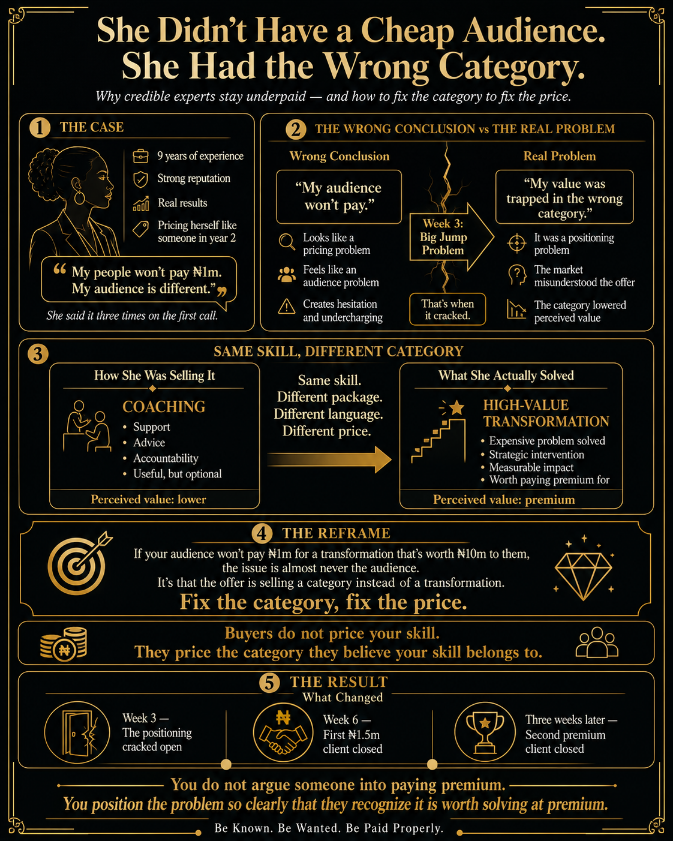
Ps: here's an infographic that captures this:
0 comments