
Dear Remi,
Most experts think their next level comes from more marketing.
But that’s usually not the real problem.
The real problem is that your practice is still asking too much of you for every result it produces.
You can get a client.
You can have a good month.
You can even make strong money now and then.
But if every result still depends on the same mix of effort, urgency, mood, and manual pushing, then what you have is not yet mastery.
It’s motion.
That’s one of the reasons I’ve been developing what I call the Tribemaster Belt System.
Not as a gimmick.
But as a way to measure something most experts never stop to measure:
How quickly can you reproduce a real economic result cleanly, calmly, and reliably?
That’s the real question.
Because the issue is rarely whether you’re capable.
The issue is whether your capability has been turned into a practice that can produce outcomes with increasing consistency and decreasing strain.
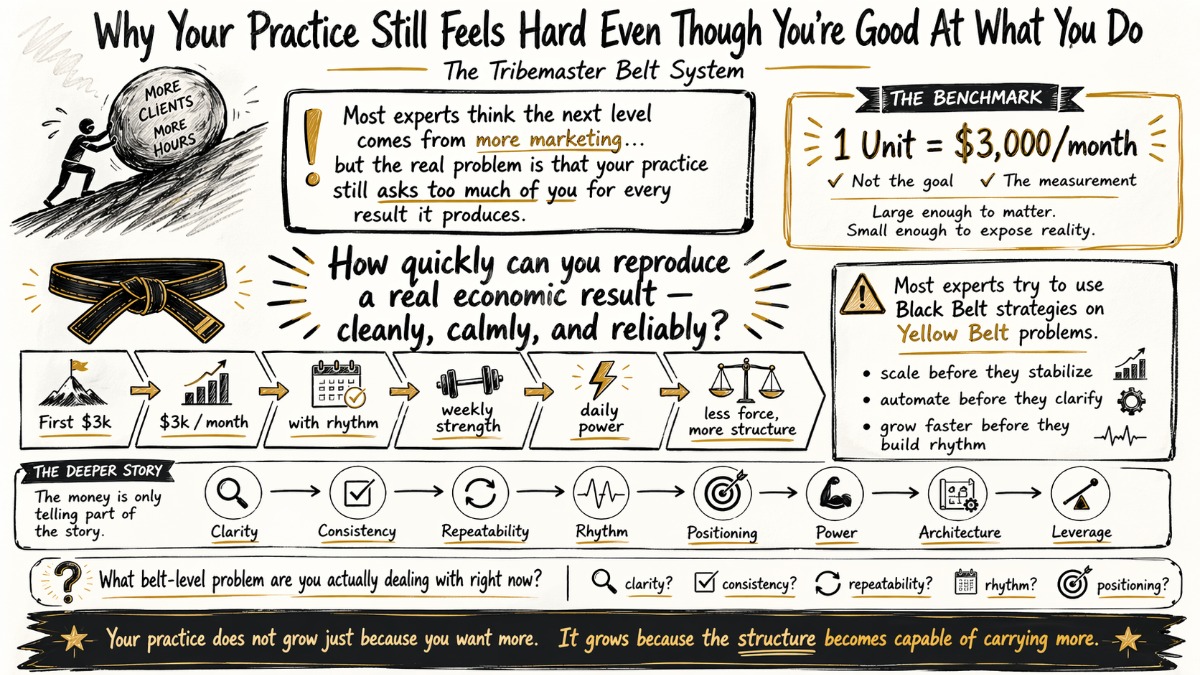
That’s why the system is built around a simple benchmark:
1 unit = $3,000/month
Not because $3,000 is the dream.
But because it is a useful unit of truth.
It is large enough to matter.
Small enough to expose reality.
Clear enough to show whether you have real command or just occasional success.
So the game is not “how do I hit a big impressive number one day?”
The game is:
Can you produce the first $3k?
Can you do it monthly?
Can you do it with rhythm?
Can you do it weekly?
Can you do it daily?
Can you do it with less force because the structure is doing more of the work?
That is a very different way of thinking about growth.
And it matters because each level demands a different kind of evolution.
At the lower levels, the problem is usually clarity.
Then consistency.
Then repeatability.
Then rhythm.
Later, the problem becomes positioning.
Then power.
Then architecture.
Then leverage.
In other words: the money is only telling part of the story.
The deeper story is what your practice has had to become in order to make that level of output normal.
That’s what most experts miss.
They try to use Black Belt strategies at Yellow Belt problems.
They try to scale before they’ve stabilized.
They try to automate before they’ve clarified.
They try to grow faster before they’ve built a rhythm that can hold.
And then they wonder why the whole thing feels heavier than it should.
So here’s a useful question for you:
What belt-level problem are you actually dealing with right now?
Is it a clarity problem?
A consistency problem?
A repeatability problem?
A rhythm problem?
A positioning problem?
Because until you solve the real constraint of your current level, the next level will keep feeling harder, slower, and more expensive than it needs to.
Your practice does not grow just because you want more.
It grows because the structure becomes capable of carrying more.
That’s the real point of the belt system.
Not status.
But honest diagnosis.
Because once you know the level you’re actually operating at, you stop guessing.
And when you stop guessing, you can build properly.
Till tomorrow
Get out of your own way
Sensei
0 comments