Bad Night ≠ Bad Day
Nov 25, 2025 10:45 pm
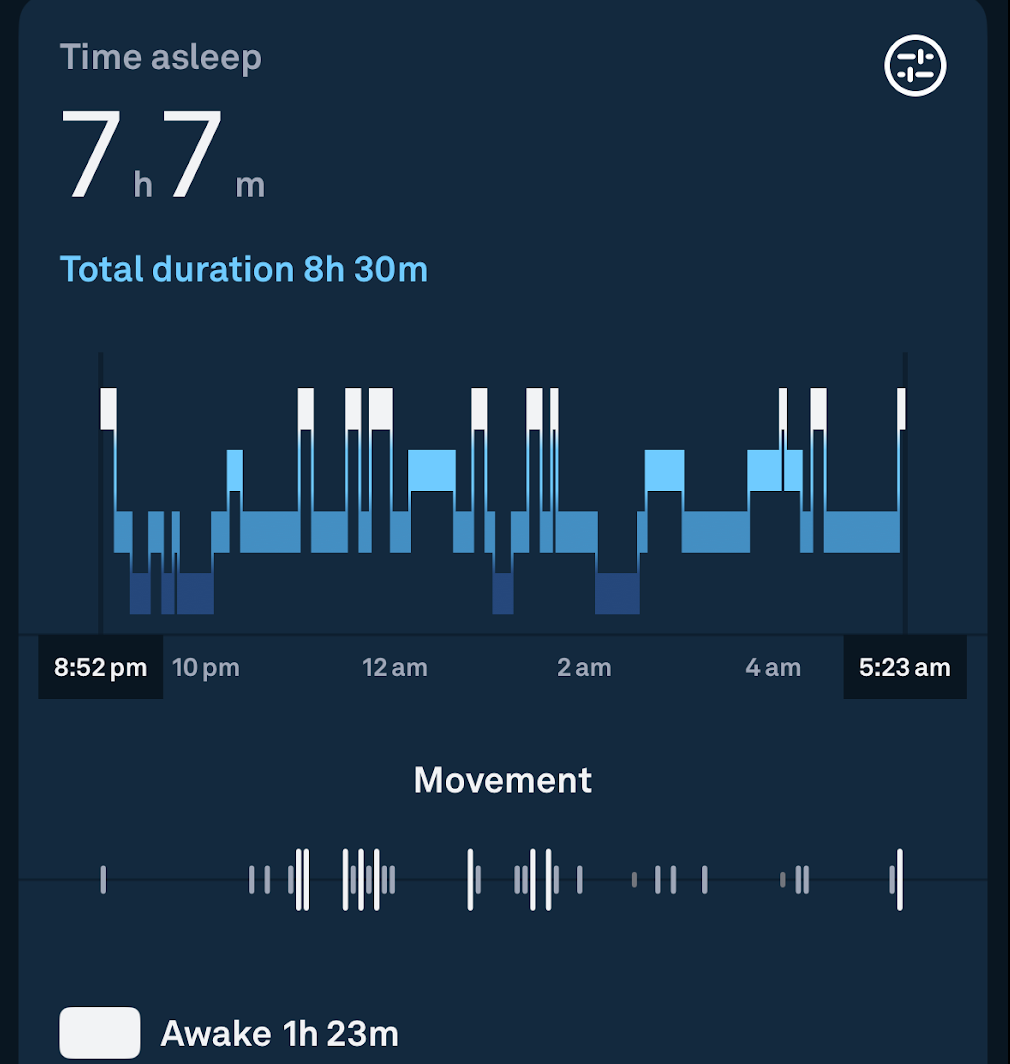
Good evening, everybody.
If you’re seeing the screenshot in this email, that lovely barcode-looking chart is my sleep from a couple of weeks ago.
Kids were sick.
Dog needed to go out.
Random noises, wake-ups, interruptions.
Total time asleep: about seven hours.
Total quality sleep: almost none.
The “awake” bars look like someone tried to scan my brain at a supermarket.
But this isn’t a “look how tough I am” story.
This is about something much more useful:
Sleep deprivation is a constraint. Constraints don’t stop productivity—they shape it.
We don’t get to choose all of our constraints.
We do get to choose the operating system we run the next day.
Most people wake up after a night like this and think, “Well, that’s it. Today’s ruined.”
It doesn’t have to be.
There’s a difference between a bad night and a bad day.
You don’t have to let the first one automatically become the second.
1. Drop the Inflammation First
When your sleep tanks, inflammation spikes.
Your brain literally swells. Executive function drops. Everything feels harder.
So on a day like this, my first move isn’t heroic—it’s physiological:
- Cold shower or at least cold rinse
- Extra hydration
- Lower sugar intake
- A bit of movement to get circulation going
- Sometimes an extra fish oil / krill oil
This isn’t about “biohacking flexing.”
It’s about getting my brain back online enough to make sane choices.
2. Don’t Aim for 100% — Aim for Intelligent
On low sleep, I don’t expect myself to perform at full cognitive capacity.
Instead, I adjust the type of work:
- Avoid heavy creative thinking, big strategic decisions, or emotionally loaded conversations.
- Lean into mechanical tasks, approvals, reviews, admin, simple follow-ups.
A sleep-deprived brain has less executive function.
Fighting that reality is how you turn a bad night into a bad week.
When you plan your work around your physiology—not your fantasy version of the day—you stop working against yourself.
3. Tighten Your Decision Space
After a night like that, every extra decision is a tax.
Decision fatigue + sleep deprivation = bad choices on autopilot.
So I consciously shrink my decision surface area:
- Pre-decide meals or let tools/automation choose for me
- Offload scheduling and logistics
- Use templates or AI to draft replies instead of “writing from scratch”
- Say no to anything optional that adds cognitive load
The goal is simple:
The fewer decisions I have to make, the better the ones I do make.
4. Resilience Comes from Exposure, Not Fantasy
I’ve seen this up close in EMS more times than I can count.
You can be dead asleep, get a tone,
be in an ambulance in three minutes,
and be treating a critical patient in a place you’ve never been before…
all while your brain is still trying to remember what day it is.
You don’t adapt to that life by “toughing it out” alone.
You adapt by building systems that support you when you’re not at your best.
Bad sleep isn’t an edge case.
It’s part of real life.
5. The System Has to Be Bigger Than the Conditions
Sleep is important. I’m not dismissing that.
But perfection is not required for productivity.
What is required is the ability to:
- Recognize your constraints that day
- Adjust your operating mode accordingly
- Run a system that still works at reduced capacity
Some days your system runs at 100%.
Some days it runs at 60%.
But it still runs—because the system is bigger than the variable conditions inside it.
If this hit a nerve—maybe you had a night like this recently, or you’re realizing your workflow assumes “ideal conditions” that almost never happen—let’s talk about it.
👉 Send me a private Carbon voice message (you can reach me at talktoari.com) and tell me:
- What your last “barcode night” looked like
- How you currently handle the next day
- Where you think your system breaks under real-life constraints
We can talk through what your adjusted operating mode could look like.
Make it an effective day, everybody.
—Ari
