
Hi , you good?
Your brain is the most energy-hungry organ in your body.
Yet, you're probably finding yours is running low by midday,
I'm listing some ways in which technology can help.
So strap in. You're in for a treat.
Executive Function (EF)
Executive Function describes the 'CEO-like' skill of your brain which helps you prioritise, inhibit and adapt your behaviours to complete tasks and reach goals.
It's one of the things that makes Homo Sapiens so smart: sitting in the fresh new suite of our Pre-Frontal Cortex (PFC) and fully coming online around the age of 25.
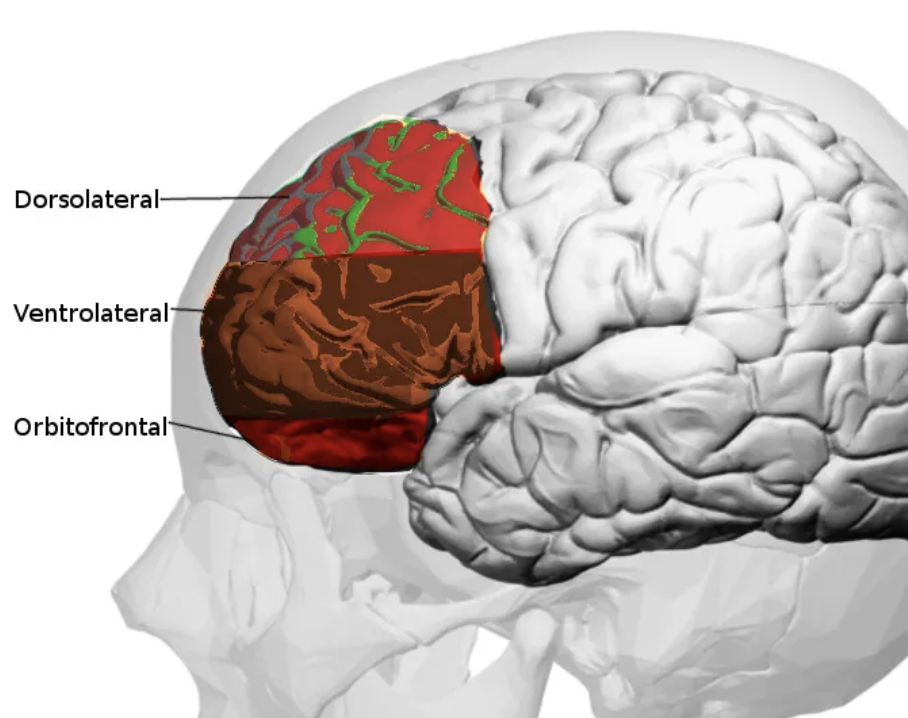
We might take it for granted, but EF is one of the soft skills we, as adults, see kids struggling with.
ie. When we tell them to go upstairs to find their shoes, yet find them 5 mins later, one shoe on, playing with some lego.
EF helps us achieve stick to a plan and pursue longer term goals.
Other animals have simple(r) priorities and shorter time frames - eat, sleep, reproduce, repeat.
But we're choosing complex, effortful behaviours to reach distant goals:
Good work today, for a pay rise in Q2, for a mortgage in 2027...
Two things you might not know about Executive Function - EF.
1. The Pre-Frontal Cortex (the EF centre) is energetically expensive.
Whilst our brain is 2% of our body weight, it uses 20% of our energy.
When we scan the brain, the PFC is a metabolically active region burning through glucose and oxygen.
When tired, drunk or stressed, your brain's 'low-power-mode' will reduce this area. This reduces your EF ability.
2. Not doing things is also energetically expensive.
Executive Function inhibits impulses if they do not meet the desired goal. However, inhibition is an active process that requires energy.
Many of the actions we don't do require us sending signals to say 'ignore that other signal.'
People asked to wait next to a bowl of cookies but NOT eat them perform worse when later asked to complete a puzzle task. Their brain tires from impulse control.
Tired brain ➡️ less energy ➡️ less EF ➡️ fewer goals
So - to achieve our goals we want to work at all stages of this chain.
That's what this email is going to work on - using tech.
The personal story bit.
Back in 2018, after my brain injury, my EF was underperforming.
Other parts of my brain - walking, talking, movement tracking - all worked just fine. But I struggled to juggle tasks, remember things and prioritise actions.
Brain injury often causes EF issues, and I wasn't even 25 yet!
This became a real problem when I moved to London and started my first grad-job.
I was fired in just 7 weeks.
It turns out you really need EF for the workplace.
Without it, every notification, every person walking by, every overhead conversation stole my focus away from the task at hand.
And I'm aware many of you might be thinking
'Hmm, I struggle with my memory, prioritisation and planning too, do I have a brain injury?'
Probably not. But you're not alone to wonder.
EF is not a skill we all get in equal measure.
No matter our age or education.
If you feel your EF is below average:
- You might just be tired.
- You might not be clear (enough) on your goals, EF needs clear direction.
- You might need more EF training. (Discipline, focus, reward etc.)
How can I improve my EF and mental energy?
Well, the PFC is not the only place we can find executive function now.
We each carry round our own external EF drive.
We've just got to learn how to use them.
The limitless ability of AI tools is staggering - and offers us a lot more potential than I think we realise.
Here's how:
1. Doing tasks to save your brain energy.
Your brain has a finite capacity per day.
To learn, think and solve challenges is tiring. It's why the first week at a new job is so hard.
AI is inexhaustible. It can, and will, solve problems ad infinitum.
In the same way no one judges an accountant for using Excel to track spend. AI is just another tool to lean into for copy-writing, thinking, and reducing mental load.
2. Providing goal clarity and direction.
One of the challenges many of us have in our working day is knowing what we need to do, taking the time to think about it strategically, without being pulled away by other side-tasks.
A tired mind ceases to be proactive. It reacts to stimuli, and can't stay on track. Gen AI has a staggering capacity to hear your thoughts, break down the direction, process and even sort by urgency and logical order.
3. Switching brain systems to save energy.
Your brain's made up of multiple areas and specialities. We spend (maybe too) much of our day in the written, reading system - with emails, documents, PDFs and slides.
But sometimes, the fastest way to think is to talk it out.
The best thing about talking, as opposed to reading/writing, is that we can do other tasks with our eyes and hands. We can drive, prepare lunch, walk to the post-box and much more.
AI can be your secretary, patiently hovering over your shoulder throughout your day to summarise, prioritise, simplify and answer queries.
Quick aside:
On the topic of audio vs visual thinking. My brain rehab taught me just how strong these differences are. I'd tire by lunch for writing emails - but could verbally talk and listen all day.
So - even 6 years ago, would be found in a meeting room dictating my emails to the computer to save my brain.
We've all experienced how many problems we can solve just by 'talking out a problem with a colleague or manager.'
Now you have one with you all the time.
Ok, so where is this LONG email taking me?
Here's your weekly challenge.
- Go for a walk and talk once a day this week.
- Just find 5-10 mins
- Turn on your voice notes or whichever AI app you'd like to speak with (I'm a traditional chat-GPT boy)
- Then waffle about tasks you need to do, a complex email you need to write, an upcoming meeting you've got coming up.
- Save your brain the 10% energy tasks for sorting, limiting and processing - and, instead, take a condensed step by step of what to do next.
human BEINGs use tools.
Tool use allows us to drastically outperform our biological limits.
Emails, like this one, were once a 'new game changing tool'
Now, they are old rope.
Best of luck,
Trial, play, learn.
James
0 comments