
Howdy.
I'm going to need your imagination for 2 minutes.
I'm going to show you how reality is subjective:
Here's one of the coolest experiments conducted in the 80s by Robert Kleck (University of Oregon).
Imagine, for a second, that we're in the 80s and you are one of the participants in this study.
You volunteer and show up for the day, intrigued and looking forward to taking part.
1. You get told that the experiment is looking at people's bias towards those with face scars/abnormalities.
2. So, as part of the experiment, you sit opposite a mirror and watch a makeup artist draw a convincing face scar on you.
3. They tell you that you're going to go and take an interview to see how having this scar on your face changes your interviewer's behaviour.
4. You wait a little while, get a final touch up by the team before going into the room, and head into your interview.
5. You're told the interviewer knows nothing about you, or your scar.
But you are told to be on the lookout for whether the interviewer is treating you differently because of it.
6. You, and the other participants leave the meeting and report that you felt you were being treated differently.
7. Because you felt like you were.
- He was making more eye contact than normal.
- It felt like he was distracted.
- You felt uncomfortable.
- The conversation flowed less well...
So what?
Here's the kicker.
You go back to a mirror and they show you that you don't/didn't have a scar during that interview.
Right before you went into the meeting, when the makeup artist said they were just going to 'touch up' your makeup before you went in, they took it back off.
Imagine how you'd feel...
He definitely looked at you differently.
You're sure of it.
But this news implies that - if the interviewer didn't see anything on you - then you felt weird for no reason.
It was all your subjective experience, not objective.
You have now experienced a different reality to... well, reality
And this reporting happened with many other participants who'd also had their scar removed.
In fact, the interviewer didn't see any scars that day...
You feel silly, you'd been tricked, and you were certain that you had one. Worse: you acted, felt and thought it was the truth.
'But how can I have felt so different if nothing was different except my mindset?!'
Exactly...
Say it again.
These limiting beliefs, these biases, these narratives we tell ourselves are not always true.
But...
They are if you think they are.
As we've just seen
(This trial has been copied and replicated consistently).
_______
So, how can we tie this finding into your life?
How about by adding this great quote from Henry Ford.
"Whether you think you can, or you can't ...
You're right."
I love it, it's kind of like when someone says they can't do something and you reply 'not with that attitude'.
But - I've taken it a step further...
I've added this image to a men's health presentation I'm running next week:
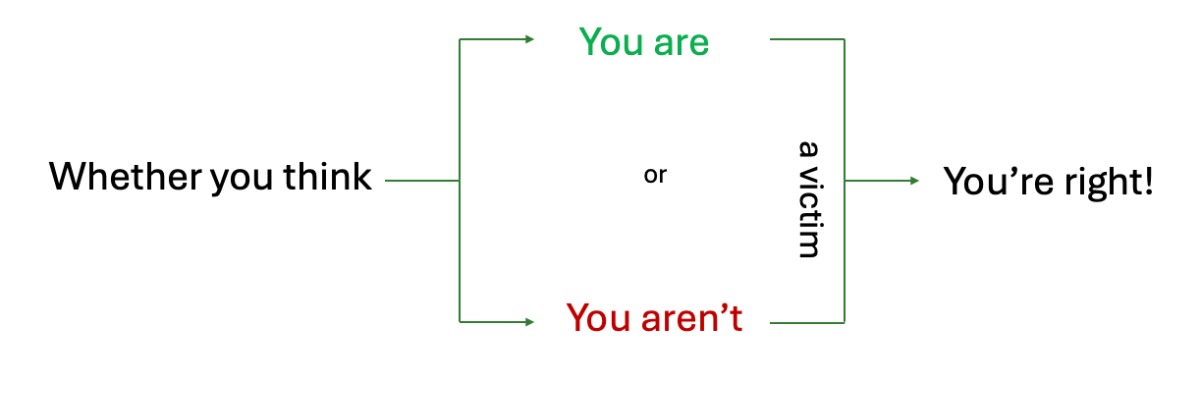
The key word there being 'victim'.
But it might also be any limiting belief you have about yourself: lazy, messy, stupid, confident...
Just like with a face scar, the reality you believe you live in bleeds into the behaviours you act out.
These behaviours then feed your beliefs.
Imagine what 30 years of this loop looks like.
How about 60?
Tell yourself you're bad with numbers and you'll always announce that when someone asks who's going to split the bill.
You might actually be the best with numbers at the table but... not with that attitude.
"I'm bad with names"
"I can't speak in public"
"I'm a terrible cook"
Or the opposite.
"I'm a great listener"
We've all met those people...
After my brain injury, I was legitimately, cognitively, objectively very bad at many things.
I was forgetful, unfocussed, bad with numbers, names and dates... The list goes on.
But I got better at many of these things.
And I didn't do it by repeatedly telling people I had a brain injury...
Ok, but what about the rest of us.
Here's the problem: we're moving towards a world of labels and identities.
"I'm neurodivergent".
"I'm ADHD"
"I'm anxiously attached"
You may well be...
You might even be diagnosed.
But, you certainly will be if you tell yourself you are.
This is a real tragedy in the identity politics era where we tell people they should expect to be judged by others based on their race, gender, sexuality.
How could they not be, when they think they're continually carrying a scarred face?
Anyway - something to mull over.
The flip of this, of course, is that you use this to your advantage.
This is where it gets powerful - people who succeed often choose their identity first:
- Muhammad Ali calling himself the greatest way before he was.
- Jim Carrey writing himself a $10M cheque to manifest being given one.
- Even Stevie Wonder (apparently) being identified as having better hearing than his classmates - which gave him the self-belief to move into music.
Your habit this week:
Write down one “scar” you think you’re wearing - then get one piece of disconfirming evidence
Want to action this further? Forward this email to someone to challenge them to do the same 😎
One belief that’s been coming up for me lately is the idea that I’m bad at planning.
But when I look at the evidence, it isn’t actually true.
I’ve planned plenty of things well.
What’s really going on is that planning requires effortful thinking, so I label myself “bad at it” as a way of avoiding the discomfort.
Simply noticing that pattern - and even allowing myself to say “I’m actually a decent planner” - means that next time I need to plan something, I’m more likely to lean in instead of lean away.
So, I'd be keen to hear what scars might be surfacing for you - feel free to hit reply and share.
Otherwise, have a great weekend.
“Reality is negotiable. Outside of science and law, all rules can be bent or broken, and it doesn’t require being unethical.”
― Tim Ferriss
James - humans BEING
Found this useful? Share it with a friend.
Or want to learn how to apply these tools to your own routines?
Chat with me here - no cost.
PS you might have read the experiment and thought:
"But hold on James, I get what you're saying: This person got tricked into thinking they had this scar when they didn't - and reported the interviewer treating them differently...
But, isn't that because they were giving off such a weird vibe from feeling like they had a scar?
Maybe the interviewer then, in turn, matched their behaviour to no-scar and then fed off that different energy, causing no-scar to feel different?
Good thought my Dear Reader.
And even if that were the case, the experiment would still provide the same meaning as above.
But alas.
No.
As part of this experiment, the interviewer was filmed and had other people watch the behaviour, compared to people in the control (no deception or scar) group.
The interviewer acted normal in both groups.
Disclaimer: The information I share is for education and general interest only. It is not medical advice, diagnosis, treatment, or a substitute for professional care. Please do not start or stop any medication or supplement without guidance from a qualified health professional who knows your personal history.
The views expressed are my own, based on sources available at the time of writing. Logos, images, and short excerpts may appear for identification, critique, or educational purposes; all trademarks and copyrights remain with their owners. I aim to be accurate, and if you believe something here is incorrect, please let me know so I can review and, if needed, correct it.
0 comments