|
| |
| Issue #82 · November 8, 2026 · 4 min read |
Buyers Have More Room Right Now. Here's What That Means.
The latest GTA numbers, in plain words, plus how to read fixed and variable rates.
|
 |
| TRREB shared its October numbers on November 4. Fewer people are buying, and prices are a little softer than a year ago. Let's look at the numbers together, and what they may mean for your family. |
|
Market Pulse
Durham Homes Cost Less Than the GTA Average. Here's the Gap.
A common worry is, "Is it even possible to buy in the GTA?" Here is what the October numbers show, based on the information available.
Across the whole GTA, 5,603 homes sold in October. That is 7.9 per cent fewer than a year ago. The average price was $1,024,108, down 2.7 per cent from last October.
Now look closer to home for many families. In Durham Region, the average sale price was $793,024. That is lower than the GTA average. Here are a few Durham towns:
- Oshawa: $653,466
- Pickering: $821,211
- Whitby: $876,275
- Ajax: $918,704
An "average price" is the total of all sale prices divided by the number of homes sold. It mixes condos, townhomes and detached homes. So your own search may look different.
The trade-off: a lower price often means a longer drive to work. Some families are happy with that. Others are not. Neither choice is wrong.
Lower prices only help if the commute and the lifestyle also fit your family.
The takeaway: Prices differ a lot from town to town, so compare the places you could really live in.
Sources: TRREB Market Watch, October 2026
|
|
|
One Thing to Know
More Room to Negotiate. What Does That Really Mean?
Many first-time buyers feel behind before they even start. Let's slow down and look at what the data says.
In October, homes in the GTA sold for about 97 per cent of the asking price on average. There were 25,098 homes for sale at the end of the month, which is 10.0 per cent fewer than last year. Homes took an average of 31 days to sell.
TRREB also said buyers have had real power to negotiate on price over the past year. It added that lower prices have helped keep monthly payments in check, even with higher borrowing costs.
"Negotiating power" simply means you may be able to ask for a better price or fair terms. It does not mean every seller will agree. Every home is different.
- Know your budget before you look, not after.
- Ask for a pre-approval (a lender's written estimate of what you may borrow).
- Plan for closing costs too, not just the down payment.
- Compare homes in more than one neighbourhood.
Before you decide, understand your options. You don't have to figure it out alone.
The takeaway: A calmer market gives you time to plan. It is not a reason to rush.
Sources: TRREB Market Watch, October 2026
|
|
|
From My LinkedIn This Week
A $25,000 price cut that didn't stick
This week on LinkedIn, I shared a story that was posted online about a condo buyer. I want you to see it too, because it fits right in with negotiating in this market.
The buyer's offer depended on reviewing the condo's status certificate. That's a report on the building's money, rules and any problems. The review found some issues, so the buyer and seller reportedly agreed to lower the price by $25,000.
Then the buyer's agent sent two papers at the same time: the price change, and a notice saying the buyer's condition was met. But the price change wasn't fully signed by everyone yet. Once the condition was met, the deal was firm. The seller didn't sign the change, so the buyer reportedly closed at the original price.
A good deal isn't just negotiated. It's properly protected.
- Get any price change signed by everyone before you confirm your conditions are met.
- If time is running out on a condition, ask for an extension in writing. Don't rush.
You don't have to figure it out alone. If you're making an offer and something changes, let's go through the paperwork together.

The takeaway: In a market with more room to negotiate, make sure every win is in writing and signed before your deal goes firm.
Sources: Fred Camingal on LinkedIn, Nov 6, 2026
|
|
|
Rate Watch
Fixed or Variable? Two Rates, One Real Question
If your mortgage renewal is coming, you may be asking which rate to choose. Let's look at what is posted today.
On October 28, the Bank of Canada raised its rate to 2.50%. Prime, which sets variable rates, went up to 4.70%. The Bank's next decision is on December 9.
A fixed rate stays the same for your whole term. A variable rate can move up or down during the term. The table below shows a few offers from lenders on my agent page. Desjardins has a 3-year fixed and a 5-year fixed, both at 4.29%. NEO has a 5-year variable at 3.60%.
The variable number looks lower today. But no one knows where rates will go next. A fixed payment is easier to plan around. A variable payment can change.
The lowest number on the page is not always the right fit for your family. Comfort and cash flow matter too.
These are advertised rates. The rate you get depends on your property, down payment and credit. I'd be happy to look at your real options with you.
|
BoC policy rate
2.50%
No change this week
|
|
|
Prime rate
4.70%
▲ 0.25 pts this week
|
|
|
5-yr bond yield
3.39%
▼ 0.19 pts this week
|
|
Bank of Canada, as of 2026-11-05
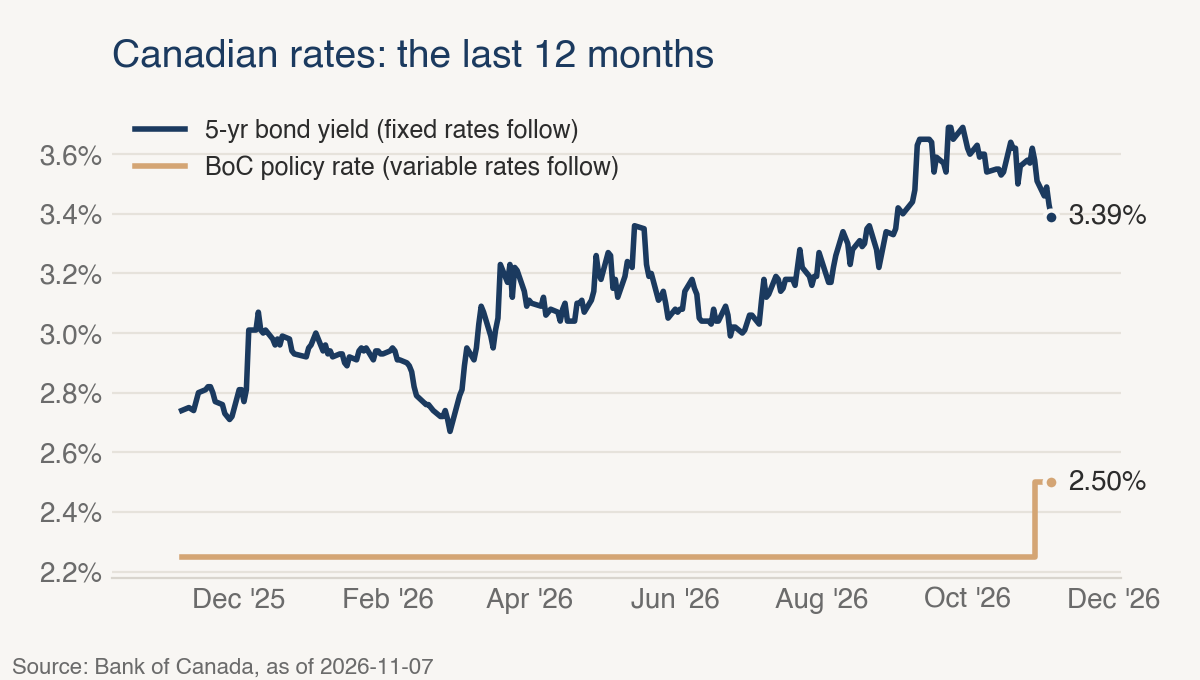
The takeaway: Compare the whole picture, not only the headline rate.
Sources: Bank of Canada · Pegasus Mortgage Lending Center (Fred Camingal's agent page)
Mortgage rates from our lender partners
Desjardins
3 Years fixed |
4.29% |
Desjardins
5 Years fixed |
4.29% |
NEO
5 Years variable |
3.60% |
Rates as of 2026-11-07. All rates are O.A.C. (on approved credit) and may change without further notice. Rates shown are for illustration only; your rate may vary based on property, down payment, amortization and credit profile. Terms and conditions apply. See all current rates
|
|
Not sure where to start?
No pressure. No obligation. Just clarity before you make a big decision.
Let's Talk — No Pressure
|
Your home should support the life you're building, not make it harder.
— Fred
|
|
|


0 comments