Hi ,
So while reviewing a shell-and-tube exchanger design, this problem was found: 2 bar (29 psi) shell-side pressure drop when the allowable was only 1 bar (14.5 psi).
This happens more often than you'd think. And some engineers immediately jump to redesigning the exchanger. But there may be other solutions.
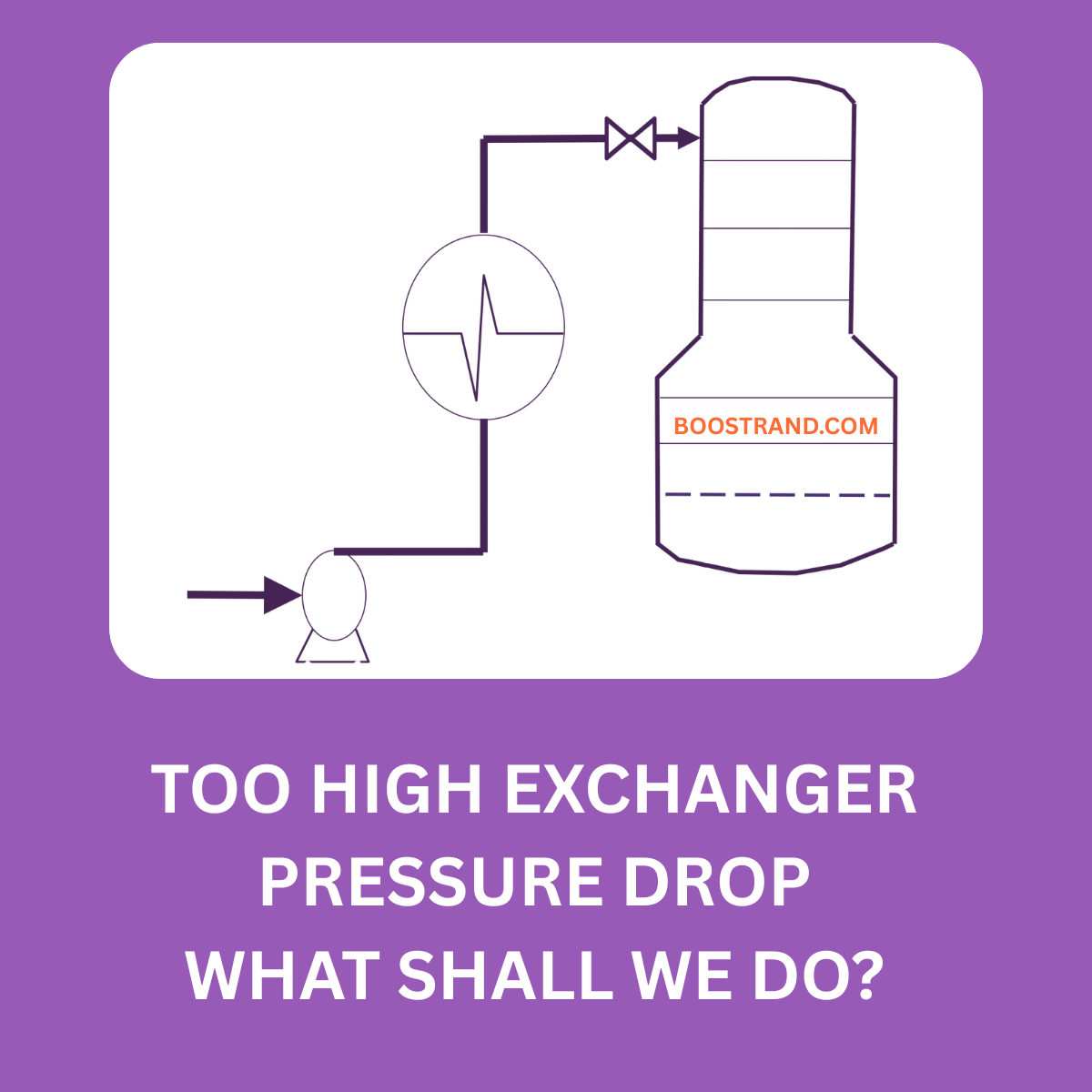
When dealing with excessive exchanger pressure drops, we have two options (or a combination of both):
Option 1: Reduce the exchanger pressure drop
Change the thermal design itself:
- Use two shells in parallel (splits flow, halves ΔP)
- Increase shell diameter
- Switch to double-segmental baffles (reduces cross-flow velocity)
- Reduce the number of baffles (increases baffle spacing → lower ΔP)
The catch: Parallel shells increase CAPEX and piping complexity (especially if you need symmetrical flow distribution). Higher diameter also increases CAPEX and has its maintenance limitations. Fewer baffles can reduce heat transfer performance. You might end up with an undersized exchanger.
Option 2: Increase the allowable pressure drop
If we have an issue with exchanger pressure drop, we can look at the hydraulics of the system. Can the system handle more ΔP? The below are 2 examples:
- Reboilers and condensers: Usually No. These have tight hydraulic constraints (gravity flow, thermosiphon circuits). So maybe it'd be difficult to increase allowable pressure drop here.
- Exchangers on pump discharge: Usually YES. Specify a pump with higher differential head.
⚠️ Warning: Higher pump head = higher shutoff head = higher exchanger design pressure. Make sure the exchanger pressure rating can handle it, or you'll need a thicker/more expensive shell.
The lesson:
Process engineers need to think about the whole system, not just one piece of equipment in isolation.
Exchanger pressure drop isn't just a thermal design problem — it's a hydraulics problem. The best solution might not be in HTRI. It might be in the pump datasheet.
This systems-thinking approach is what separates junior engineers from senior ones.
Want to master both heat exchanger design AND system hydraulics? All courses are currently ON SALE.
Our Heat Exchanger Thermal Design using HTRI course covers baffle design, pressure drop optimization, TEMA types, and how to balance thermal performance with hydraulic constraints.
Plus, pair it with our Pump Hydraulics & Sizing course to understand how pumps and exchangers interact in real systems.
Want to get both courses in addition to other 7 courses at a 60% sale of sum of all courses? Check out our Process Engineering Masterclass:
Keep designing smartly,
Mohamad
P.S. Have you ever had to redesign an exchanger because of pressure drop issues? What solution worked for you? Hit reply — I read every response.
0 comments