Hi
When carrying out any engineering project, the project schedule always reserves a place for safety studies. This is because they play a critical role in ensuring that the expected hazards are identified and dealt with in the design. Otherwise, this can cause significant operational issues or costly project delays when executing the project or operating the plant afterwards.
But here's what many project teams get wrong: they treat safety studies as isolated checkboxes to tick rather than understanding how each study builds upon the previous one to create a comprehensive risk management strategy.
The Sequential Nature of Safety Studies
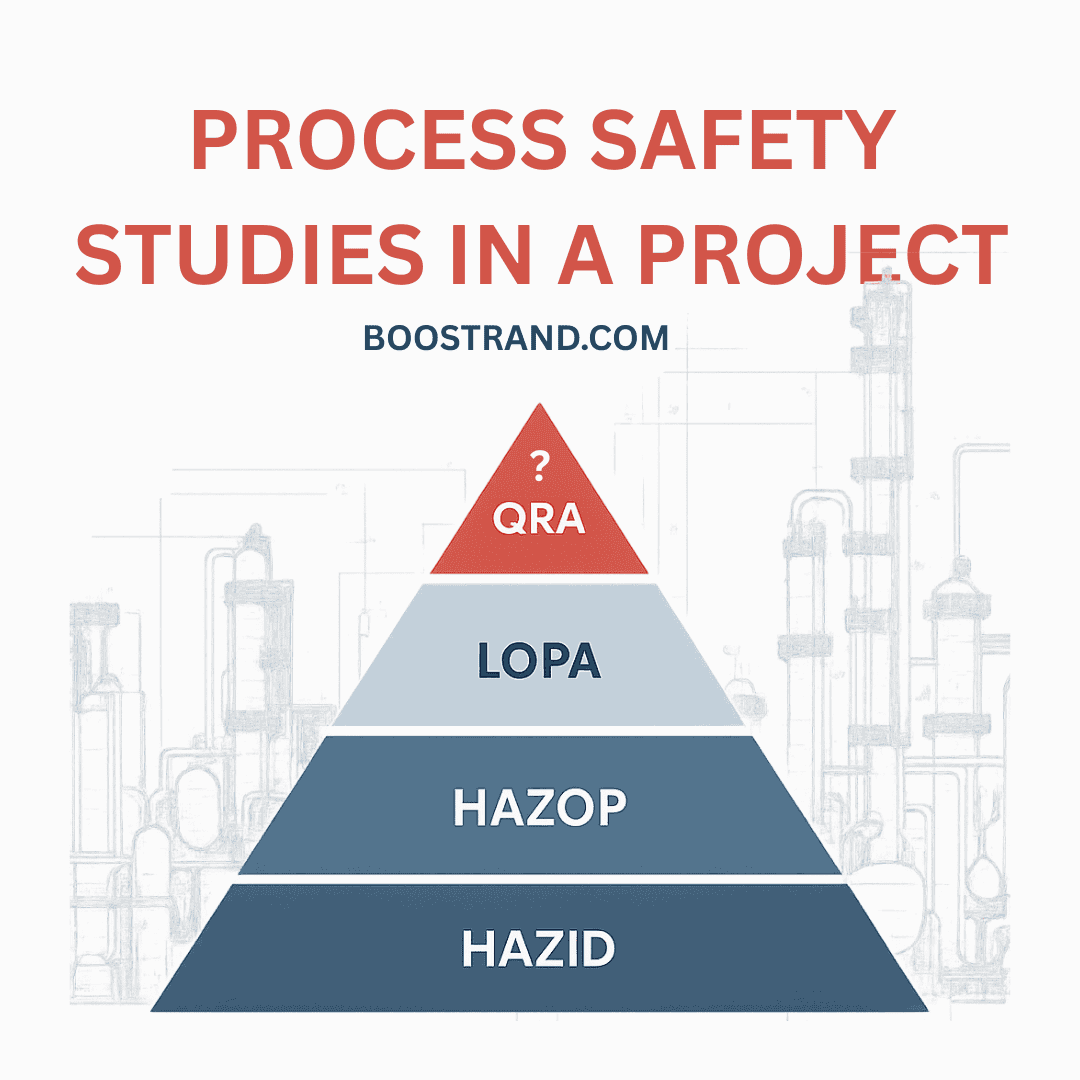
Think of safety studies as a pyramid. At the base, you have broad hazard identification that gets progressively more detailed and quantitative as you move up:
HAZID (Hazard Identification) - This happens early in your project, often during conceptual design. It's your first systematic look at what could go wrong, identifying major hazards when you still have maximum flexibility to make design changes cost-effectively.
Example: During a HAZID study, a team might discover that a flammable chemical storage tank is too close to an electrical substation. The team recommends relocating the tank to a safer area to mitigate fire or explosion risks.
HAZOP (Hazard and Operability Study) - Conducted during FEED and detailed design when your P&IDs are mature. This is where you systematically examine deviations from design intent using guide words like "more," "less," "no," and "reverse." HAZOP forms the foundation for all subsequent safety analyses.
Example: In a steam pipeline design, a HAZOP team might uncover the uncover the absence of adequate layers of protection in case of more pressure. The team recommends adding a pressure safety valve to prevent pipeline rupture.
LOPA (Layer of Protection Analysis) - This semi-quantitative bridge follows HAZOP when you need to evaluate whether your existing safeguards are adequate. LOPA counts your independent protection layers and determines if you need additional safety systems.
Example: A LOPA is used to analyze a high-pressure scenario identified in the HAZOP. The analysis concludes that the existing alarms are not enough to prevent a vessel rupture and that an additional 100-fold risk reduction is required. This finding then triggers a separate SIL Assessment to design a SIL 2-rated emergency shutdown system.
QRA (Quantitative Risk Assessment) - Here's the key point: QRA isn't automatic. It's triggered on a need basis, often when HAZOP or LOPA identifies high-consequence scenarios that require detailed quantitative evaluation for regulatory compliance or when semi-quantitative methods prove insufficient.
Example: A QRA for a petrochemical plant might evaluate the risks of a flare gas release. The study could recommend additional fencing and evacuation plans for workers based on the severity of the risks.
Why Timing Matters
The biggest mistake I see is conducting these studies at the wrong project phase.
Start HAZID too late, and you miss opportunities for inherent safety.
Conduct HAZOP too early without sufficient design detail, and you'll be making too many assumptions. Wait too long for QRA when it's needed, and you'll face schedule delays and costly design changes.
The sweet spot? HAZID during conceptual design, HAZOP during FEED, LOPA immediately after HAZOP for flagged scenarios, and QRA only when specifically recommended by earlier studies or required by regulations.
This isn't just academic theory - getting this sequence right can save project months of delays and significant costs while ensuring you meet all regulatory requirements.
Things aren't clear yet? Then I advise you to check out the below articles talking more about project stages and plant protection measures.
Critical Role of Safety Shutdown Interlocks in Equipment Protection
Understand Process Design Stages From Conceptual Design To Startup
Have a nice day!
Mohamad
0 comments