Hello ;
In any plant, some components may be idle during normal operation, but their function is to provide protection during a specified upset. This is commonly called latent failure. Latent failures are described as unrevealed failures that are not immediately detected. These failures remain hidden for a significant period and can lead to more serious issues if not addressed in time.
Latent failures should normally be considered as an existing condition and not as a cause of overpressure when assessing whether a scenario is single or double jeopardy. For example, latent failures can exist in instrumentation that prevents it from functioning favourably during an overpressure condition. It is not double jeopardy to assume the absence of beneficial instrumentation response in combination with an unrelated overpressure cause. Likewise, it is not double jeopardy to assume a latent failure of a check valve allowing reverse flow during a pump failure.
API 521, FIFTH EDITION, JANUARY 2007
Here we can see an example the latent failure of a check valve.
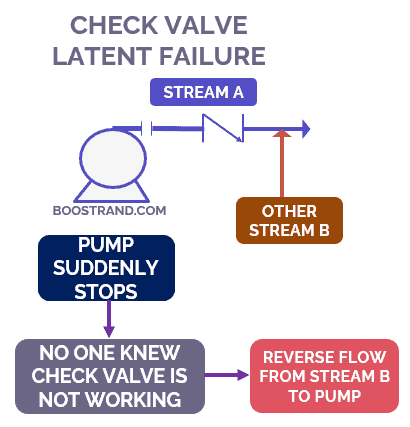
Suppose we have two streams, A and B, that are mixed at a point, and a check valve is installed on both streams to prevent backflow. If the pump supplying stream A fails, can we guarantee that the check valve on stream A will prevent backflow? Actually, we cannot.
This is because the check valve is not normally in operation, so we cannot guarantee that it won’t fail when needed.
So here a process engineer should take care of these scenarios. Although in most cases we consider that 2 upsets occurring at the same time is double jeopardy. There are scenarios where there can be a relation between the 2 upsets or that the upset already occurred while we are not aware.
I have talked about this in more detail in one of my articles, you can check it out in the below link:
I hope you shall enjoy the article, feel free to reply to this email for any questions.
Regards
Mohamad
0 comments