Hi ;
As we highlighted in a previous article, How Two Phase and Three Phase Separators Work? , we have explained different parameters for separator sizing. In this email, we shall talk about
The choice of separator internals is highly dependent on the separation requirements, which are typically defined by the maximum droplet size of the phase to be separated. For example, in gas-liquid separation, if we want bulk separation of liquid from gas, we may specify that the maximum droplet size of liquid in the outlet gas should be 150 microns. This means that droplets larger than 150 microns will be effectively separated in the vessel. However, for more efficient separation, we may target a maximum liquid droplet size as small as 10 microns, especially in applications where fine mist removal is critical.
The same principle applies to liquid-liquid separation. For instance, when separating oil from water, we may specify the maximum oil droplet size allowed in the wastewater or the maximum water droplet size allowed in the oil phase. These specifications will dictate the type of separator internals required to achieve the desired separation efficiency.
In bulk separation, we typically rely on gravity settling to separate the phases. In such cases, the separator may only require minimal internals, such as a simple weir or baffle, to achieve a maximum droplet size of around 150 microns for liquid in gas, oil in water, or water in oil. However, this approach is suitable only when separation requirements are not very stringent.
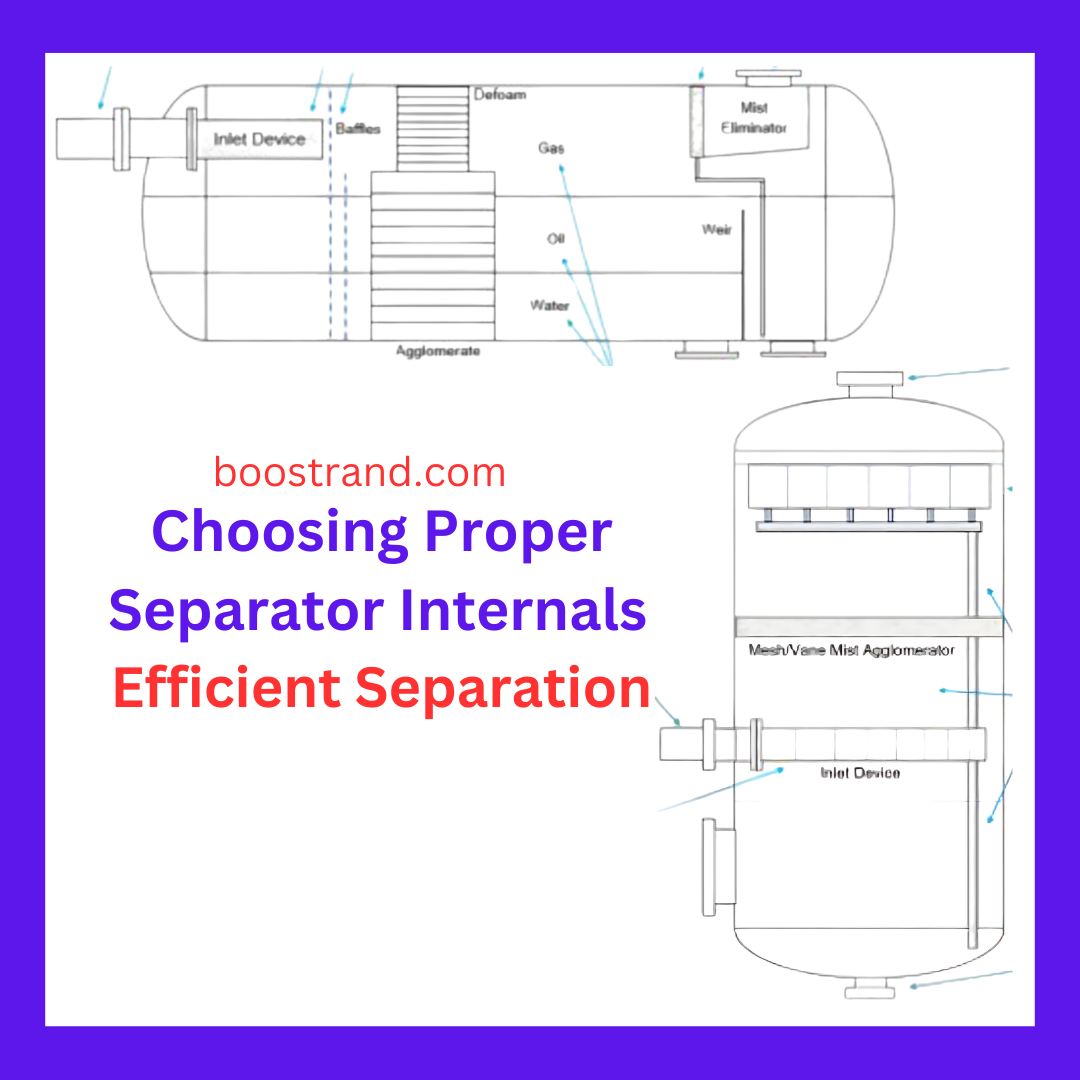
If more efficient separation is required, additional internals can be installed in the vessel. Here are a few examples:
- Plate Packs: When we need to reduce the maximum liquid droplet size to 50 microns, plate packs can be used. These internals increase the surface area for liquid to coalesce and settle more efficiently, improving separation performance.
- Coalescers for Emulsions: In cases where we are dealing with emulsions in liquid-liquid separation, gravity alone may not be sufficient to separate the phases, as the droplet sizes are too small to settle by gravity. Coalescers are used to increase the droplet size by combining smaller droplets into larger ones, allowing them to settle more easily. Coalescers can treat droplet sizes down to 30 microns or even smaller, depending on the design and application.
- Wire Mesh Demisters and Vane Packs: If we need to remove liquid droplets from the gas outlet while maintaining a high K factor (which allows for higher gas velocity and therefore a smaller vessel diameter), we can use wire mesh demisters or vane packs. These internals are highly efficient at capturing fine mist droplets, often down to 10 microns or smaller, thereby reducing the vessel diameter and improving separation efficiency.
- Inlet Devices: The proper selection of the inlet device can significantly improve the efficiency of bulk separation. An inlet device, such as a vane-type inlet or cyclonic inlet, reduces the momentum of the incoming stream and directs the flow in a way that enhances primary gas-liquid separation. This initial bulk separation reduces the load on downstream internals, such as mist extractors or settling sections, allowing them to perform more efficiently. A well-designed inlet device can also help reduce the overall vessel size and the size of the inlet nozzle by optimizing the flow distribution.
In conclusion, the choice of separator internals is not a one-size-fits-all solution. It depends on the specific separation requirements, including the maximum droplet size and the desired separation efficiency. By selecting the appropriate internals, such as plate packs, coalescers, mist eliminators, and inlet devices, we can optimize the separator’s performance and minimize its size while ensuring high separation efficiency.
If you'd like to know about other parameters that should be consider in vessel sizing, don't forget to check out the article How Two Phase and Three Phase Separators Work?
Have a nice day!
Mohamad
0 comments