
Hey there...
So..
I run a programme for young people called The Priority Compass.
The goal is to help them develop the leadership capability and quality of thinking they'll need to succeed in school and in the real-world marketplace.
One of the things I require is simple:
Publish your distinctions every week.
Why?
Because publishing is now a core marketplace skill.
If you cannot take what is in your head, communicate it clearly, create media around it and build an audience that trusts your thinking…
you are disadvantaged.
Pure and simple.
A few editions ago, one of my clients published an idea:
Keep your outcome fixed. Modify your options for reaching it until you get it.
Nothing revolutionary in the sentence itself.
But the intelligence behind it was solid.
So we took that intelligence and built a web-based Strategic Expansion Tool around it.
He's 18.
The newsletter documented his wisdom.
The tool codified it.
And that brings us to our next distinction:
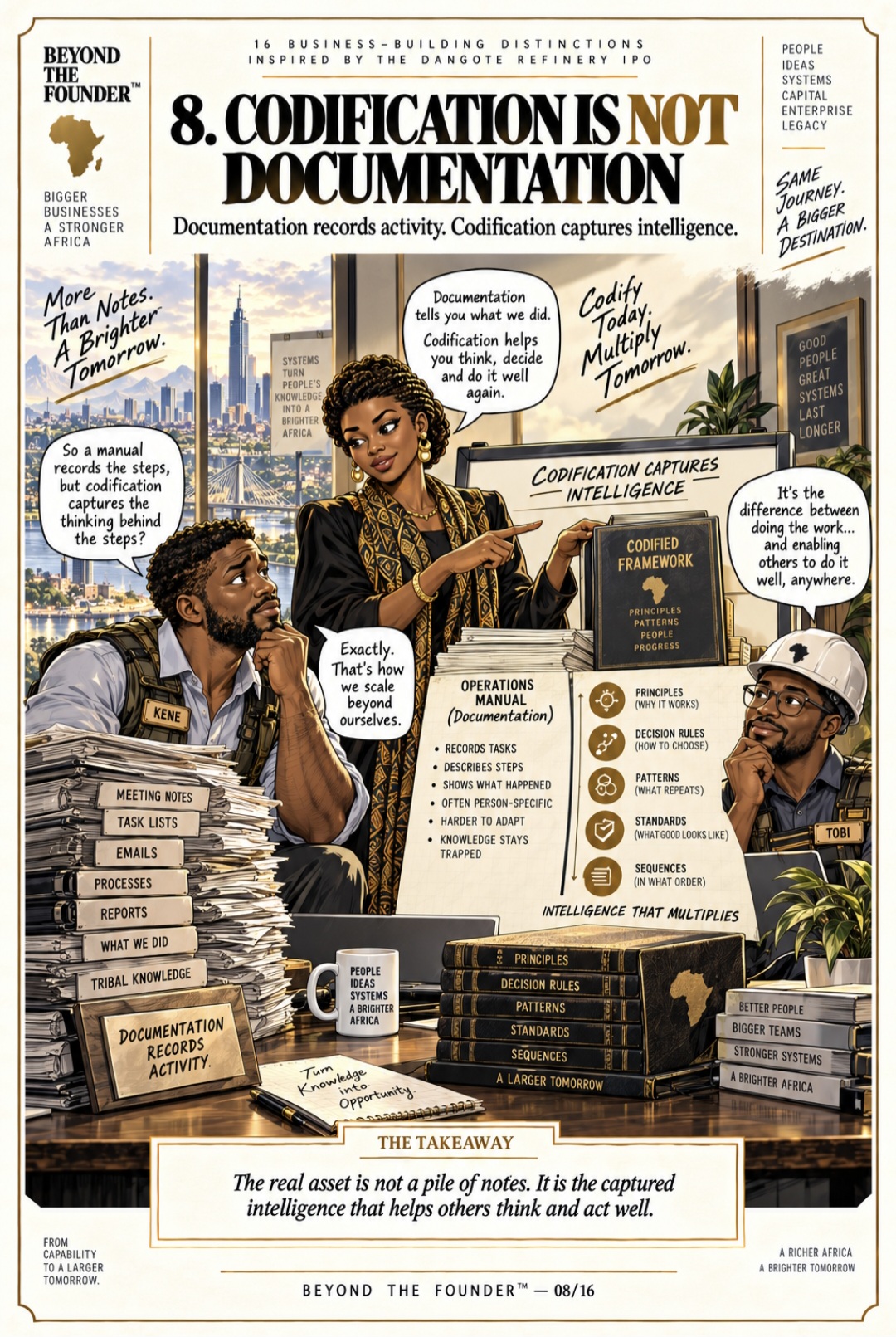
CODIFICATION IS NOT DOCUMENTATION.
Documentation says:
Here is what I know.
Codification asks:
How do I make what I know usable by someone else?
The article could be read, shared and discussed.
The tool could now be used to facilitate, coach, consult, train and eventually be licensed.
Same intelligence.
Different leverage.
That is where a lot of people misunderstand intellectual property.
A book is not automatically codified expertise.
A course is not automatically codified expertise.
Neither is a folder full of recordings or an SOP.
The real intelligence often sits underneath the steps:
What do you notice?
What question do you ask?
What changes your decision?
What tells you something is wrong?
What standard are you using?
What exception changes the rule?
That is the stuff that needs to be captured.
And in the age of AI, this matters even more.
Information is cheap.
Useful judgment is not.
The valuable thing is not simply what you know.
It is the distinctions, decision logic and standards that help someone know:
What should I think about?
What should I decide?
What should I do next?
That is what we increasingly mean by Packaged Intelligence.
And I think the bigger lesson from this is not the tool itself.
It is the capability he is learning:
→ Notice what works
→ Distinguish what's important
→ Articulate it effectively
→ Publish it for others
→ Codify the intelligence behind it
→ Deploy commercially
Imagine learning to do that before university is over.
Imagine doing it for the next 20 years.
That is a very different relationship with knowledge.
So here's the question I'd leave you with:
How much of what you call your intellectual property is actually just documentation?
And how much has been codified deeply enough that another person can use it to think better, decide better or produce a result?
Because the distinction is simple:
Documentation preserves intelligence.
Codification makes intelligence operational.
And once intelligence becomes operational…
it can become an asset.
Till tomorrow...
Be dangerously useful
Get out of your own way
CTM
P.S. Take one thing you teach repeatedly and ask:
Could a competent person use what I've created to make a good decision without needing me in the room?
If not, you may have documented it.
You probably haven't finished codifying it.
0 comments