
Hey there.
This morning I read story I kinda like.
Here's the direct copy and paste version with gratitude to Aesop:
Once upon a time...
A master blacksmith had two apprentices.
The first was excellent at helping.
When the master reached for a hammer, it was already in his hand.
When the fire weakened, the apprentice added coal.
When metal needed moving, he moved it.
He was quick, loyal and hardworking.
The second apprentice was slower.
Annoyingly slower.
He kept asking questions.
"Why do you heat this blade longer than that one?"
"How do you know when the metal is ready?"
"Why three strikes here and five there?"
"What are you listening for?"
The master would sometimes sigh.
But he answered.
Years passed.
Then one morning the master fell ill.
The first apprentice arrived at the forge and stood waiting.
There were tools everywhere.
Coal.
Iron.
Orders from customers.
Everything he had used a thousand times.
But without the master telling him what to do next, he was lost.
The second apprentice walked in, lit the furnace and began working.
Not exactly as the master would have.
But according to the principles the master had taught him.
He understood the fire.
He understood the metal.
He understood the standard.
The first apprentice had learned to help the blacksmith.
The second had learned to carry the craft.
=================================
Cool story...right?
Anyways...
Over the years I've had clients who happily referred me.
Clients who paid me to help them but kept me their extremely private secret weapon.
And others who grudgingly paid simply because they knew they needed access to what I could do.
Different relationships.
Different circumstances.
But one thing kept proving itself:
We need people.
The question is what kind of people you are building around you.
And that brings us to our 7th distinction:
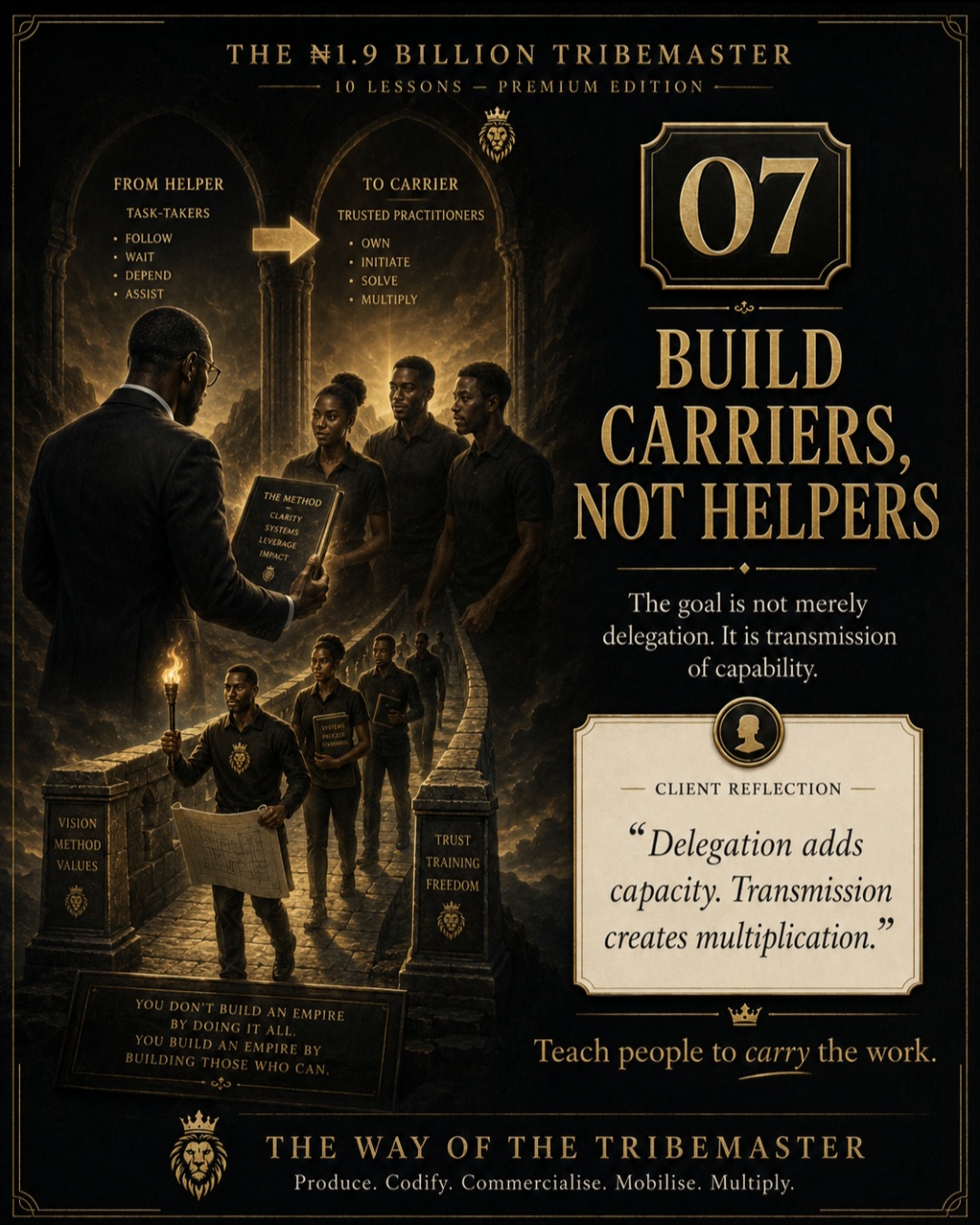
Build Carriers Not Helpers
Hiring someone does not automatically create leverage.
Sometimes it simply gives you another person to manage.
A helper assists you in carrying your work. A carrier becomes capable of carrying the work.
Those are not the same thing.
A helper asks:
"What should I do?"
A carrier asks:
"What result are we trying to produce?"
A helper learns tasks.
A carrier learns principles.
A helper becomes more useful when you are present.
A carrier becomes valuable even when you are absent.
Here's a thought:
Delegation adds capacity. Transmission creates multiplication.
If all you teach people is what to do, you can get more done.
Useful.
But if you teach them how to think, what to notice, how to decide, what standards matter, why the method works and how to produce the outcome.
something different becomes possible.
Your capability begins to move with your people.
A practitioner can serve someone you will never meet.
A teacher can train someone you will never personally teach.
A partner can carry your work into a room you will never enter.
In my world we call that multiplication.
And this is why codification matters so much.
You cannot seriously transfer what you cannot explain.
Eventually every expert who wants real leverage has to stop asking only:
"Who can take some work off my plate?"
and start asking:
"Who could become genuinely capable of carrying this work without me?"
That question changes the kind of people you bring into your world.
It changes what you teach them.
And ultimately, it changes what your work is capable of becoming.
So here's a question for you to sit with today:
Am I building people who help me do my work or people who could eventually carry the work without me?
There's a world of difference between the two.
Till tomorrow...
Be dangerously useful.
Get out of your own way.
CTM
0 comments