
In last week’s newsletter, I admitted that I was having a hard time hanging in there.
This week, after what happened in Minneapolis, that tension has only gotten louder. The pull between the reality of the country I live in and the expectation that it’s business as usual doesn’t feel subtle anymore. It feels impossible to ignore.
And I know what some of you might be thinking.
Why get political?
You write about work, alignment, and shifting how we do business. Why bring all of this heavy, ugly stuff into it?
I get that reaction. I really do. We’ve been trained for a long time to believe that the “real world” should stay outside our professional lives. That if we just keep our heads down, stay polite, and focus on the work, everything else can be neatly compartmentalized.
But the thing is, it doesn’t actually work that way.
All of that “ugly stuff” shows up anyway. It shows up in our energy, our focus, our patience, and our capacity to keep pushing like nothing has changed. It shows up in the way work that used to feel manageable suddenly feels heavier. It shows up in the quiet question a lot of people are asking right now: Is it just me, or is this getting harder to carry?
If you scroll through LinkedIn, though, you’d never know any of that. You’d think the biggest issue facing businesses right now is whether or not to adopt AI. Those conversations are everywhere. Loud, urgent, and strangely sealed off from what’s happening outside the algorithm.
Meanwhile, honest conversations about how the world around us is affecting the people trying to run businesses inside it are pretty rare.
To a certain extent, I understand why.
We’ve been taught that being professional means being neutral. After more than eighteen years in business, I’m starting to see how much that training has cost us. Learning to cut off our emotions in the name of professionalism hasn’t made us better leaders or better business owners. It’s made it easier to disconnect our empathy and call it maturity.
And I don’t think I’m alone in noticing that.
This is not an emotionally neutral moment. Economic pressure, healthcare instability, and the creeping normalization of authoritarian behavior aren’t abstract ideas. They’re affecting real people and disrupting real lives. People are being harmed. And yet, so much of the business world is carrying on as if none of this should matter.
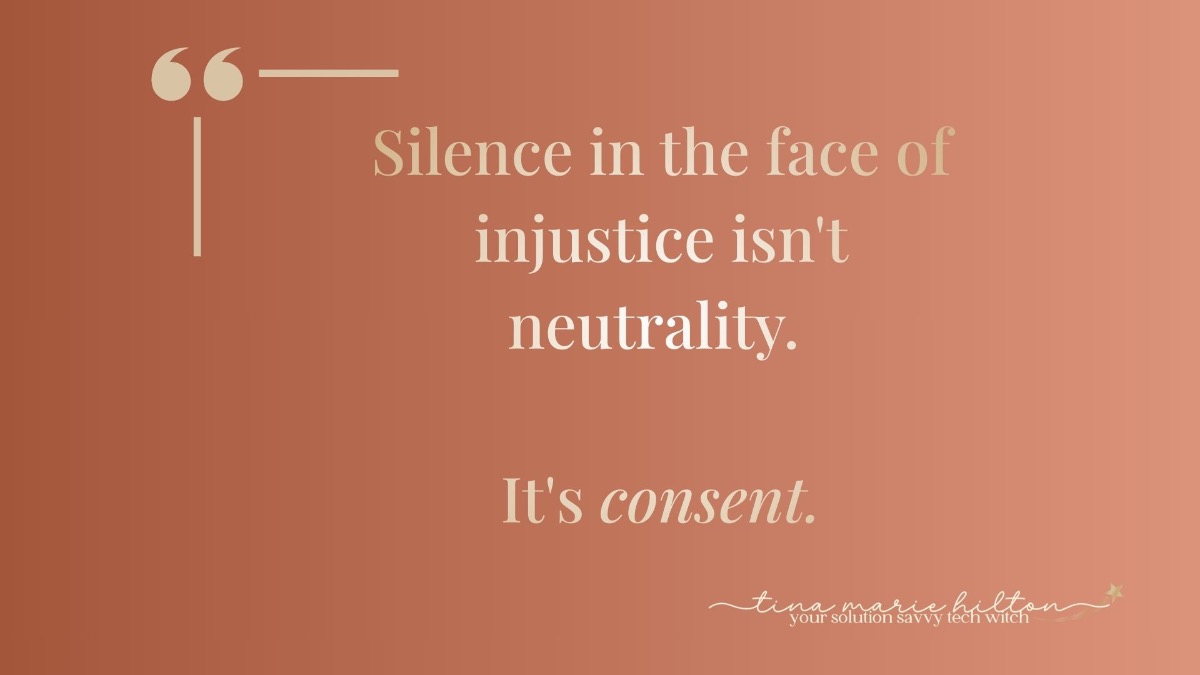
Silence isn’t neutral.
When businesses and professionals avoid naming what’s happening because it feels “too political,” they’re not staying above the mess. They’re choosing comfort. And over time, that kind of quiet compliance becomes part of the problem.
I think the belief that we need to stay palatable to everyone has done more damage than we like to admit. We should never be required to pretend we aren’t seeing what we’re seeing just to be considered professional.
Businesses don’t exist outside of society. They’re part of it. They benefit from it. And whether they acknowledge it or not, they help shape it.
At some point, silence stops being a strategy and starts being a position.
So this is the question I keep coming back to, and maybe you are too.
What am I willing to stay silent about in the name of professionalism?
And can I live with that answer?
Keep asking the important questions,

Decoding the Shift: Acknowledging Reality Without Oversharing
I want to be honest about something.
I’m a little nervous about sharing this in the newsletter this week.
Not because I don’t believe what I’m saying, but because I know how quickly “naming reality” gets labeled as “getting political.” I also know the pressure to keep things tidy and agreeable in business spaces is real. There’s always that quiet voice that says, Maybe this is too much. Maybe this isn’t the place.
That hesitation is part of the shift, too.
One of the big questions underneath all of this is where the line actually is. If I acknowledge what’s happening in the world, am I oversharing? If I take a stand as a business owner, does that automatically make it too personal?
I don’t think it does. And here’s why.
There’s a difference between disclosure and acknowledgment.
Oversharing is when you ask your clients, customers, or colleagues to hold your emotional experience. It’s when your business becomes a place where other people are expected to process your fear, grief, or overwhelm.
Acknowledgment is simpler, and harder. It says this moment isn’t neutral, and pretending it is doesn’t make us more professional. It just disconnects us from reality.
You can say, “This is affecting how we work,” without explaining every feeling behind it. You can take a stand without turning your business into a diary. You can name what you see without asking anyone else to carry it for you.
That’s the line I’m trying to walk here.
The old version of professionalism rewarded silence, endurance, and emotional distance. The shift I’m seeing, and trying to practice, is toward something more honest and more humane. Clear boundaries. Clear values. And a willingness to say, “We’re not operating in a vacuum,” even when that feels uncomfortable.
Authenticity doesn’t require exposure.
It requires alignment.
And sometimes alignment means speaking up even when you’re a little nervous about the response.

If this feels worth passing on
Some conversations don’t start easily, but they travel well once they’re started. If this mirrors something you’ve been noticing or struggling to name, feel free to share it with someone who might need it too.
A quick note about the links below: some are affiliate links, and some are my own digital resources. If you choose to use them, it helps support this newsletter and keep it free. I only share things I actually use or have created with care.

0 comments