
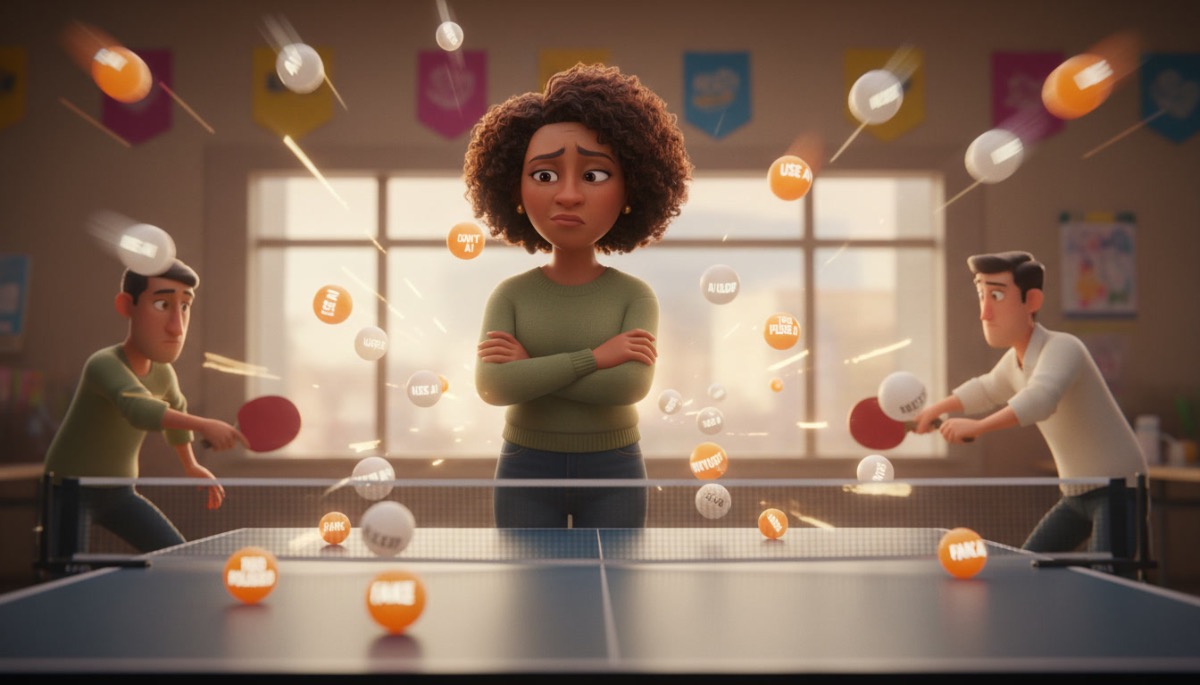
We’re living in a weird moment when it comes to AI right now. We’re caught between being told we need to learn to use AI or risk being left behind… while also being harshly judged if it even looks like we’re using it.
Good punctuation?
Good grammar?
Excellent writing skills?
People are side-eyeing all of it, often declaring it AI-generated… even when it isn’t.
It’s been going on for a while, but the recent news about the author of Shy Girl being dropped by their publisher after accusations of AI use has definitely added fuel to the fire.
I’m not weighing in on that situation specifically, but I am going to touch on some things that are incredibly frustrating… and very much connected.
First, let’s talk about what’s happening in business communities, especially on LinkedIn.
One post screams that you need to adopt AI immediately or risk becoming irrelevant.
The next insists that if you’re using AI, your work isn’t authentic.
Then someone jumps in accusing others of using it to write posts and comments and labels it “AI slop.”
You get the picture.
It’s like watching a ping pong match that never ends.
And the rest of us?
We’re standing in the middle of it with a digital case of whiplash.
Next up… AI detectors.
The so-called lie detectors of the writing world.
Except they don’t work the way people think they do.
And they’re not nearly as reliable as people assume.
These tools are wildly inconsistent. They’ve flagged classic literature, academic writing, and even sections of the U.S. Constitution as “AI-generated.”
Which is not only untrue… it’s impossible.
So why are they calling out Shakespeare, Jane Austen, and the Founding Fathers?
Because their writing is structured, formal, and predictable in ways that AI models were trained on.
And that’s the part people tend to miss.
AI learned from us.
From books, essays, articles, blog posts, and everything else humans have written over time.
So when something sounds “AI-like,” what people are often reacting to is… well-written human language.
Which is a little ironic when you think about it.
All things AI have gotten a bit messy.
Right now, we’re living in a situation where:
- If you aren’t using AI, you risk falling behind
- If you do use AI, your work could be questioned
- If you write well, people may assume you didn’t write it
- And if you don’t write well, people will tell you to use AI to improve
It’s an ugly, no-win situation. And it’s loud right now.
So what do we do with that?
First, the choice to use or not use AI is yours.
No one knows for sure that you’ll be worse off if you don’t use it. And no one can guarantee you’ll be more successful if you do.
The AI “bubble” could burst the way the dot-com bubble did.
Environmental concerns could force major changes in how AI is developed and used.
Or, as AI becomes more embedded in everyday life, people may start rejecting it in favor of human creativity and connection.
We don’t actually know how this plays out.
So what do we do in the meantime?
We hold on to our voices.
Not the perfectly polished version.
Not the overly optimized version that gets labeled as AI.
Our real voices.
Because AI can mimic patterns. It can follow structure. It can sound “right.”
But it doesn’t have lived experience.
It doesn’t have your weird little turns of phrase.
Your opinions.
Your stories.
Your contradictions.
That part still belongs entirely to you.
And honestly? That’s the part cutting through the noise right now.
I know it’s exhausting.
Good writers are being questioned.
Bad takes are being amplified.
And depending on the day, these tools are treated like either saviors or villains.
It’s tiring to feel like you have to stay hyper-aware just to avoid being accused of creating “AI slop.”
But here’s the part that matters:
Your voice is still yours.
No detector, algorithm, or LinkedIn hot take gets to decide otherwise.
Keep showing up as yourself. That’s still the one thing no tool can replicate,
If you know someone who’s been second guessing whether they are doing AI right or wrong, feel free to forward this to them.

0 comments