
Figuring out who your ideal client is requires data you don't have yet.
I've trained hundreds of agencies on finding their ideal clients and realized they didn't need to use the methodology consumer products companies use. Actually it made it worse.
Why? Not enough volume.
Old school ideal client profiles can only be defined from a lot of data points. But... The nature of expert work makes it impossible to handle lots of clients. A really large agency maxes out around 100 clients. Some of you have productized your services (smart move), which lets you move faster. You might reach 1,000 clients. But either way, it'll take you years to get enough data points.
Here's the math:
With average sales skills, you need:
- 4 qualified prospects per 1 client
- 16 qualified leads to get those 4 sales calls
- 64 interested leads to get those 16 qualified leads
- 256 cold leads to get those 64 interested leads
To land 100 clients = 25,600 cold leads.
Sounds like a lot of data, right? It's not. These weak connections won't tell you much. You'll only know they were initially interested, then dropped off somewhere in your funnel.
The good news? Most of you convert much better than this, probably one client per 100 cold leads or fewer.
The bottom line: You won't talk to enough people to know your ideal client for several years.
So What Do You Do?
You make an educated guess, then iterate. Here's your framework:
Step 1: Start with your preferences
When I started, I worked with large companies like Nike and Intel. Great money. Creative projects. But endless meetings murdered my soul. But I had friends in advertising who loved schmoozing at corporate HQs. Not me.
I discovered founder-led companies were my sweet spot. They made fast decisions and were growth-oriented (still a requirement for me today). They weren't crazy about highly creative ideas. They wanted "sure things," but I was willing to let this slide because I enjoyed working with them.
Ask yourself what you've learned so far:
- What size companies sync with your work cadence?
- What decision-making style do you prefer?
- What client mindset do you need? (Growth-oriented? Risk-averse? Data-driven?)
Step 2: Apply THE WORK filter
Three non-negotiables:
- If you don't like doing the work, it's not ideal
- If it isn't profitable, it's not ideal
- If clients don't want what you want to do, it's not ideal
Unless you're coming from a job where you already know work that's enjoyable, profitable, AND in-demand, you need to find Service-Market Fit.
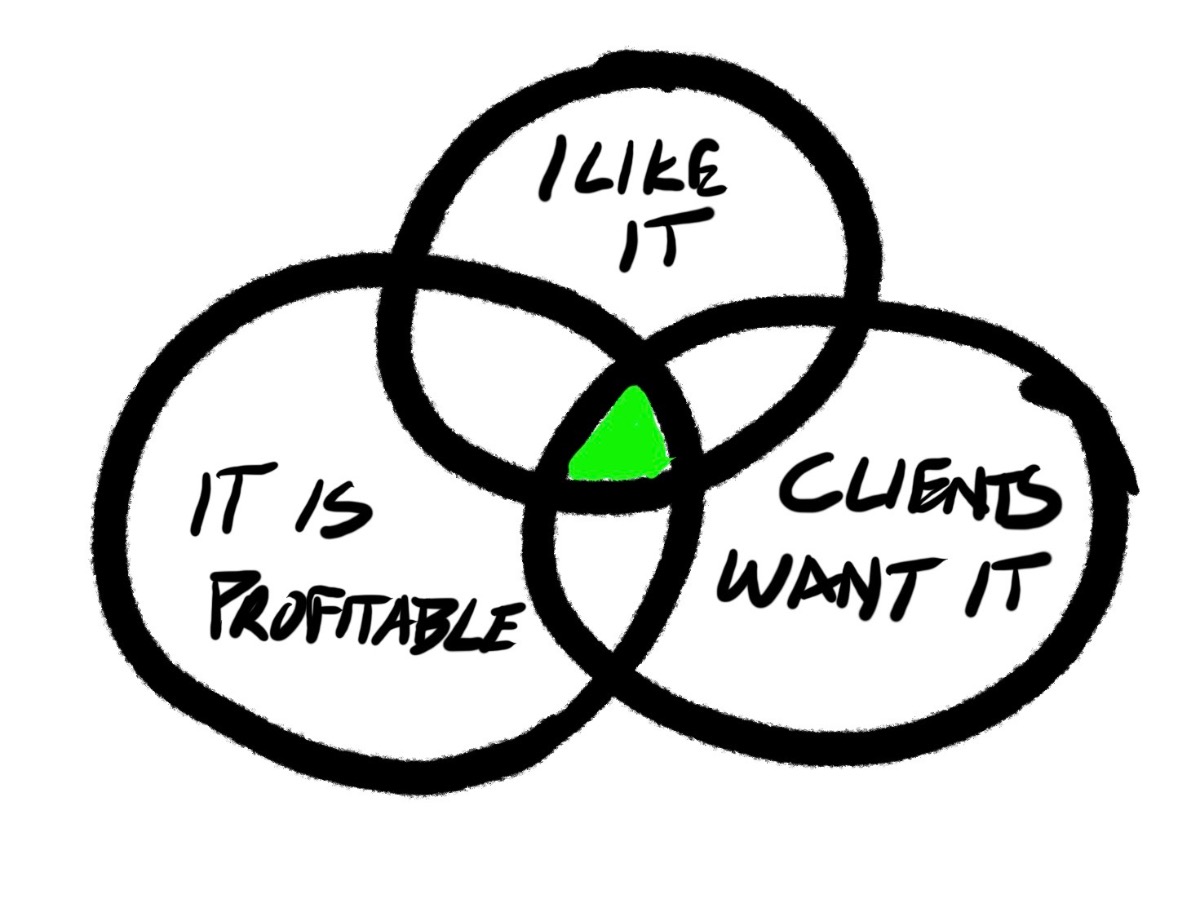
Your ideal client lives in the center of:
Circle 1: Client Demand
Which services are clients happy to pay for?
Circle 2: Profitability
Which services have the highest margins? Which clients get the best results?
Circle 3: Enjoyment
What work do you and your team actually like doing?
If you hate the work, choose lower-margin services you enjoy over high-margin work you dread. Or take the harder path and find people who love that work.
From my experience, we naturally gravitate toward high-margin clients and services. Why? Big rewards create positive reinforcement loops. The more rewards you get, the more you want to do that work.
Step 3: Emulate what's working
You're probably not inventing new services that the market has never seen. The market already shows you what it wants by what's being sold. Emulating existing successful services is the fastest path to finding your ideal client. Maybe even try to poach some of your competitors' clients.
Step 4: Dive into your existing client data
If you've worked with clients already, you most likely have ideal clients sitting in your past projects. Go back through your last 10-20 clients and score them:
Client Experience (1-10):
Who was easy to work with? Who drained you?
Project Profitability (actual numbers):
What did you charge? What were your costs? How many hours did it actually take?
Results Quality:
Which clients got the best outcomes? Who was thrilled? Who was just satisfied?
Repeat Business:
Who came back? Who referred others? Who disappeared?
Look for patterns. Maybe your best clients all came from the same industry. Or they were all at a similar revenue stage. Or they all had in-house marketing teams (or didn't).
This isn't about the Venn diagram overlap of what's theoretically ideal. This is about what actually happened when you worked with real people.
The clients who scored high across multiple categories? That's your pattern. That's who you should be targeting more of.
Step 5: Document everything (this is critical)
Don't run on vibes. Write down:
- Which clients you enjoyed working with and why
- Which projects were most profitable
- Which services clients were eager to pay for
- Which work energized your team
- Which results made clients happiest
Choose your ideal client based on these numbers, even if you only have a few data points.
Your Action Plan
- Make your best educated guess about your ideal client right now
- Document every client interaction against your hypothesis
- Review quarterly: What's working? What's not?
- Adjust your targeting based on actual results
- Repeat
Start with your educated guess today. Refine it as you go.
t
PS. New The Monetize is out. It's about how to eliminate feeling guilty charging what you're worth. WATCH or LISTEN
0 comments