Hello RAMblers!
Have you ever wondered why the numbers on your phone produce certain sounds?
The wired telephone era started off with manually operated switchboards where a caller would first talk to a human operator who then physically connected the circuit between the caller and receiver.
A large improvement on that system was the rotary dial. With this system, the phone would send a series of pulses to indicate the number of the person they were calling. Hardware at the switch would detect the pulses and make the connection.
The next major innovation came with the Touch-tone phone which made use of a technology called Dual-Tone Multi-Frequency (DTMF).
Instead of sending a series of pulses for each digit, DTMF sends a single short signal as a waveform. This waveform is composed of two waves, which is why it's called Dual-Tone. The system cleverly assigns a frequency to each column and each row on the phone's number pad. When the user presses a button for a certain number, the combination of the row frequency and the column frequency is sent. You can see the arrangement in the image below.

To decode the tones on the receiving end a set of filters can be used. First, a pair of low and high pass filters separates the frequencies corresponding to the rows and the columns. Then there are a bank of bandpass filters for the specific row and column frequencies. Alternatively, and how this is commonly done today, digital signal processing can be used to achieve the same result.
If you'd like to take a look at an implementation, MATLAB has a DTMF Generator/Decoder sample at https://www.mathworks.com/help/dsp/ug/dtmf-generator-and-receiver.html.
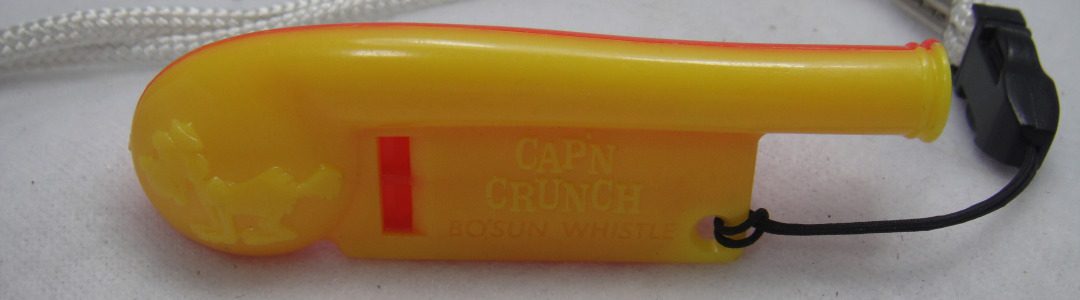
One interesting, historic note. Tones are not only used for dialing numbers in phone systems but are also used as control signals. Back in the day a specific frequency, 2600 Hz, was used to authorize long-distance calls. It just so happens that a toy whistle that was found in Cap'n Crunch cereal boxes produced this exact frequency. Telephone hackers (known as Phreaks) took advantage of this and would use the whistle to get free long-distance calling. This is where the hacker magazine, 2600, gets its name. You can read about the Cap'n Crunch whistle at https://telephone-museum.org/telephone-collections/capn-crunch-bosun-whistle/.
If you enjoyed this email, please share it! Getting more readers will make writing this newsletter worthwhile.
New subscribers can join at sendfox.com/theRAMblings.
-TRON
References:
https://en.wikipedia.org/wiki/DTMF
https://www.cryptomuseum.com/phone/dtmf/
Thomas, Roland E, and Albert J Rosa. The Analysis and Design of Linear Circuits. New York, Wiley, 2004.
0 comments