The RAMblings
, Thank you for subscribing to the RAMblings! For this very first newsletter I thought it would be fitting to tell you about the first, practical random-access storage device (i.e. RAM).
Before we begin, I'd like to ask you to share this with anyone who might find these kinds of topics interesting. Just forward them this email or send them to https://sendfox.com/theramblings. Thanks!
The First RAM
RAM, as you likely know, stands for Random-Access Memory. Random-Access refers to the ability to read and write data to any location in memory in essentially the same amount of time.
The first RAM device was created in 1946 by Freddie Williams and Tom Kilburn and is known as the Williams-Kilburn tube, or just Williams tube. It is based on another electrical engineering marvel, the cathode-ray tube (CRT).
Basic Principle
The CRT is a type of display which produces an image by firing an electron beam at a phosphor-coated screen. It turns out, that during the process of energizing the phosphor on the screen, with enough energy, electrons are also released from the phosphor. This is known as the secondary emission effect. When this happens, a small positively charged region forms around the location of the beam and lasts for a fraction of a second. The electrons that are released fall back to the phosphor screen and create a negative charge in the vicinity of the beam location before eventually returning to their original location.
Application
So how is this used for memory? Well, a useful memory needs to be able to write a '1', write a '0', and read whatever is stored.
For the Williams tube, writing a '1' occurs when the electron beam hits the screen and creates a positively charged region. To write a '0', the beam is offset slightly so that the negative region surrounding the location of the beam forms in the location of the bit.
Lastly, we need to be able to read the value back that's stored at the location. In order to read data back a thin piece of metal is placed over the screen. When the beam writes to the location, if it is a '0', electrons will be displaced and the movement of electrons will induce a voltage in the metal. If the location was storing a '1' then the region would have already been depleted of electrons and no voltage would be induced.
Closing Thoughts
As I mentioned earlier, the charged region lasts only for a fraction of a second. This means that the memory locations must continuously be read and re-written in a manner similar to modern DRAMs.
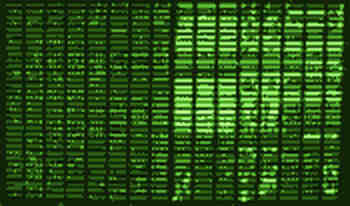
Perhaps the most interesting aspect of the Williams tube though is seeing the patterns generated on the screen. I can imagine looking at some of the mainframes and seeing something that looks like the matrix.
-James "TRON" Trimble
References:
https://www.radiomuseum.org/forum/williams_kilburn_williams_kilburn_ram.html
https://en.wikipedia.org/wiki/Williams_tube
https://www.computerhistory.org/storageengine/williams-demonstrates-crt-storage/
0 comments