

Be yourself. Love yourself. Take care of each other.
Hello, world! Shelly here! Time for another edition of Take Care, a weekly-ish bit of tips and updates to help you be yourself, love yourself, and take care of each other (and yourself!) I’m Shelly of Geek Out of Water.
You all have been sending me fantastic ideas for the Ingredient Literacy series on YouTube! Let me know what you'd like me to deep-dive into - a marketing claim that sounds suspect, and ingredient you're curious to learn more about, you name it! Reply to this email and let me know. I'm keeping a list to make future videos from! A few things currently on the list: hyaluronic acid, skin care preservatives, and ingestible collagen.
Episode 4 is up on YouTube now and it's all about PEPTIDES.
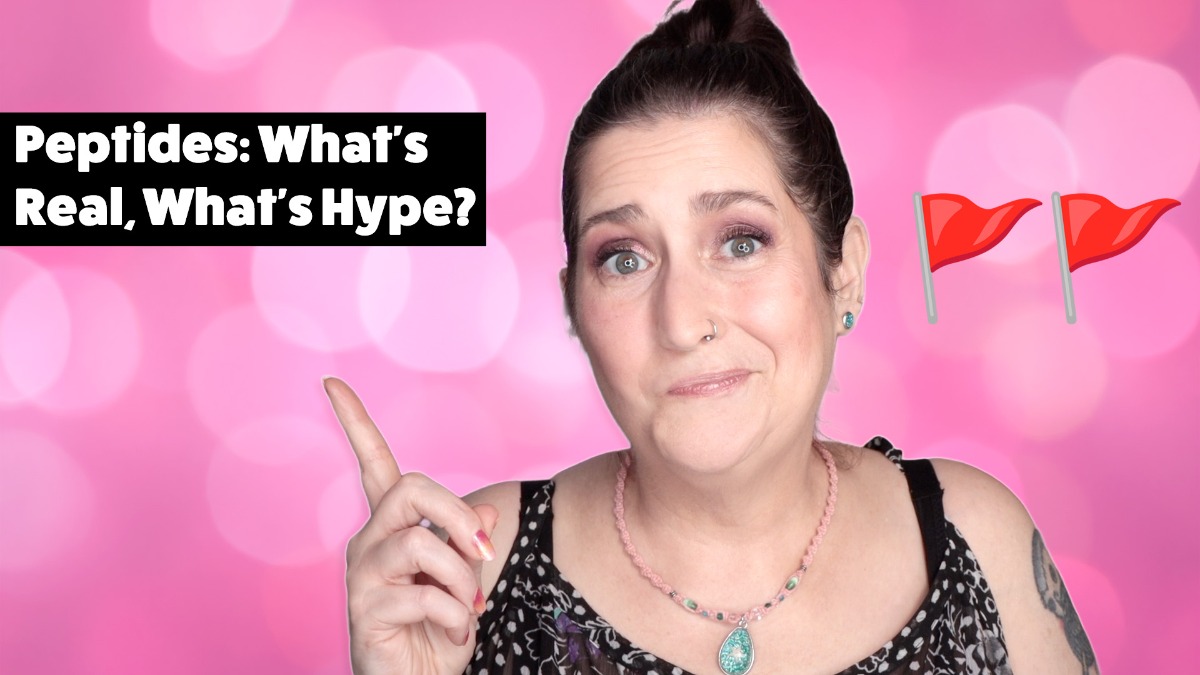
Brands have started competing on peptide counts. You'll see "8 peptide complex," "powered by 12 bioactive peptides," even a product literally named Peptide 21. And the implication is always the same: more peptides equals better results.
Here's the thing. Peptides are legitimate skincare actives - some of them genuinely excellent. But a grocery list of peptides is a marketing strategy, not a skincare strategy. There's a real difference, and once you know it, you can't unsee it.
What a Peptide Actually Is
Your skin is made of proteins. Proteins are made of amino acids. A peptide is what you get when you string a few amino acids together, anywhere from 2 to about 50. They're useful in skincare for two reasons: size (many peptides are small enough to actually penetrate your skin barrier - remember the 500 Daltons rule!) and signaling (specific peptides can tell your skin cells to ramp up collagen production, block collagen-degrading enzymes, or deliver trace minerals like copper to the tissue).
The key word there is specific. Different peptides send completely different messages. And that's where the grocery list falls apart.
The Four Peptide Families
There are four families of peptides in skincare, and they do entirely different jobs:
- Signal peptides tell your fibroblasts to produce more collagen and elastin (Matrixyl is one example)
- Carrier peptides deliver trace elements into the skin — copper peptides (GHK-Cu) are the most studied example
- Neurotransmitter-inhibiting peptides attempt to mimic Botox topically; Argireline is the most famous
- Enzyme-inhibiting peptides block the enzymes that break down your existing collagen
A signal peptide and a carrier peptide are not doing the same job. They're not automatically synergistic just because they're in the same bottle. When a brand says "our formula contains 7 peptides," what they're often describing is: several peptides from different families, rarely at a concentration that matches clinical research, bundled into a complex that shows up near the bottom of the ingredient list.
The Concentration Problem
Here's how the math works. Let's say a brand uses a "peptide complex" — a pre-blended mix from a supplier — at 0.5% in their formula. That complex might contain trace amounts of 7 peptides, so technically all 7 are present. But each individual peptide might be at 0.05% or less. Compare that to a product built around one well-studied peptide at an evidence-based concentration.
The product with one peptide is almost certainly doing more. The product with seven has a better marketing story.
To check for yourself: find the peptides on the ingredient list. Are they listed individually above or very near the preservative? Or are they bundled as a "peptide complex" after the preservative? (The preservative is your rough 1% marker — anything below it is less than 1%.) If it's a complex near the bottom, you're looking at a marketing ingredient, not a treatment ingredient.
What to Look For Instead
Green flags: individual peptide INCI names listed in the first half of the ingredient list (for example, palmitoyl pentapeptide-4 or tripeptide-29), concentration disclosure (what percentage of the formula is peptides), specific mechanism language (which family of peptide, what it does), and formulas built around one or two well-researched peptides rather than eleven.
The GOOW Copper Peptide Serum uses GHK-Cu at 1% — a single well-studied carrier peptide, in the middle of the evidence-based range, with a mechanism I can explain: copper supports the enzymes that crosslink collagen and elastin, and GHK-Cu itself has research supporting wound healing and collagen stimulation.
One peptide. Clear mechanism. Known concentration. That's the formula.
Watch the full breakdown in Episode 4 of the Ingredient Literacy series on the GOOW YouTube channel.
Ready to try a peptide product built for transparency? GOOW Copper Peptide Serum
Level up! +1 to Ingredient Literacy!
Thanks and remember: be yourself. Love yourself. Take care of each other,
💜 Shelly
0 comments