

Friends,
I spoke last week on how to focus on the Dhamma during a cataclysmic political season, highlighting the doubt I hear from so many practitioners around how healthy it is to obsessively track the news. And like many of you I felt myself move through so many feelings and states in myself as I tracked the news this week. The crisis du jour (although as I proof this note only 4 days after I wrote it, there are already new crises)—war plans leaked on an insecure messaging platform—reveals fractals of awfulness, with officials demonstrating incompetence and malice in equal measure. Facepalm.
So then this week I explored one solution for the doubt that can arise around engagement with the political situation, starting with reminding us of the fundamental difference between the monastic vocation and lay life, and drawing from that distinction some of the natural responsibilities of lay life, namely to stay engaged.
Often when we read the early Buddhist texts we elide the difference between monastics and laypeople, as the Buddha himself sometimes did—though not hardly as often as we do. Because it is clear that both monastics and laypeople can meditate and experience the fruits of meditation, we tend to assume that laypeople can practice virtually all of the disciplines that monastics can, only less intensively. But there are problems with this elision.
The core monastic discipline is a systematic renunciation of direct engagement with economic and social/sexual/familial culture. Monks and nuns replace working for, and spending, income with a system of organized begging: relying fully on gifts for food, shelter, clothing, and medicine—the four material requisites. And they replace dating, marriage, sexual partnership, and child-raising with the communal life of the Saṅgha, bounded by celibacy and substantial constraints on social activity with the laity.
These renunciate practices are far more central to the development of tranquility and insight than we commonly reflect on as laypeople, so although we can practice many kinds of letting go, wise livelihood, and living simply, none of these lowercase "r" renunciations really operate like the capital "R" Renunciations of commerce and sexuality/family. They don't categorically change our lifestyle to something "against the stream" as monastic life does.
I haven't heard this discussed much by Buddhists supporting social engagement, partly because Engaged Buddhism is primarily a Mahāyāna style, and the doubt I'm exploring here comes up more in Theravāda settings where renunciation is more starkly emphasized. But if we understand social engagement and political action as being intrinsically part of economic and social life, we can understand them not just as appropriate but even necessary parts of skillful lay practice. Maybe the the lay-monastic dialectic isn't the heart of your process in figuring out how to engage with the current chaos, but in case your process, like mine, grapples with your place in the world and how we structure the lives we lead, here's some reflections in support of a vigorous social engagement on the part of dedicated Buddhist laypeople.
Stay safe & sane. Blessings always.
With mettā,
Sean
In other news, I'm teaching a 4-night retreat again this year for the SF Gay Buddhist Fellowship, April 23-27 at Vajrapani Institute in the Santa Cruz redwoods. If you're male-identified and queer, come join us. It's a lovely retreat—this year with more silence! ;) Details below.
From Satsang, Tue 3.18.25
Democracy and Doubt:
(How) Should We Practice Amid the Chaos?
It's been a delight to be talking through Yoga history and the postmodern chaos of contemporary spirituality at Satsang, and about attention training in the NY Insight class. Then I come over to FB—my feed is almost entirely alarmed commentary on the US coup—or read the news and have another wave of doubt. This thing I've been doing of trying to balance obsessing about the global disaster that is this political moment and continuing with our Dhamma investigation and inner practice: is it skillful? Should I drop the themes I've been teaching on for the moment and encourage focusing all our collective energy on the crisis? I basically flip-flop on this weekly.
This doubt is everywhere in my communities at the moment, and absolutely natural, I think. I hear it in your questions and our discussions of practice all the time. What is the right balance of inner and outer attention for each of us, in this disorienting moment, and in the next, and the next?
We know that political, military, and economic crisis is an ongoing part of our world, so there is strong contemplative justification for mostly letting it sort itself out and staying close to the task of inner cultivation. We know the resilience and wisdom our practice grows is absolutely necessary for our own well-being in the long run and our ability to help others around us. But there are at least two other strong justifications pulling on our psyches.
When danger becomes local, there is a natural urge to help those around us stay safe. This is the active compassion that brings us to engaging in our immediate communities—joining with those who are tracking ICE raids or showing up at city council meetings to hold off what we can of the many-tentacled monster and not lose the culture war by giving up. This is an activism that stays close to the nervous system—to our instinctual need to protect those we care about in the immediate ecosystem.
The other force that pulls on us, though, is more distant, and is based on the profound but complex abstraction called "democracy." Whether or not you live in a healthy or unhealthy democracy, the idea has been planted deep in our collective imagination that we have the power, collectively, to change the political situation we live under. In so many ways that weren't possible in the ancient world, we do—this is what we mean by democracy. I think it is partly because of this that we have this doubt about social engagement as the opposite of contemplative spirituality. If we have the power to change an unjust situation, after all, shouldn't doing so be our primary concern?
The Buddha didn't try to overthrow the local murderous, imperial king Ajātasattu partly because his spiritual wisdom had other methods (he tried, with imperfect success, to convert him to the Dhamma), but also because people didn't overthrow kings in those days. It wasn't part of the collective consciousness that you could do that. But now that we have a great set of idealistic revolutions, but also just positive democratic processes, in our rearview mirror, we've been trained to feel the naturalness and rightness of the democratic process. We feel like we can have a voice in the affairs of the state, and that becomes the idea that we should exercise that voice, which can lead to the conclusion that doing so—because it seems to address most directly the suffering of the world—is the best use of our time and energy. Basically, the sense of empowerment that democracy gives us also leads to the doubt about whether it's ethical to focus on anything other than politics, since politics is where the biggest harms and potentials for good both reside.
Meditation: Gravity, Central Column, Manipura Breathing
Talk: Democracy and Doubt: (How) Should We Practice Amid the Chaos?
From Satsang, Tue 3.25.25
Meditation: Setting Down Our Social Roles
Talk: Engagement is Appropriate Response
April Retreat for Queer Men
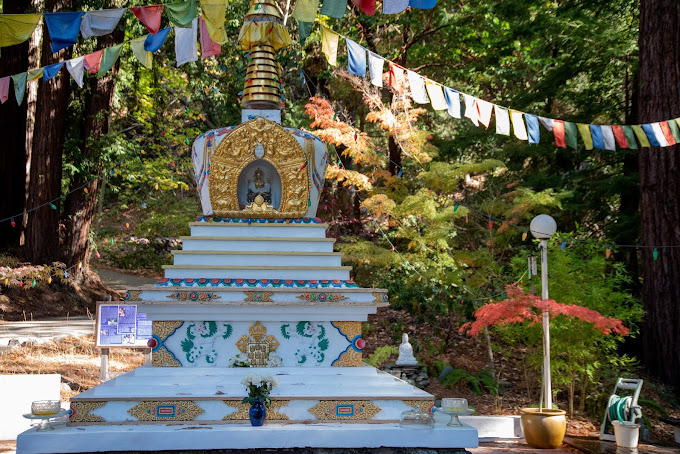
Deepening Practice: Quieting Our Minds and Opening our Hearts in Community
Gay Buddhist Fellowship Spring Retreat for queer male-identified practitioners
Apr 23-27, 2025 | Vajrapani Institute
Dāna
Our ability to offer as much as we can in this beautiful tradition of gift economy depends on your support. Your gifts make scholarships possible for those with less resources to attend retreat, support our preservation of the teaching archive, and make it possible for us to offer everything we do as accessibly as possible. Thank you.
Ongoing Saṅgha Spaces
Tuesdays 7:30-9pm (Pacific), weekly
Meditation, talk, discussion
Book Club: Read the Dīgha Nikāya, the Long Discourses of the Buddha
Fridays 8:30-10am (Pacific), monthly
Talk, inquiry, discussion
Next session: Fri Apr 18
Saṅgha Facebook group
Recordings, discussion, Q & A
All are welcome
May our practice be of benefit to all.
0 comments