
Greetings, !
It’s summertime! Time for warm weather, splashing in a pool, sitting around a campfire, and enjoying your favorite summer foods – hot dogs, ice cream, peanut butter, and fairy floss.
Fairy floss? Wait a minute, what is that? It’s a popular food and you’ve almost certainly eaten it at a fair or circus. Oh, wait, maybe you know it by a more modern name – cotton candy!
It might be hard to imagine but all these fun foods (and more) were “invented” or became accepted in 1904 at the St. Louis World’s Fair in St. Louis, Missouri.
The 1904 Louisiana Purchase Exposition is credited with introducing several foods that we eat today. It also reinvented a few foods we already ate but gave us new ways to eat them. The 1904 fair welcomed over 20 million visitors and offered over 125 places to eat, with a global menu.
Foods the 1904 Word's Fair Made Famous
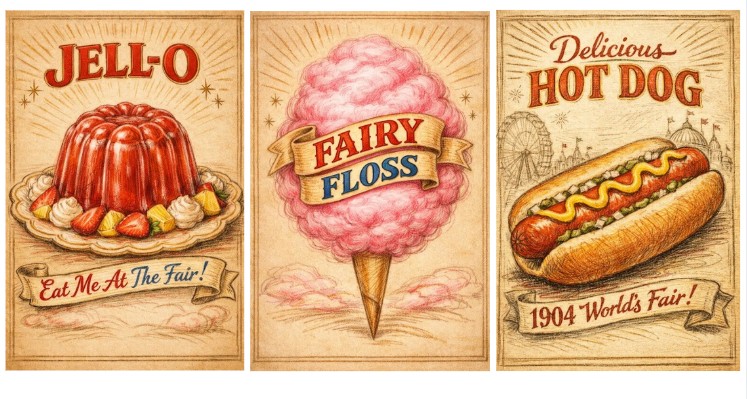
Jello-O was first introduced at the fair and the gelatin dessert became a household name.
Cotton candy or fairy floss (and isn’t that a cool name?) was invented by a dentist believe it or not. Dr. William J. Morrison and a confectioner, John C. Wharton of the Electric Candy Machine Company spun sugar into fluffy strands and sold them in boxes. Between 65,000 and 70,000 boxes were sold and cotton candy became a fairground must eat!
Hot dogs in buns – yum. Sausages existed before the fair, but using a soft bun to hold them made it easier to eat while walking around the exhibits. They were especially appealing to St. Louis’s German-American population.
Hamburgers Tales are also told of the hamburger being “invented” as a hand held food. An often repeated tale is that a man named Fletcher Davis or “Old Dave” from Athens, Texas decided to open a lunch counter at the fair. He introduced a sandwich of a ground beef patty between two slices of bread.
German—born residents of St. Louis called it the “hamburger” knowing that the citizens of Hamburg, Germany enjoyed ground meat. True or false, the debate still goes on about this one.
At the same time, a man named George French had fairgoers experience his new mustard – French’s. It paired very well with the hamburgers and hot dogs.
Ice cream cones – ice cream had been around for a while, but most people ate it out of dishes. When Syrian concessionaire Ernest Hamwi ran out of clean dishes, he rolled his waffle pastries into cones to hold ice cream scoops. A tasty idea!
Peanut butter had originally been developed by Dr. John Harvey Kellogg (yes, the cereal king) as a soft food protein for patients at his hospital. In 1904, C. H. Summer popularized the spreadable favorite in a sandwich and introduced it to fair goers.
And let’s not forget iced tea. Most people at the time drank tea – hot tea. With St. Louis’ temperatures rising the story goes that Richard Blechynden, the Tea Commissioner in the India Pavillion, could not sell his hot tea. In desperation, he poured his tea over ice and… iced tea was born.
Dr. Pepper was invented in the 1880’s by a pharmacist named Charles Alderton. While people had access to it in limited quantities, the public first came across the popular drink at the 1904 World’s Fair. It wasn’t a cola or a root beer, but a unique blend of flavors. The fair’s massive, thirsty audience helped it gain national attention.
Fairgoers also tasted orangeade, grape juice, apple cider, lemonade and Hires Root Beer, some guests for the first time.
It was a fair to remember and important to our culture today. For the first time, vendors sold hand-held, portable foods that were easy to eat while enjoying all the exhibits at the fair. It changed our culture in the move toward the fast food, drive thru world we live in today. So this summer as you nibble or sip your favorite treats, think about the 1904 World’s Fair, or even read more about it! You might find other interesting facts to learn.

. . . wanted to be a cowgirl when she was growing up. That never happened, but she found the next best thing was writing about characters who lived in the Old West and got to experience all the fun adventures she never had. Her New Classics novel, Jenny Cameron's Cattle Rustling Catastrophe, is one such book. It comes with a free study guide to download for your homeschool.
---------------------

--------------------
You received this email because you signed up for our newsletter, entered a giveaway, or downloaded a freebie. Unsubscribe at any time.
0 comments