Why your design ideas keep getting rejected
Jan 07, 2026 5:41 am
I've seen this happen dozens of times:
A designer does great work. Clean interface. Good UX thinking. Strong rationale.
Then they present to stakeholders.
And... nothing. Rejected. Or worse—ignored.
Not because the design was bad. Because they couldn't explain why it mattered to the business.
Here's what I've noticed from hiring and coaching:
Most designers can defend their work to other designers.
But when it's time to present to product managers, executives, or cross-functional teams?
They default to design language: "Better hierarchy," "Clearer information architecture," "Improved user flow."
The stakeholder hears: "This designer is focused on making things pretty."
And the project gets deprioritized.
The designers who get promoted? They apply empathy to their stakeholders.
The best design skill is empathy. But most designers only apply it to users.
The ones who advance? They also empathize with their cross-functional teams—product managers, executives, engineers.
They learn to speak the language of business.
When I worked at DBS Bank, I was on the transformation team looking at employee experience. Specifically: meeting productivity.
I didn't come in with redesign ideas. I came in with experiments.
11 experiments across different teams, markets, and countries. Multiple weeks-long A/B/C tests. Before-and-after productivity checks.
We tested what worked. Scaled what converted. Killed what didn't.
Result: Meeting Mojo program. $27M in annual productivity savings.
Here's what I learned from my Chief Digital and Transformation Officer:
You have to articulate the intangible into tangible metrics.
Not "better meeting experience." But "540,000 employee hours saved annually."
Not "improved productivity." But "$27M in measurable savings."
That's the language executives understand. That's how you get adoption.
That's how you actually implement change—not just present "ideas that sound good."
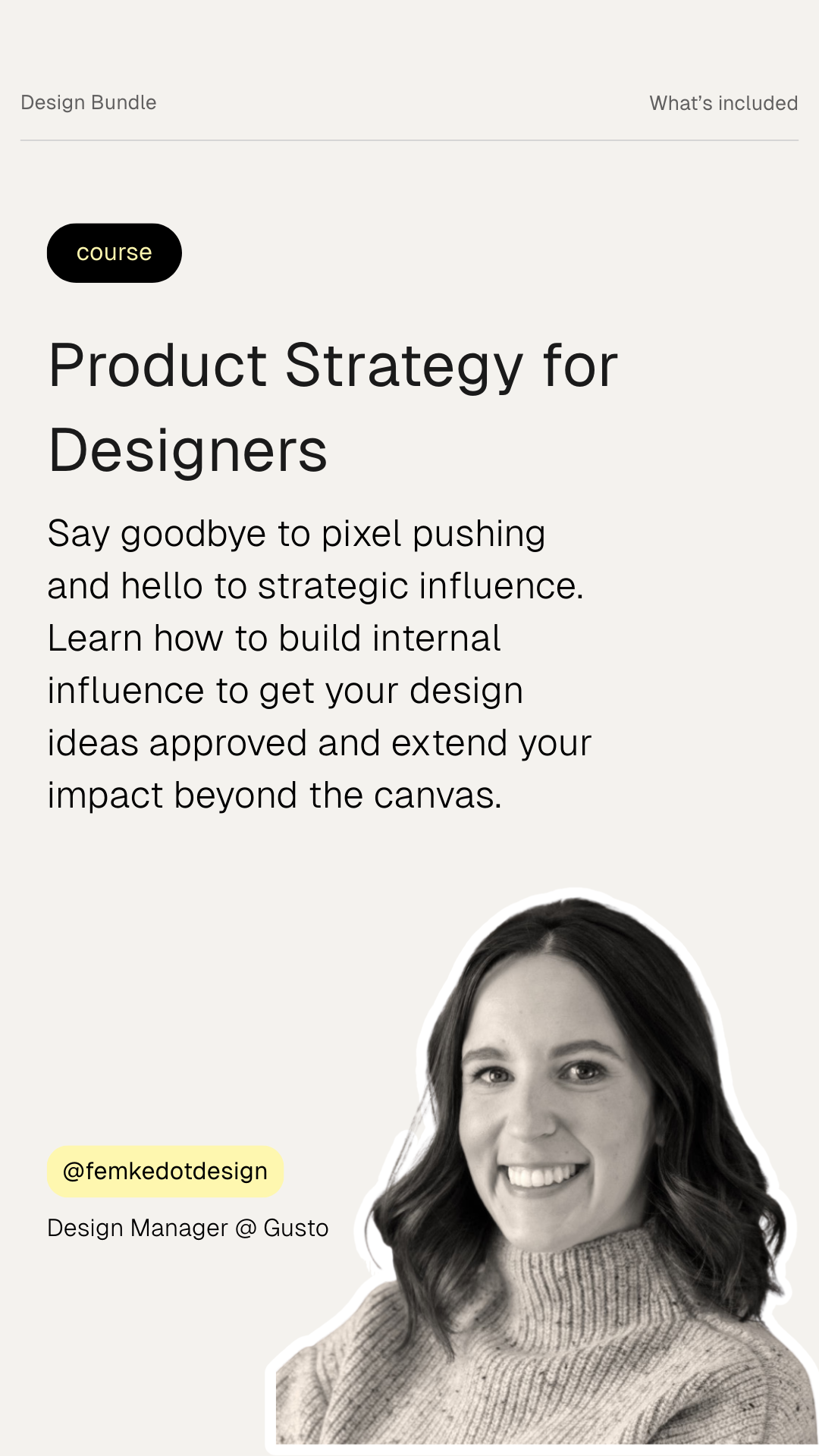
This is why Femke Van Schoonhoven is in the bundle.
Femke is a Design Manager at Gusto. Before that, she worked at companies like Booking.com, where strategic influence is everything.
Her course: Product Strategy for Designers.
It's not about making better pixels. It's about getting your design ideas approved in the first place.
What you get:
- 28 video lessons on building strategic influence
- 21 guest speakers from Stripe, Shopify, Google, Discord, IKEA (real design and product leaders)
- 12 hands-on exercises (not theory—actual practice)
- 6 Notion templates for planning vision, strategy, and stakeholder communication
- 100+ reading resources
Standalone price: $498.
In the bundle: Part of the $299 package.
Who this is for:
Designers who are tired of being handed solutions. Who want to shape the roadmap, not just execute it.
Designers on the cusp of Senior who need to close the gap between "good executor" and "strategic partner."
Designers who have the craft skills but can't get stakeholder buy-in.
Why this matters for landing roles:
When you interview for $150K-$300K positions, they're not just evaluating your design skills.
They're evaluating: Can this person influence product direction?
If you can't speak the language of product strategy, you won't get the offer.
Even if your portfolio is perfect.
Femke's course teaches you that language.
The bundle includes this + 5 other resources.
- Femke: Product strategy and stakeholder influence
- Tommy: Making UX decisions with confidence
- Anfisa: UX research and business foundations
- Elizabeth: Notion workspace (20+ templates)
- Samaneh: Portfolio positioning
- Me: Job search system (land interviews without applying online)
$299 total. Jan 5-16 only.
Link: https://bundle.femke.design/?utm_source=joseph
Joseph
P.S. 500+ designers have taken Femke's course. The common thread in reviews? "This changed how I show up in meetings." That's the unlock.