139 UXers just told me this…
Sep 09, 2025 1:11 pm
Yesterday I asked a simple question on LinkedIn:
👉 Which job search asset matters most for landing interviews & offers?
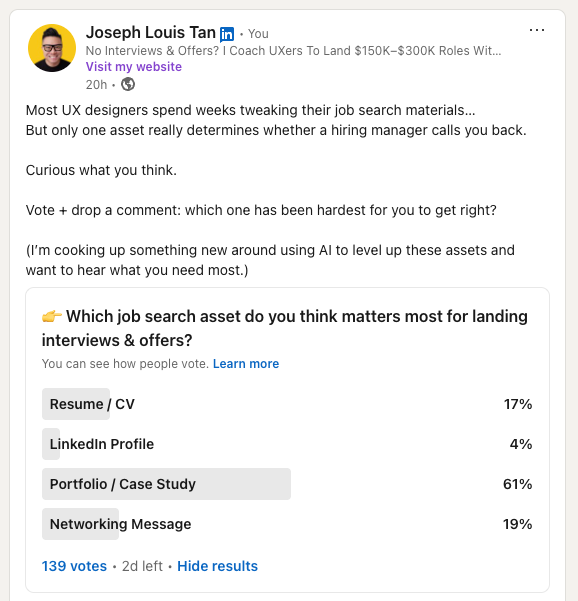
After 139 votes, here’s where we’re at so far (screenshot above):
- Portfolio / Case Studies — 61% (85 votes)
- Networking message — 19% (26 votes)
- Resume / CV — 17% (23 votes)
- LinkedIn profile — 4% (5 votes)
No surprise that portfolios came out on top.
Even my most viral LinkedIn posts have been about portfolios and case studies — it’s clearly the thing most designers worry about.
But here’s what struck me.
Networking messages beat resumes.
That tells me more designers are realizing something important: your portfolio doesn’t matter if no one actually sees it.
I’ve seen this play out in real hiring rooms.
At my previous company, I often helped my recruiter / HR partner review design candidates. She admitted — like most recruiters — she couldn’t really judge design work. She was hiring for multiple roles at once and didn’t have the training to evaluate UX portfolios.
So here’s what usually happens:
- Recruiters skim your resume or LinkedIn in a few seconds.
- If they don’t see the basics they’re looking for, your portfolio doesn’t even get opened.
- If a hiring manager does click, they spend maybe 10–20 seconds scanning to decide if you’re worth more time.
That’s it. That’s the window you’re working with.
The mistake most designers make?
They think a case study is supposed to be a long essay that explains every step of their process.
But real projects don’t look like the “ideal” design process you see in bootcamps. They’re messy.
You make trade-offs.
You work around stakeholders.
You fight for decisions.
That’s the story hiring managers actually want to see.
And yet, most portfolios bury the gold under 20 slides of wireframes and personas.
Here’s the hard truth: If I can’t tell within 20 seconds what problem you solved, what decision you made, and what impact it had, I move on.
That’s why so many talented designers feel stuck — they’re great at the work, but their case study doesn’t communicate it fast enough.
The good news is, AI changes the game here.
With the right frameworks, GPT-5 can help you:
- Distill a messy project into a 5-part executive summary that hooks in seconds.
- Expand it into a narrative that shows decisions, trade-offs, and impact.
- Even spin it into a 90-second video script or a 15-minute interview deck.
That’s the kind of clarity that gets you noticed.
👉 Next week, I’ll be running a live workshop to go deeper into this.
More details coming soon.
Talk soon,
Joseph
P.S. The poll is still live for 2 more days if you haven’t voted yet. You can add your voice here → Poll Link