I've been on both sides of the desk
Jan 12, 2026 12:51 pm
Every job I've gotten in my 15+ year career came through my network.
Not job boards. Not recruiters. My network.
Let me show you the pattern:
First design job: Met a recruiter at a networking event. She introduced me to a hiring manager. We talked at a bar. Got the job.
DBS Bank (transformation team): Someone I'd worked with before reached out. "We're building something. You'd be great for this."
NTUC Income (experience design manager): Through my network from previous roles.
Teaching at polytechnics and universities: Someone who knew my work invited me to lecture.
ContactOut (Head of Product Design): Hiring manager found me through LinkedIn. We'd crossed paths before.
Notice the pattern?
None of these came from applications. All came from people who already knew me, knew my work, or were introduced by someone who did.
Then I became a hiring manager.
Reviewed 500+ portfolios at ContactOut. Hired 40+ designers.
Here's what I noticed:
90% of the people I hired? Same pattern.
- Internal candidates (already worked or mentored before)
- Internal referrals (someone on the team vouched for them)
- External referrals (someone I trusted introduced them)
Only 10% came from job boards or recruiters.
Not because those candidates were worse. Because by the time I saw their application, I'd already found someone through my network.
This is what I call the Hire and Seek Pyramid.
Hiring managers we look at risk and cost.
We start at the top (lowest risk, lowest cost) and work our way down:
Level 1: Internal candidates Already here. Already know the culture. Lowest risk.
Level 2: Internal referrals Vouched for by someone on the team. High trust.
Level 3: External referrals Introduced by someone I trust outside the company.
Level 4: Recruiters and agencies They've done some vetting. Better than cold applications.
Level 5: Job boards Highest risk. Most competition. Lowest success rate.
Level 6: Campus recruitment Fresh grads, high training cost.
Most job seekers start at Level 5.
Job boards. Cold applications. 1-2% success rate.
They're competing with 200+ other applicants. Half those jobs are fake, already filled, or just regulatory postings.
Designers who land $150K-$300K roles? They start at Level 1-3.
They get introduced. They build relationships. They show up before the job is posted.
But here's the key:
It's not just "knowing people."
When hiring managers reached out to me, when I got those roles—it wasn't just because they knew my name.
It's because I showed them exactly how I could add value.
Not with my portfolio. Not with my resume. Not with awards or credentials.
With a strategic, targeted pitch.
For each role, I showed:
- Why I was interested (genuine intent, not just "need a job")
- What specific problems I could solve for them
- How I could add value immediately (not "hire me and see")
That's what sealed the deal. Not my portfolio. My pitch.
This took years of building:
- Personal brand (LinkedIn, content, visibility)
- Network (staying in touch with people across companies)
- Reputation (delivering results, being known for specific skills)
But once you have that foundation, jobs come to you.
This is what's inside my contribution to the bundle:
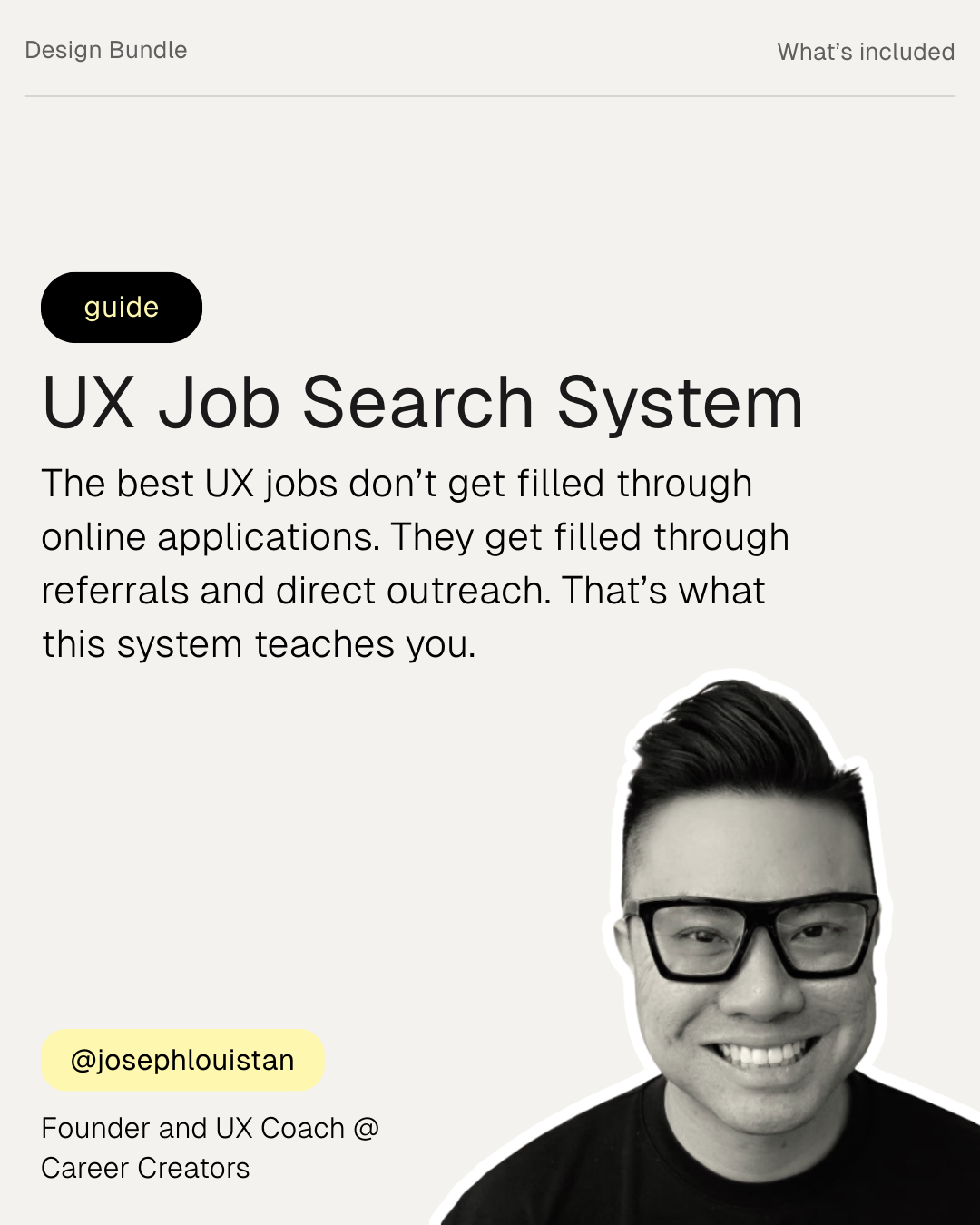
The 3-Hour UX Job Search System.
The exact process I use—and teach my clients—to tap into the hidden job market.
3 training workshops:
Workshop 1: Dream Network
- How to identify your top 10 dream companies
- Who to connect with inside those companies (hint: not recruiters)
- How to activate your existing network (people from past jobs, schools, projects)
Workshop 2: Strategic Outreach
- How to reach out without being awkward or salesy
- The messages that get responses (templates + real examples)
- How to turn conversations into introductions and referrals
Workshop 3: Minimum Viable Pitch
- How to create a targeted pitch that shows immediate value
- Not "here's my portfolio" but "here's the specific problem I can solve for you"
- How to position yourself so hiring managers want to create roles for you
Plus:
- Custom GPTs (I developed) to execute faster
- Real examples (my own + client stories)
- Scripts and templates
This is the system. The one that got me every job I've had.
Why this works:
Job boards = visible market. High competition. Low success rate.
The hidden market = where 90% of hires happen. Through referrals, introductions, relationships.
My system teaches you how to access that hidden market.
Even if you don't have a "big network" yet. Even if you're switching careers. Even if you hate networking.
The full bundle:
- Femke: Product strategy (influence stakeholders)
- Tommy: Making decisions (defend your choices)
- Anfisa: UX research foundations (what schools skip)
- Elizabeth: Notion workspace (organize everything)
- Samaneh: Portfolio positioning (stand out, don't blend)
- Me: Job search system (access the hidden market)
$299 total. Jan 5-16 only.
5 days left.
Joseph
P.S. The both-sides perspective changed everything. When you understand the hiring pyramid, you stop wasting time at the bottom. You go straight to the top.