Your design process is a mess (and it's costing you)
Jan 10, 2026 12:21 pm
Hey,
One of my clients came to me frustrated last month.
She'd been at her company for 3 years. Did great work. Multiple successful projects. Ready to update her portfolio and look for her next role.
Then she sat down to write her case studies.
And realized: She couldn't remember half the details.
"What was the actual user feedback that led to this decision?"
"What were the before/after metrics?"
"Where did I save those competitive analysis notes?"
"What quotes did users say in those interviews?"
She'd been so focused on shipping that she never documented properly.
Now her notes were scattered:
- Interview insights buried in Slack threads
- Screenshots with no context in random folders
- Competitive analysis in a Google Doc titled "competitors_final_FINAL_v3.doc"
- Design rationale... somewhere? Maybe in that Figma file?
She spent 2 weeks trying to piece together case studies from memory and scraps of old notes.
The final result? Weak. Generic. "Improved user experience by redesigning the flow."
Not because the original work was bad. Because she couldn't remember—or prove—the impact.
Here's what I see constantly:
Designers ship great work. Then 6 months later when it's time to update the portfolio, they can't recreate the story.
They don't remember:
- The specific user pain points that drove the project
- The business metrics that justified the work
- The design decisions and why they made them
- The before/after results
So their case studies end up vague:
- "Redesigned the checkout experience" (okay, but why?)
- "Improved usability" (how do you know?)
- "Collaborated with stakeholders" (what did you actually do?)
Hiring managers read this and think: "This person can execute. But can they think strategically?"
I learned this the hard way.
Early in my career, I worked on a project at DBS Bank that saved millions in productivity.
But when I went to document it for my portfolio 8 months later? I couldn't find:
- The exact experiment results
- The user feedback quotes
- The before/after productivity metrics
- The stakeholder presentations
I had to recreate everything from memory. The case study was okay. But it could have been 10x stronger if I'd documented as I went.
Now? I organize as I work. Not just for current stakeholders. For future me who needs to build case studies.
This is why Elizabeth Alli is in the bundle.
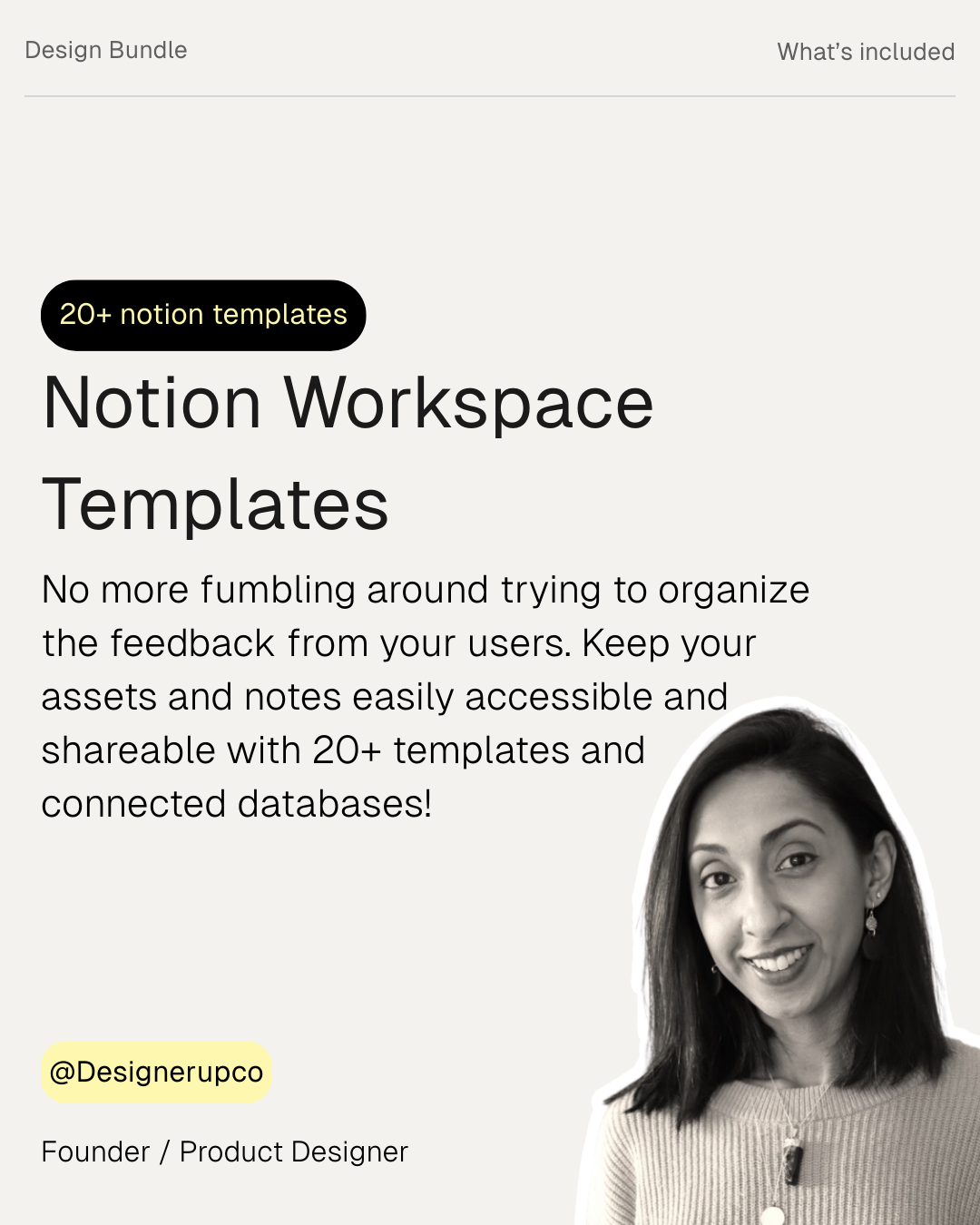
Elizabeth is a Product Designer and founder of DesignerUp. She's taught thousands of designers through her courses and YouTube channel.
Her contribution: Notion Workspace for Product Designers.
21+ templates you copy to your Notion with one click. Not generic templates. Actual systems for organizing:
UX Research & Design:
- User interview templates (so you capture insights, not just notes)
- Survey management (track responses in one place)
- Persona builders (update as you learn more)
- Empathy maps (document user pain points properly)
Information Architecture:
- Site inventory
- Sitemaps
- User flows
Visual & UI Design:
- Color palette storage (with hex codes, usage notes)
- Typography library
- Design asset organization
- Prototype links (find them when you need them)
Business & Strategy:
- Competitive analysis (document once, reference forever)
- Business case templates
- Project roadmaps
1,000+ downloads. Fully customizable.
Standalone price: $40.
In the bundle: Part of the $299 package.
Who this is for:
Designers who ship great work but struggle to build strong case studies 6 months later.
Designers with research scattered across Google Docs, Slack, screenshots, and memory.
Designers who want to document as they work—not scramble later.
Why this matters for landing $150K-$300K roles:
Your case studies are how you prove your thinking.
If you can't show:
- The specific user feedback that drove decisions
- The business metrics that justified the work
- The before/after results
- The design rationale
You look like a pixel pusher. Not a strategic designer.
Elizabeth's workspace helps you capture this as you work. So when it's portfolio time, you're not scrambling. You're copy-pasting from organized notes.
Real feedback from designers:
"Thank you for organizing my endless streams of printouts and notebooks."
"Love Notion now! Bye millions of different Google Docs."
"These templates solve our problem in such an elegant way. Gathering and organizing data can be messy—this framework helps."
The bundle includes this + 5 other resources.
- Femke: Product strategy and stakeholder influence
- Tommy: Making UX decisions with confidence
- Anfisa: UX research and business foundations
- Elizabeth: Notion workspace (21+ templates for organizing your work)
- Samaneh: Portfolio positioning
- Me: Job search system (land interviews without applying online)
$299 total. Jan 5-16 only.
Joseph
P.S. The best time to organize was when you started the project. The second best time is now—before you work on your next case study and realize you can't remember anything.