What design schools don't teach (but should)
Jan 09, 2026 3:36 pm
Hey,
I was reviewing a client's portfolio last month. They were applying for senior-level roles. $180K range.
The work looked solid. Clean UI. Good case studies.
But when we did mock interview prep and I asked: "How did you validate this solution?"
The answer: "We did some user interviews and... people seemed to like it."
No methodology. No sample size. No usability testing framework. Just "people seemed to like it."
I told them: "You won't get the offer with that answer."
Not because they couldn't design. Because they couldn't defend their decisions with research.
Here's the pattern I see constantly:
Most designers skip the foundation.
They learn tools (Figma, Sketch). They study UI patterns. They build portfolios.
But they don't learn:
- How to actually run user research (not just "talk to some users")
- Why users behave the way they do (psychology foundations)
- How business metrics work (so they can speak the language of stakeholders)
- How to measure design impact (not just ship and hope)
This is the stuff schools skip. Bootcamps gloss over. YouTube tutorials ignore.
And it's the difference between designers who get stuck at mid-level and designers who advance to senior+ roles.
When I worked across different organizations—agencies, banks, startups, teaching at universities—here's what I learned:
The designers who got promoted? They could answer these questions:
- "How do you know this solution will work?" (Research methodology)
- "Why do users behave this way?" (Psychology of behavior)
- "What's the business impact?" (Metrics and business vocabulary)
- "How will you validate this?" (Usability testing framework)
The designers who stayed stuck? Usually they had beautiful portfolios but couldn't answer any of these.
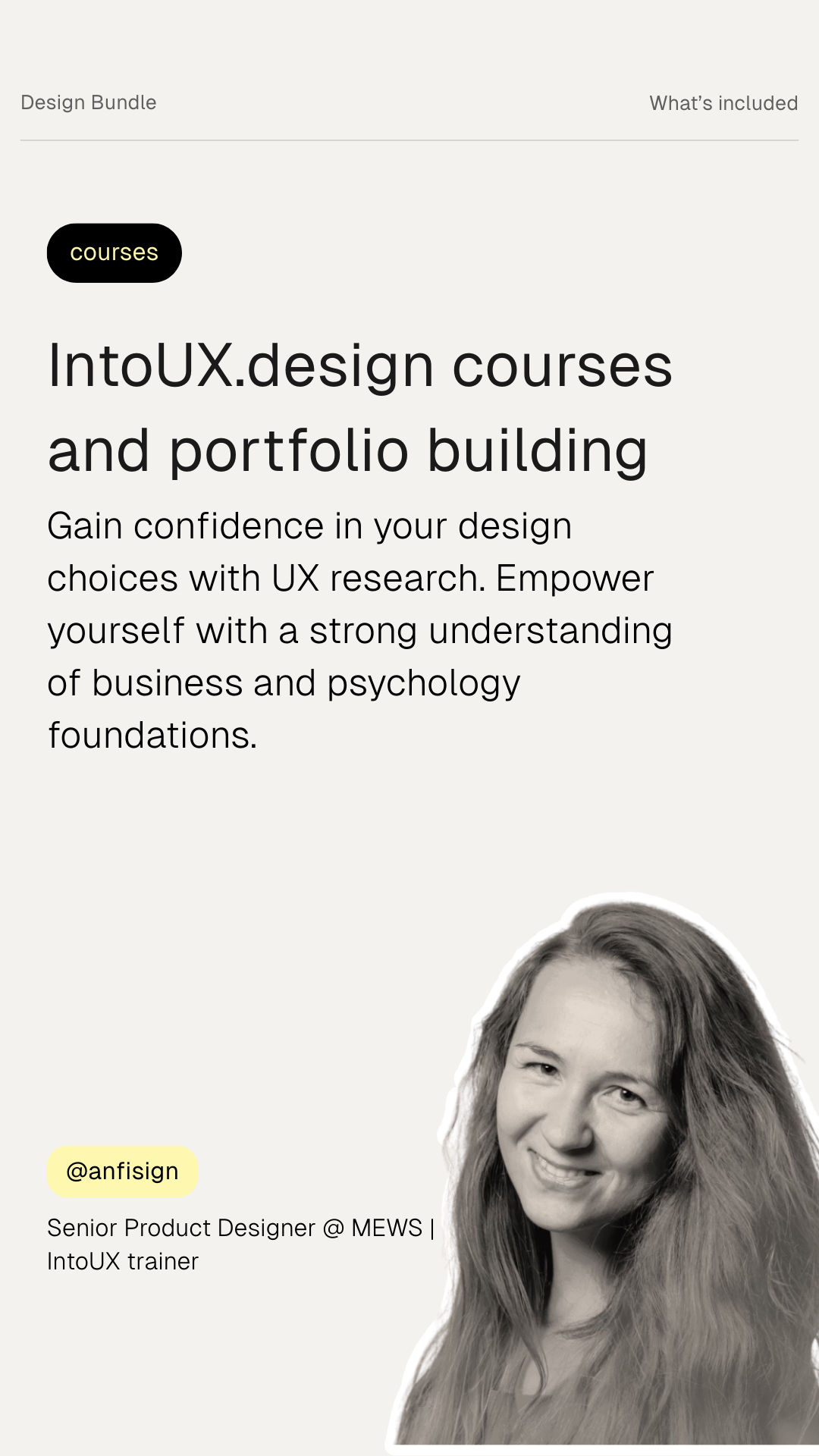
This is why Anfisa Bogomolova is in the bundle.
Anfisa is a Senior Product Designer at MEWS. She's been designing for 12 years across multiple countries—Ukraine, USA, Estonia, Italy, Georgia, China, Czechia.
She founded IntoUX.design in 2021 specifically to teach the foundations that schools skip.
Her courses: Full UX Research & Strategy + Design Validation program.
Not scattered mini-courses. One complete system. From research to testing.
What you get:
Course 1: UX Research & Strategy (15 hours)
- UX methods and when to use each
- Secondary research (analytics, market research)
- Primary research (qualitative and quantitative)
- User behavior psychology (why people do what they do)
- Business basics for designers (the language executives speak)
- Design brief and strategy
Course 2: Design + Validation (15 hours)
- Conceptualization and ideation tools
- Workshops (design sprints, decision jams)
- Information architecture (card sorting, prioritization)
- Foundational design principles
- Usability testing and measuring impact
Plus:
- 75+ bite-size lessons
- 30+ quizzes to test your knowledge
- Templates for interviews, proposals, testing
- Community access (ask questions, get answers)
- Captions in 8 languages
1,900+ students. Multiple job success stories.
Standalone price: $250 for full bundle.
In the Design Bundle: Part of the $299 package.
Who this is for:
Junior to mid-level designers who know how to design but can't defend their decisions with research.
Career switchers who need structured foundations (not scattered YouTube tutorials).
Designers who interview well but get stuck on: "How did you validate this solution?"
Why this matters for landing $150K-$300K roles:
In interviews, they'll ask: "Walk me through your research process."
If you say "We talked to some users and they liked it," you won't get the offer.
If you say: "We ran 12 user interviews using a semi-structured script. Analyzed qualitative data through affinity mapping. Validated with usability testing on 8 participants. Measured a 34% improvement in task completion," you sound like a senior designer.
Anfisa's courses teach you that vocabulary. That process. That confidence.
Real results from Anfisa's students:
- Pratik: Started as intern during course. Hired as junior designer after completing it.
- Hafsah: Landed job in US 4 months after finishing.
- Alina: Transitioned from tech writer to UX design in 4 months.
- Romana: Landed job 1 month after completing course.
These aren't exceptions. This is what happens when you have real foundations instead of scattered knowledge.
The bundle includes this + 5 other resources.
- Femke: Product strategy and stakeholder influence
- Tommy: Making UX decisions with confidence
- Anfisa: UX research, business, and psychology foundations
- Elizabeth: Notion workspace (20+ templates)
- Samaneh: Portfolio positioning
- Me: Job search system (land interviews without applying online)
$299 total. Jan 5-16 only.
Link: https://bundle.femke.design/?utm_source=joseph
Joseph
P.S. One of Anfisa's students: "I learned more with you than I did in the bootcamp I paid $8,000 for." That's the difference between scattered mini-courses and structured foundations.