In honor of Hakham Rabbi Dr. Elie Abadie, whose remarks about his refugee experience and prayers for the new Syria’s future resonated with and were published by our friends at the Muslim American Leadership Alliance (MALA)
Click here to dedicate a future issue in honor or memory of a loved one
Subscribe ◊ Upcoming Events ◊ ASF Sephardi Shop ◊ Donate ◊ Sephardi Ideas Monthly ◊ ASF Sephardi House ◊ Archive
The Sephardi World Weekly is made possible by Daniel Yifrach, Rachel Sally, Professor Rifka Cook, Maria Gabriela Borrego Medina, Rachel Amar, Deborah Arellano, & ASF VP Gwen Zuares!
“Daramsuq [Damascus] sees first Shofar blowing in decades. Jewish presence revives eastern religious heritage in Syria”
By Syriac Press
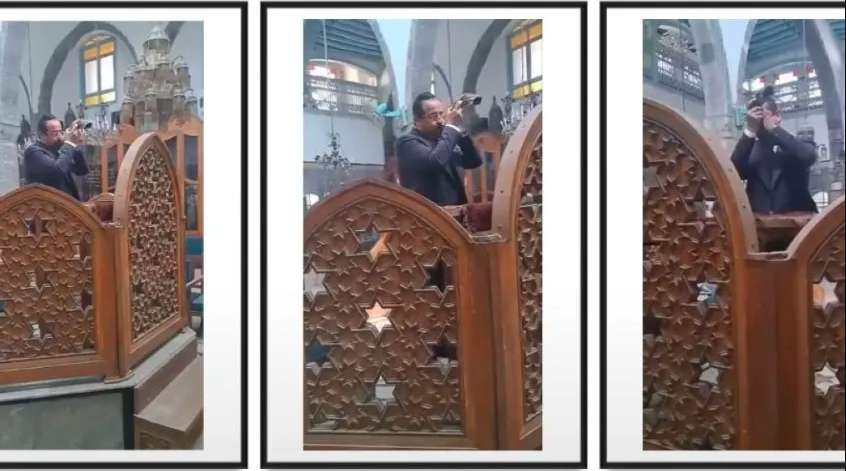
Henry Hamra blowing the shofar
(Photo courtesy of Syriac Press)
For many Middle Eastern minorities, the Jews are the proverbial “canary in the coal mine,” with their treatment an early warning sign of danger or trouble, but also hope. Recent events in Syria testify to this countercultural Middle Eastern perspective on the Jews.
Syriac Press is a news agency covering events related to the Syriac-Aramean-Assyrian–Chaldean people in their native lands in Mesopotamia, Lebanon, Israel, the wider Middle East, as well as the global diaspora. Syriac Press publishes in Syriac (Aramaic), English, and Arabic.
What caught the eye of Syriac Press?
In a scene not seen for nearly three decades, the sound of the Shofar—a traditional ram’s horn trumpet—resonated inside the Elfrange Synagogue in [Damascus]. The shofar was blown by Henry Hamra, who fled Syria in the 1990s and founded the Jewish Association in Israel, in celebration of the Jewish New Year and Yom Kippur.
How did the Shofar blast echo for staunch defenders of Syriac culture and language in Syria?
While taking place within a purely Jewish ritual, the event also recalled Syria’s multifaceted identity, shaped over centuries by the coexistence of Jews, Catholic and Orthodox Christians, Druze, Alawites, Sunnis, and Shia.
Just as the Syriac language has remained alive in the liturgies and vernacular of Maaloula and Gozarto (Jazira) Canton, the sound of the Shofar now resounds to reaffirm that the East does not belong to a single faith, but is a cultural mosaic that for centuries brought together Jews, Christians, and Muslims.
In the liturgy for Rosh HaShana, we pray to God to “remove the rule of wickedness from the earth.” For Syriac Press, the blowing of the shofar likewise conjured up the image of a more tolerant future for the region, particularly in the war-torn state of Syria:
The return of this Jewish ritual to [Damascus], even symbolically, may open a broader discussion on the meaning of belonging and religious identity in post-war Syria: could this scene mark the beginning of a reconciliation with the country’s pluralistic past, or will it remain a singular event in a nation whose wounds are still raw?
~~~~~~~
FEATURE: ASF-WJC’s Remembering the Forgotten Jewish Refugees: The Next Generation 2024
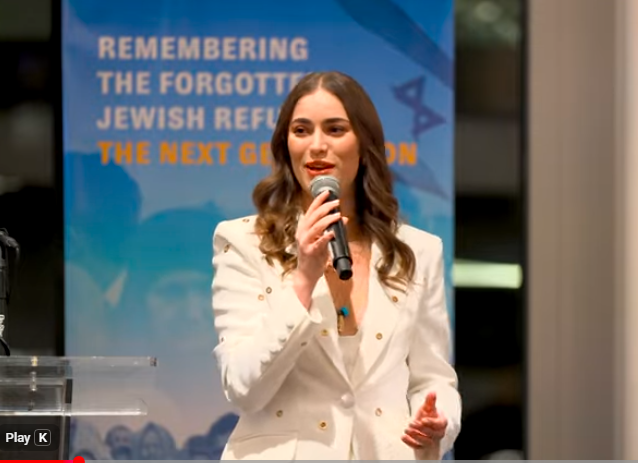
Moderator Adela Cojab, WJC & ASF’s Remembering The Forgotten Jewish Refugees: The Next Generation, 3 December 2024, The Moise Safra Center
(Screenshot courtesy of YouTube)
2024’s “Remembering the Forgotten Jewish Refugees: The Next Generation” brought together the voices of Jewish refugees, young leaders, and students from the Greater Sephardi world for the annual World Jewish Congress - North America and American Sephardi Federation commemoration of the approximately 1,000,000 Jews who were uprooted from Arab and Islamic lands in the 20th century. Our stories of struggle, resilience, and Jewish pride transcend narratives of victimhood or those that idealize or demonize the past rather than reflect the full beauty, depth, diversity, and vitality of the Jewish experience. A particular focus last year was on how the mass exodus and expulsion of Jews from the Middle East, North Africa, and Central Asia is impacting present-day antisemitism. Special guest speakers included Jewish refugees from Iran, Syria, and Uzbekistan, as well as Americans of Afghan, Lebanese, Iraqi, Iranian, Syrian, and Yemenite Jewish ancestry.
Listen to this panel discussion chaired by Syrian/Lebanese-Mexican young Sephardic leader and influencer Adela Cojab featuring Syrian attorney and online activist Abraham Hamra, the author of “From Kabul to Queens” Sara Aharon, and online educator Rabbi Isaac Choua.
During the course of the discussion, Hamra identified the mentality that simultaneously guarantees Jews’ continued flourishing as well as the reason their plight is overlooked:
We’re not people who cry victim, so when my family came from Syria to the United States, my father ingrained in me: listen, you better succeed. You have no excuse. You speak English right. And you came as a kid, you speak the language, and the sky's the limit.
~~~~~~~
Our Story: The Jews of Sepharad; Celebrations and Stories
A special publication of the coalition for the advancement of Jewish education.
Celebrations and Stories will enhance the teaching of Sepharad in lower grades of both congregational and day schools. The life cycle and annual cycle sections are designed to horizontally connect to the teaching of customs and ceremonies. The stories will provide insight to the life of Jews who emerged from Sephardic roots. They are glimpses of daily life and values, as well as tales of our history's heroes.
Matzah and Flour: Recipes from the History of the Sephardic Jews
by Dr. Hélène Jawhara Piñer
A collection of 125 meticulously crafted recipes showcasing the enduring flavors that define Sephardic culinary heritage.
Matzah and Flour: Recipes from the History of the Sephardic Jews offers a tantalizing exploration of the central role of matzah and flour in Sephardic cuisine. Journey through centuries of tradition as flour, from various grains like chickpea, corn, and barley, intertwines with cultural narratives and religious observance. Delve into the symbolism of matzah, from its origins in the Exodus story to its embodiment of resilience and identity. Each of this cookbook’s thoughtfully prepared recipes is a testament to the transformative power of flour in Sephardic culinary heritage. From savory delicacies to sweet delights, these timeless flavors have sustained Sephardic families through history. Matzah and Flour is a celebration of tradition, history, and the enduring legacy of Sephardic Jewish cuisine.
~~~~~~~
Upcoming Events or Opportunities
Our friends at Qesher in partnership with the American Sephardi Federation present:
Greek Jewry: At the Crossroads of Civilizations
“The presence of Jews in Greece dates back to antiquity; it is one of the oldest Jewish communities in Europe, with a unique and multifaceted cultural heritage. Greece became a major center of Sephardi culture and was home to the distinctive Greek-speaking Romaniote community, as well as Jews who had taken refuge there from across Europe. On the eve of World War II, the Jewish population of Greece numbered around 80,000; however, the Holocaust decimated this community. Today, the Jewish community is working to preserve its remarkable heritage. In this exploration, we will delve into this ancient, diverse, and enduring Jewish culture that has spanned more than two millennia and continues to resonate in the modern era.”
Sunday, 9 November, at 3:00 PM ET
Sign-up Now!
Live on Zoom
Tickets: $18
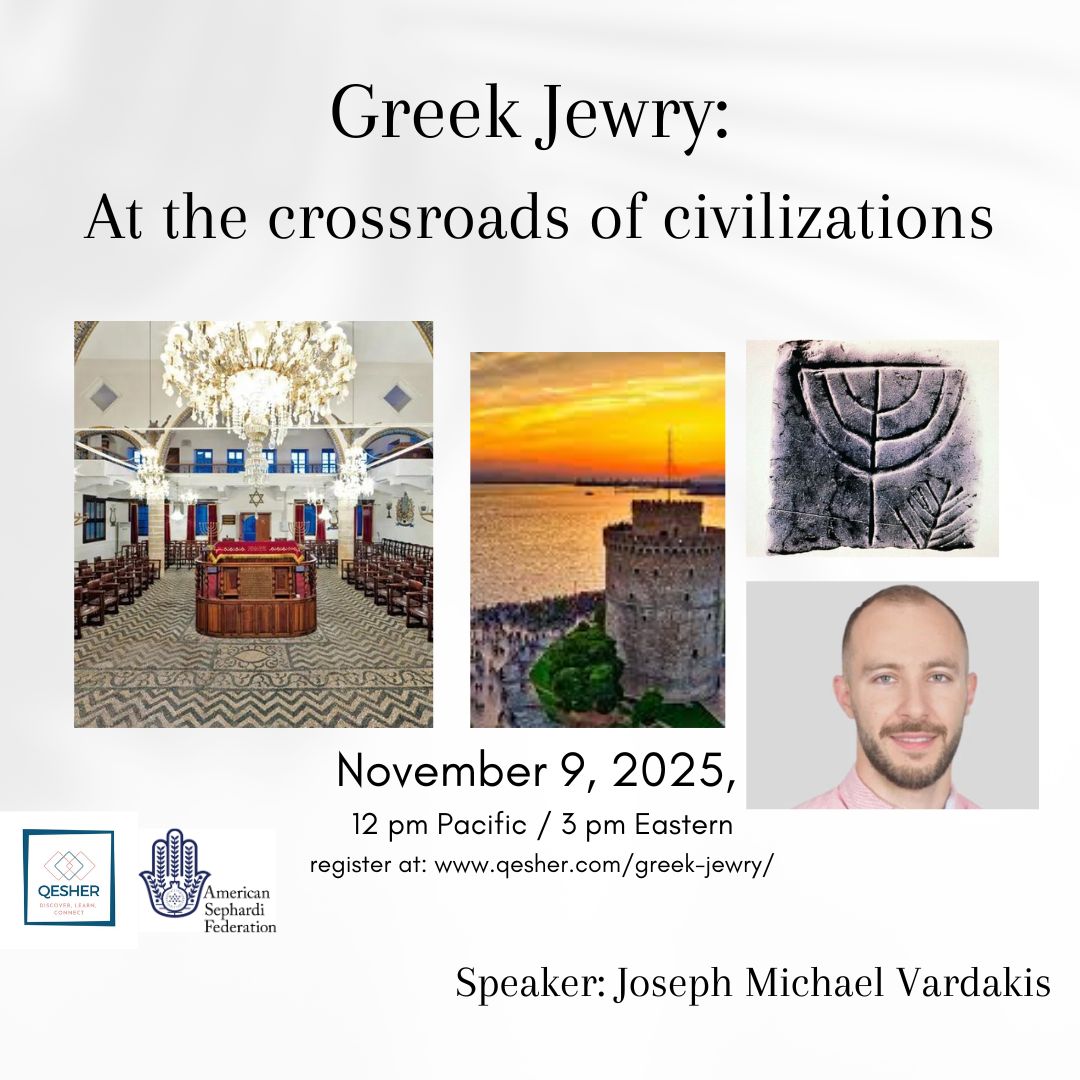
About the speaker:
“Joseph Michael Vardakis was born in Athens, Greece. He has a B.A in Psychology, an M.A in Psychobiology and is currently completing his M.Sc in Clinical Psychology. He has lived and studied in the UK, South Africa and Israel and is currently residing in Athens. He has been a student counsellor for the Ministry of Absorption for new immigrants to Israel and has also worked in an educational framework for the Jewish community in South Africa before his studies. On his spare time, he offers themed tours in Athens, including sites of Jewish interest.”
~~~~~~~
Our friends at Jewish Heritage Alliance in partnership with the Habura, Jewish Virtual Library, and American Sephardi Federation present:
From Persecution to Renewal: The Sephardic Legacy & Foundations of Freedom
A 3-Part Series: Part III:
From the Iberian Inquisitions to the U.S. Constitution
“This three-part series explores how the Sephardic Jewish experience—from forced conversion and exile to commercial ingenuity and constitutional ideals—shaped Jewish law, identity, and modern legal thought. Through a journey spanning the Iberian Peninsula, Amsterdam, the Ottoman Empire, and the early American Republic, we uncover how trauma, resilience, and intellectual exchange forged both Jewish and Western legal imaginations.
Jewish History, Religious Freedom, and the American Legal Tradition. This final session traces the legacy of Sephardic exile and resilience into the American context. We’ll explore how experiences of forced conversion, inquisitorial repression, and transatlantic migration influenced foundational ideas about religious liberty in the early United States. As we mark the 250th anniversary of the American Revolution in 2025, this session highlights the relevance of Sephardic memory to enduring constitutional values.”
Sunday, 16 November, at 1:00 PM ET
Sign-up Now!
Online event
Tickets: Complimentary
RSVP required
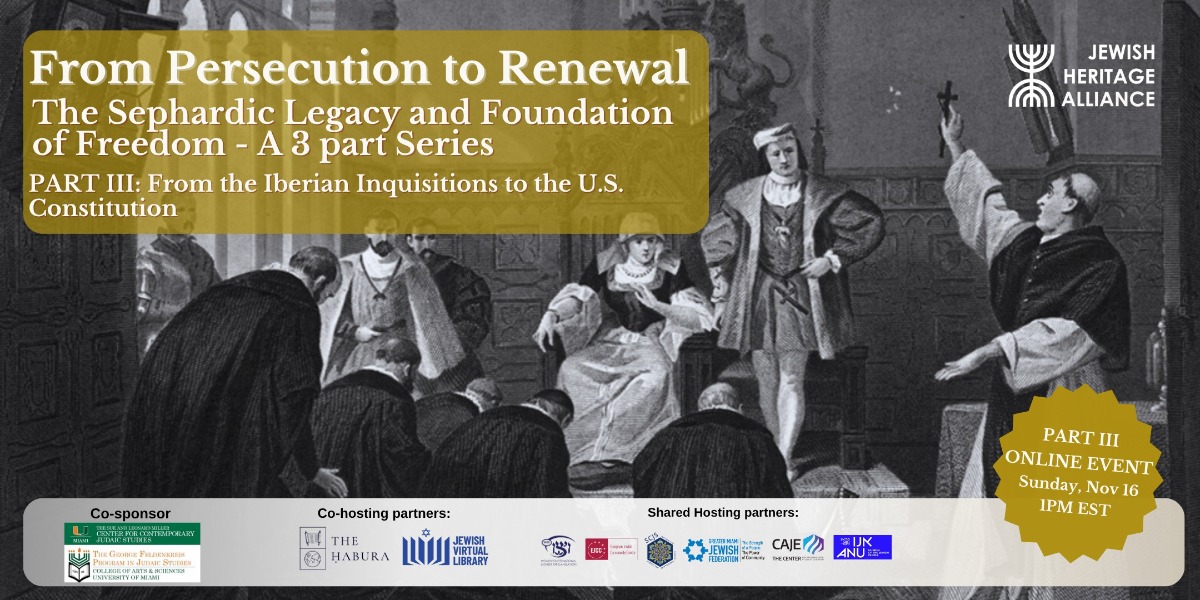
Key Speaker/Presenter:
“Dr. Isaac Amon is the Director of Academic Research at the Jewish Heritage Alliance and an attorney. He is also a Lecturer at Washington University School of Law in St. Louis and was recently named a Fellow at the London Centre for the Study of Contemporary Antisemitism. A grandson of Ashkenazi, Sephardi, and Mizrahi immigrants to the United States, Dr. Amon has served as a Legal Fellow at the International Criminal Tribunal for the Former Yugoslavia in The Hague and as an ISIS war crimes investigator. He frequently speaks on law, antisemitism, and Jewish memory, with particular focus on the Inquisition and the Holocaust.”
~~~~~~~
Our friends at Qesher in partnership with the American Sephardi Federation present:
Jewish Tour of the Balkans
“Join us for a virtual tour through the rich Jewish history and culture of the Balkan peninsula. Learn about the Romaniote and Ashkenazi communities who inhabited the region. We'll place particular emphasis on the Sephardic Jews of the Balkans who became the dominant Jewish community after 1492. We will highlight significant events and individuals from the Jewish history of Salonica, Sarajevo, Belgrade, Sofia, Dubrovnik, Bucharest, Zagreb, and Split. Find out about the Sephardic origins of proto-Zionism, the development of the Neo-Moorish architectural style, and the new Jewish holiday that Ottoman Sephardim invented in 1892.
In the second part of our meeting, we will present the annual Jewish heritage tours of the Balkans organized and led by Dr. Joseph Benatov of the University of Pennsylvania. Next year's tour schedule includes the following trips:
Jewish Bosnia, Croatia, Slovenia, and Trieste (Italy) – May 2026
Jewish Romania, Serbia, and Szeged (Hungary) – May 2026
Jewish Montenegro, Albania, and Corfu (Greece) – May/June 2026
Jewish Bulgaria, North Macedonia, and Greece – June 2026”
Sunday, 16 November, at 3:00 PM ET
Sign-up Now!
Live on Zoom
Tickets: Complimentary
RSVP required
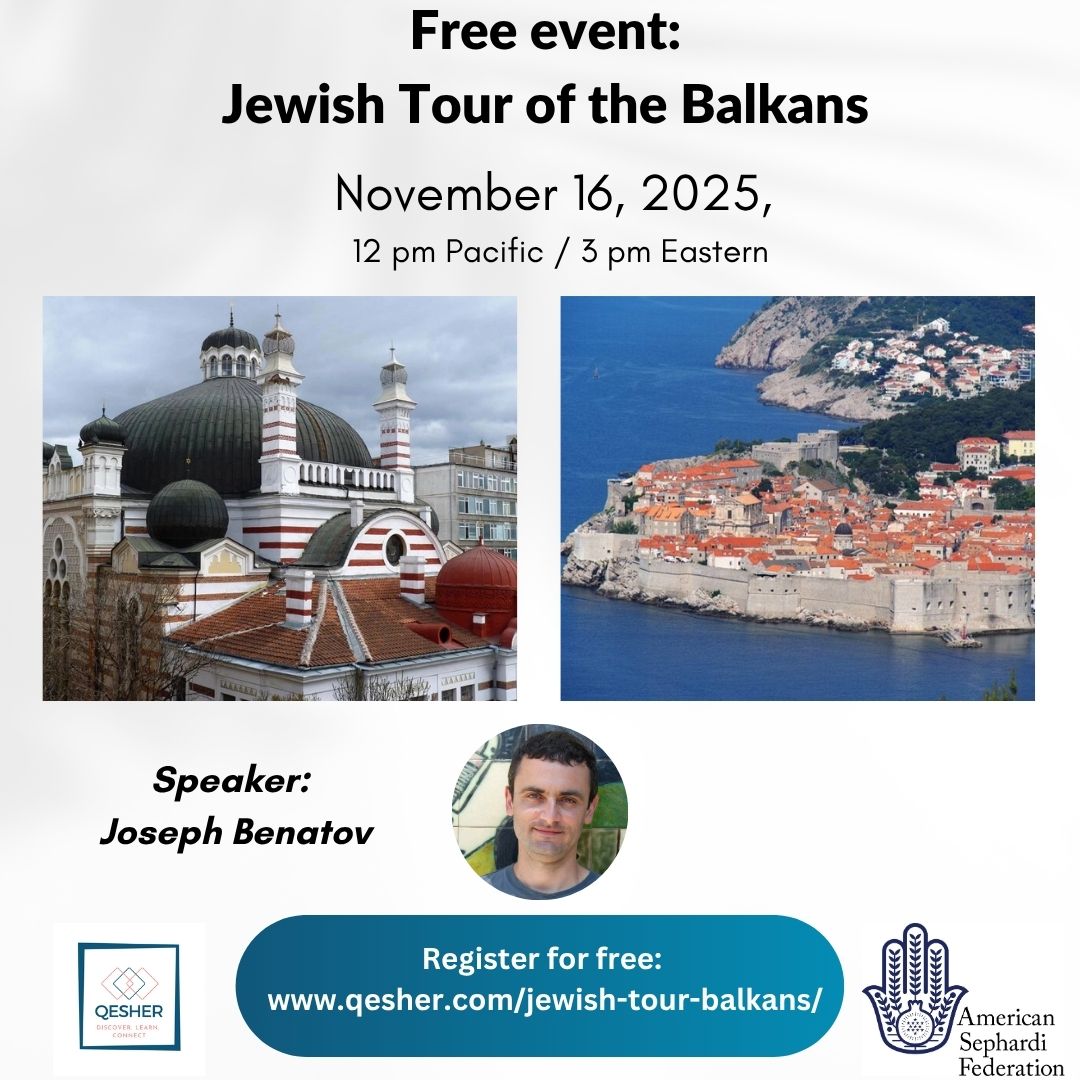
About the speaker:
“Joseph Benatov holds a Ph.D. in comparative literature from the University of Pennsylvania, where he teaches Hebrew. He is originally from Bulgaria and a member of Sofia's Jewish community. Joseph has over 15 years of experience leading travelers across the Balkans, including UNESCO representatives, 92ndStreetY visitors, JDC board members, and Anti-Defamation League officials. He lectures regularly on the history of Jewish life in Bulgaria and on Balkan Sephardic culture. Every summer Joseph leads Sephardic trips to the Balkans.”
~~~~~~~
Our friends at Fed Tanour, Inc in partnership with the American Sephardi Federation and Sephardic Mizrahi Q Network present:
The Magic of Moroccan Song
Discover the Magic of Moroccan Song: A Hands-On Singing Workshop
“At this FED event, we’ll share the warmth and flavors of a traditional Moroccan Friday night dinner, for a full cultural and musical experience.
Join Dr. Yona A. Elfassi for a one-of-a-kind Moroccan singing workshop, the first of its kind at FED Talks! Together, we’ll dive into ‘Hiya Hiya,’ one of Morocco’s most beloved songs, telling the story of a woman in love. Through this song, we’ll:
- Explore how love and desire are expressed in Moroccan music
- Unpack the lyrics and their cultural context
- Sing together in Moroccan Arabic
- We’ll also share a delicious homemade Moroccan Shabbat dinner!
No prior knowledge of Moroccan Arabic is required - just bring your voice, curiosity, and an open heart.
Get ready to sing, connect, and fall in love with the rhythms and stories of Morocco!”
.
Sunday, 16 November, at 6:30 PM ET
@Manhattan
(exact address will be provided upon registration).
Sign-up Now!
Tickets: $50 (Includes singing workshop and Shabbat dinner)
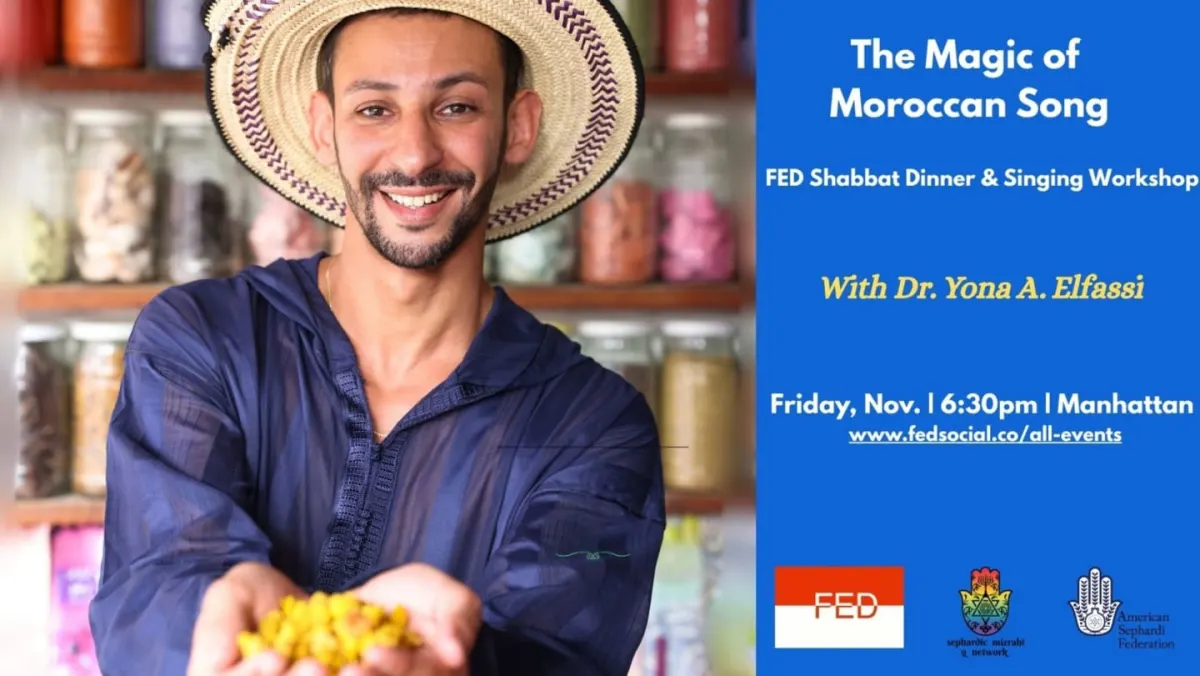
About the speaker:
“Dr. Yona A. Elfassi is a Moroccan-born educator, researcher, and content creator whose work bridges cultures, disciplines, and continents. He has been based in Israel for the past decade. He holds a dual PhD in Middle East Studies (Ben-Gurion University, Israel) and Sociology/ Anthropology (Sciences Po Bordeaux, France). Yona’s work has taken him around the globe, where he has been invited to lecture at leading universities and institutions. His academic journey transcends traditional boundaries, driven by a belief that research should also build connections and foster understanding. Beyond academia, he amplifies his impact through social initiatives, public engagement, and creative storytelling, including short films. Dedicated to exploring the complexities of Muslim-Jewish relations, the plurality of identities, and the preservation of indigenous cultures, Yona’s mission is to generate knowledge that inspires dialogue, empathy, and meaningful change across communities”.