Happy 80th Birthday to Haim Cohen, Chairman of the World Sephardi Federation, which celebrated its 100th Anniversary this past week in Jerusalem!
Click here to dedicate a future issue in honor or memory of a loved one
Subscribe ◊ Upcoming Events ◊ ASF Sephardi Shop ◊ Donate ◊ Sephardi Ideas Monthly ◊ ASF Sephardi House ◊ Archive
The Sephardi World Weekly is made possible by Daniel Yifrach, Rachel Sally, Professor Rifka Cook, Maria Gabriela Borrego Medina, Rachel Amar, Deborah Arellano, & ASF VP Gwen Zuares!
Don’t miss “No More Days for Dead Jews,” an October 7th reflection by the ASF’s Executive Director Jason Guberman
“A Tale of Two Algerian Spy Chiefs”
By Aurele Tobelem, The Times of Israel
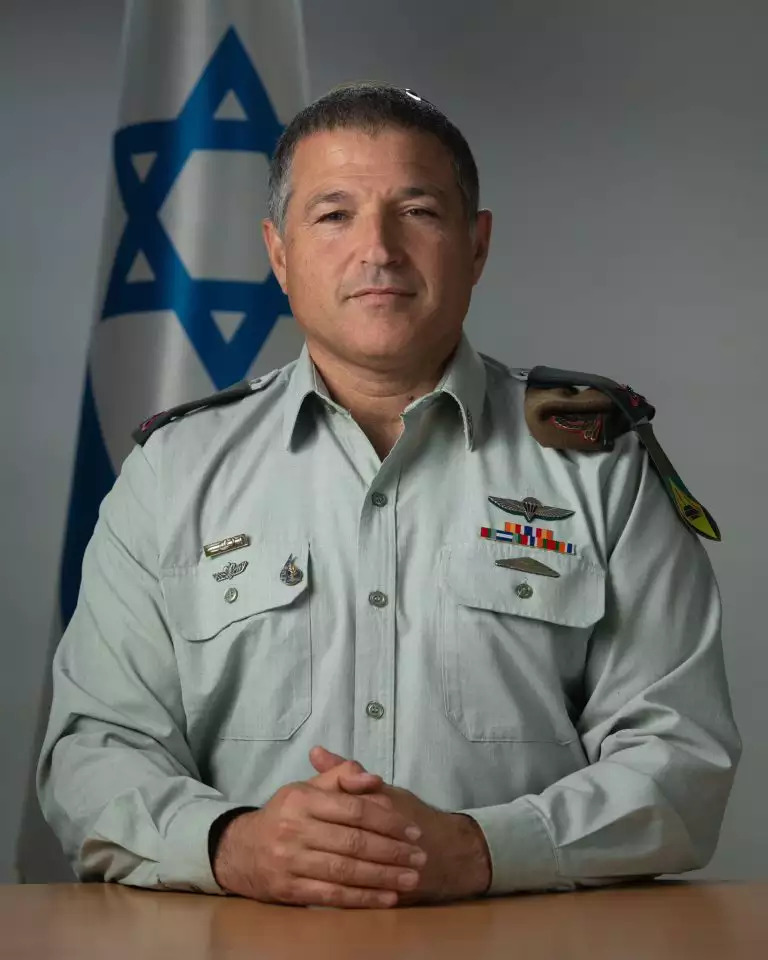
The Head of Shin Bet, Retired IDF Major General David Zini
(Photo courtesy of Wikimedia Commons)
Algeria is a land where
Yahud (“Jew”) remains a playground insult… Hitler is still hailed as a model of European intellectual prowess… every political setback is blamed on “the Jews” or “the Zionists”; and… the Jews who once enriched every facet of Algerian culture—its music, its clothing, its language—have been ousted in the pursuit of a pan-Arabist wasteland.
A recent tale of two Algerian spy chiefs—one Jewish, the other Muslim—illuminates the two paths open to the sons and daughters of the Middle East.
In Israel, on Thursday, 25 September, the Senior Appointments Advisory Committee approved the candidacy of Maj. Gen. David Zini as director of the Shin Bet security agency:
Born in Jerusalem, Zini hails from a prominent Algerian Sephardic family. His grandfather, Rabbi Meir Zini, served communities in Algeria, France, and Israel, and was among the last great Sephardic rabbis of North Africa as well as a leading Zionist voice of Algerian Jewry.
Zini’s appointment to the influential position of Shin Bet Chief makes him “one of the most successful diaspora Algerians in today’s Middle East.”
Meanwhile, in Algeria, in a stunning blow to Algeria’s military establishment, during the early hours of Sept. 18th - 19th, General Abdelkader Haddad, the former director of the powerful General Directorate of Internal Security, secretly fled the country to Spain on a speedboat, “carrying with him potentially explosive state secrets that could destabilize the [authoritarian] regime of [...] Abdelmadjid Tebboune. ”
The alternatives are clear. One read leads the flourishing state of Israel, while the other takes you straight to a pan-Arabist wasteland. Looking ahead:
Perhaps one day Algeria will reckon with its mistakes. Perhaps it will even seek reconciliation. But that day lies far in the distance—and for Algerian Jews, the rear-view mirror holds no nostalgia.
~~~~~~~
FEATURE: Wake-up Call: The Piyyut-Rock Connection
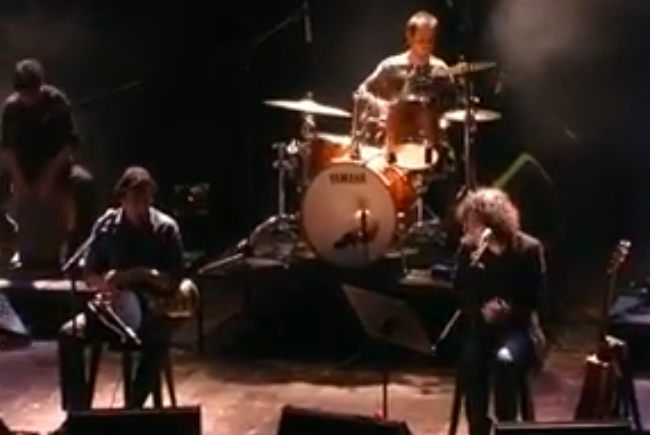
Lior Elmaleh on darbuka, Jerusalem, Israel
(Screenshot courtesy of An Invitation to Piyyut/YouTube)
This week’s video showcases a made-in-Israel collaboration from the 2008 Jerusalem Piyyut Festival featuring Lior Elmaleh, acclaimed interpreter of Sephardi piyyut with a weak spot for rock, and the Israeli rock band Knissiyat haSechel (“The Church of Reason”).
Elmaleh is known for his expressive renditions of piyyutim (liturgical soul music) in which he skillfully blends Middle Eastern and contemporary influences. Knissiyat haSechel is a band from the Mizrahi-heavy town of Sderot on the Gaza border that is celebrated for merging rock, Mizrahi, and Mediterranean elements. Together, they perform Ben Adam Ma Licha Nirdam ("Mortal One, Why Do You Slumber?") the song that initiates the Sephardic Selichot prayers recited in Elul, a wake-up call for both physical and spiritual awakening as the High Holidays approach.
The anonymously written piyut is a riff on a line from the Book of Jonah that is aliteral call to awaken, but here it is transformed into an urgent appeal for self-examination and reconnection with the divine source of our souls. Elmaleh gives voice to the enduring voice of traditional longings, while Knissiyat haSechel brings an urgency and accessibility to a wake-up call that, cutting across the grain of Israel’s often fractured and fractious society, brings together religious, traditional and secular Jews ‒ women and men, young and old.
~~~~~~~
“Music on the double: Liturgical singer Lior Elmaleh offers a sonic bridge for all”
By Barry Davis, The Jerusalem Post
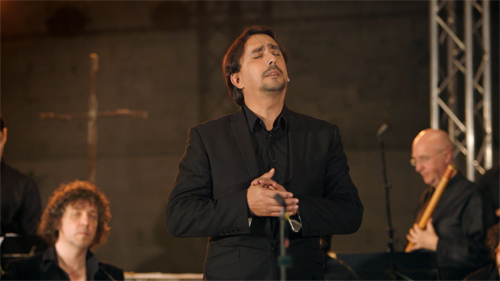
Lior Elmaleh
(Photo courtesy of World Music Central)
The State of Israel is home to one of “the most diverse populations around, with some 40 languages spoken by folk from all sorts of ethnic and cultural backdrops.” That social gumbo makes for some fascinating cultural productions, especially on the bandstand.
Lior Elmaleh is an Israeli vocalist and paytan who takes special pleasure in bringing together the worlds of Andalusian piyut and rock. Born and raised in the Northern town of Kiryat Shmona, Elmaleh became passionately interested in North African liturgical music at the young age of 12, when he began attending middle-of-the-night Shabbat prayers dedicated to singing baqashot, “songs of seeking” (in Edwin Seroussi's phrase):
I started getting up early, with my teachers and everyone else, to join them in baqashot… songs. That became the body of songs I perfected. By the age of 15 I already knew all the baqashot songs – there are over 600 of them – which only acclaimed paytanim over the age of 60 knew… I was the youngest kid who knew all those songs. I was allowed to lead the singing [in the synagogue] from such a young age.
Elmaleh notes, however, that he grew up in a “traditional, rather than a religious, home,” so he didn’t only fall in love with Andalusian piyutim:
When I was a kid… there was a rocker deep down inside me… I think that when it comes to expression, emotion, and the importance of the text, in some way I think there are meeting points between them [piyut and rock].
Integrating his own disparate musical loves and, as such, embodying the enchanting mix-and-match traditional-modern brews that often percolate in Israeli society, Elmaleh headlined a “Rock & Piyut” Slichot Concert at the prestigious Caesarea Amphitheater on 21 September. Joining Elmaleh on stage was“rock band Knesiyat Hasechel, singer-songwriters Amir Dadon and Micha Shitrit, long-standing Mediterranean-leaning rock outfit Teapacks, multidisciplinary artist Aviv Alush, and seasoned bassist-vocalist Eran Tzur.”
Is there an organic link between classic piyutim and present-day rock? Elmaleh identifies a shared candid and daring sensibility:
I think the paytanim of old, who wrote lyrics, including very abrasive and deep social texts, as well as secular and sacred texts, including gripes to God – they often piled up all their complaints to the Creator of the world and demanded he fix things – they were so expressive. They expressed themselves in ways which didn’t always suit the mainstream of the day.
~~~~~~~
Our Story: The Jews of Sepharad; Celebrations and Stories
A special publication of the coalition for the advancement of Jewish education.
Celebrations and Stories will enhance the teaching of Sepharad in lower grades of both congregational and day schools. The life cycle and annual cycle sections are designed to horizontally connect to the teaching of customs and ceremonies. The stories will provide insight to the life of Jews who emerged from Sephardic roots. They are glimpses of daily life and values, as well as tales of our history's heroes.
Matzah and Flour: Recipes from the History of the Sephardic Jews
by Dr. Hélène Jawhara Piñer
A collection of 125 meticulously crafted recipes showcasing the enduring flavors that define Sephardic culinary heritage.
Matzah and Flour: Recipes from the History of the Sephardic Jews offers a tantalizing exploration of the central role of matzah and flour in Sephardic cuisine. Journey through centuries of tradition as flour, from various grains like chickpea, corn, and barley, intertwines with cultural narratives and religious observance. Delve into the symbolism of matzah, from its origins in the Exodus story to its embodiment of resilience and identity. Each of this cookbook’s thoughtfully prepared recipes is a testament to the transformative power of flour in Sephardic culinary heritage. From savory delicacies to sweet delights, these timeless flavors have sustained Sephardic families through history. Matzah and Flour is a celebration of tradition, history, and the enduring legacy of Sephardic Jewish cuisine.
~~~~~~~
Our friends at the Tribeca Synagogue in partnership with the American Sephardi Federation present:
Jewish Women in Film Festival
“TriBeCa Synagogue is proud to host the inaugural Jewish Women in Film Festival. Four evenings of cinema that celebrate stories told by extraordinary female Jewish filmmakers. This is more than a film festival — it is a gathering to inspire connection, conversation, and community”.
1-4 November 2025
@Tribeca Synagogue - 49 White Street, NYC
Sign-up Now!
Tickets: $10 in advance, $18 at door

~~~~~~~
Our friends at Virginia Tech in partnership with the American Sephardi Federation in celebration of Mizrahi Heritage Month present:
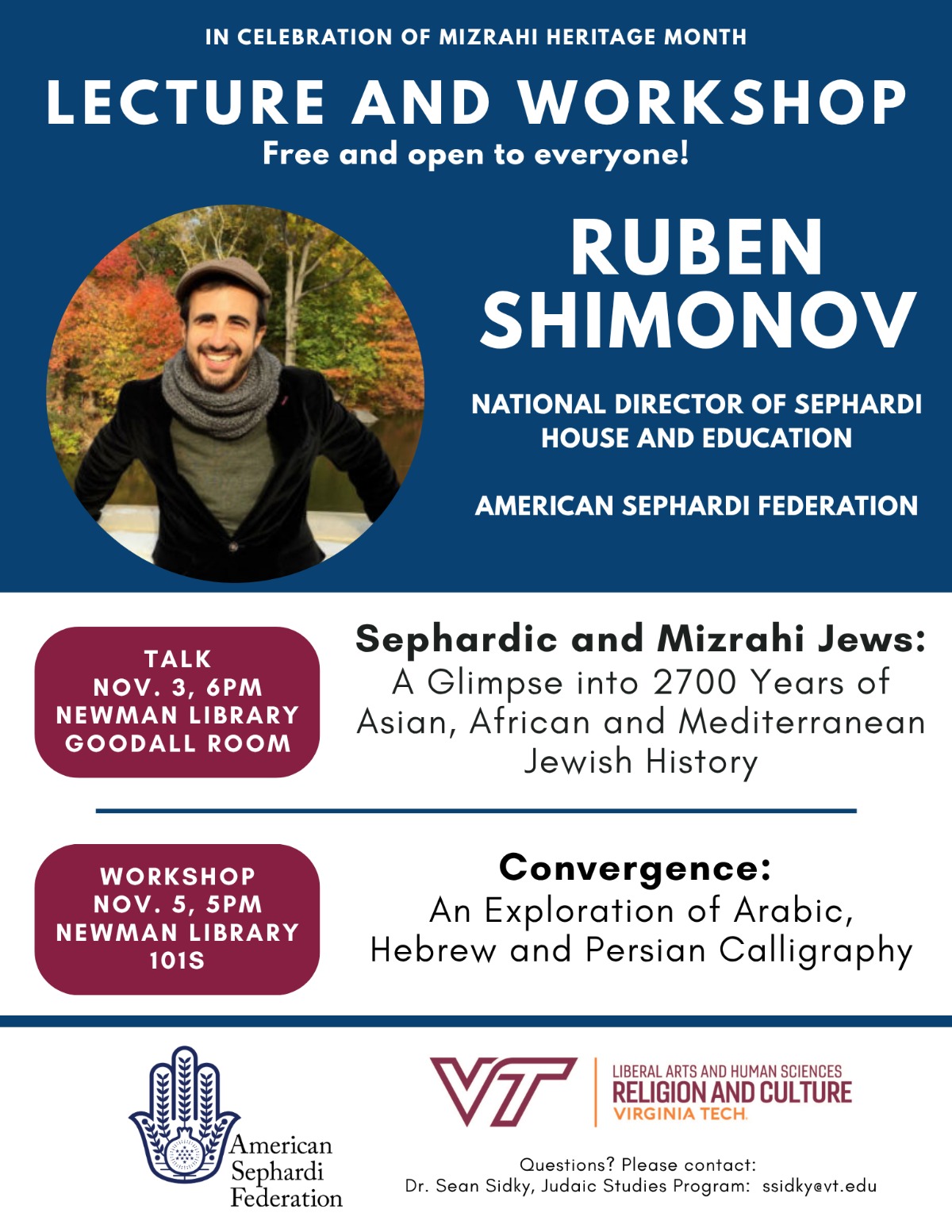
Sephardic and Mizrahi Jews: A Glimpse into 2700 Years of Asian, African and Mediterranean Jewish History
“Join us for an introductory look at the rich tapestry of Sephardic and Mizrahi histories, cultures, and identities. Journeying through various time periods and geographical areas, we will deepen our knowledge of Jewish communities with deep roots in North Africa, the Mediterranean, the Middle East, and Central Asia. Our exploration will also shed light on the ways in which Sephardic and Mizrahi experiences fit into a broader conversation about Jewish history, diversity, and peoplehood”.
Monday, 3 November, at 6:00 PM ET
@Virginia Tech – University Libraries
Newman Library Goodall Room (MPR)
Tickets: Free and open to everyone!
Convergence: An Exploration of Arabic, Hebrew and Persian Calligraphy
“Join us as we dive into the rich visual worlds of Arabic, Hebrew and Persian calligraphy. Through historical, spiritual, linguistic and artistic lenses, we will discover the connections between these languages. Educator, community builder and artist Ruben Shimonov will also take us on an exploratory journey of his own multilingual calligraphy—sharing the ways he has used his art to build Muslim-Jewish interfaith bridges and celebrate the cultural diversity of the Greater Sephardi world. Participants will then have the opportunity to engage with these languages through a hands-on calligraphy workshop”.
Wednesday, 5 November, at 6:00 PM ET
@Virginia Tech – University Libraries
Tickets: Free and open to everyone!
About the speaker:
“Born in Uzbekistan, Ruben Shimonov is an educator, community builder, social entrepreneur, and artist passionate about Jewish diversity and intercultural understanding. He is the American Sephardi Federation's National Director of Education & Sephardi House—an innovative initiative that works to enrich Jewish campus life and young leadership with the vibrancy, richness, and wisdom of the Sephardic and Mizrahi world. He is also the Founding Executive Director of the Sephardic Mizrahi Q Network. Previously, he was the Director of Community Engagement & Education at Queens College Hillel and Director of Educational Experiences & Programming for the Muslim-Jewish Solidarity Committee. As a visual artist, Ruben uses his multilingual Hebrew-Arabic-Persian calligraphy to build interfaith bridges and celebrate the diversity of the Greater Sephardi world. His art has been featured in international publications and exhibits, including at the U.S. Embassy in Uzbekistan. Ruben has brought his multilingual calligraphy workshops, as well as his lectures on Sephardic and Mizrahi Jewish histories, to conferences, universities, and museums around the world. He recently concluded an Artist Residency and Visiting Lectureship at the Tuohy Center for Interreligious Understanding at John Carroll University.”
~~~~~~~
Our friends at the Center for Jewish History in partnership with the American Sephardi Federation present:
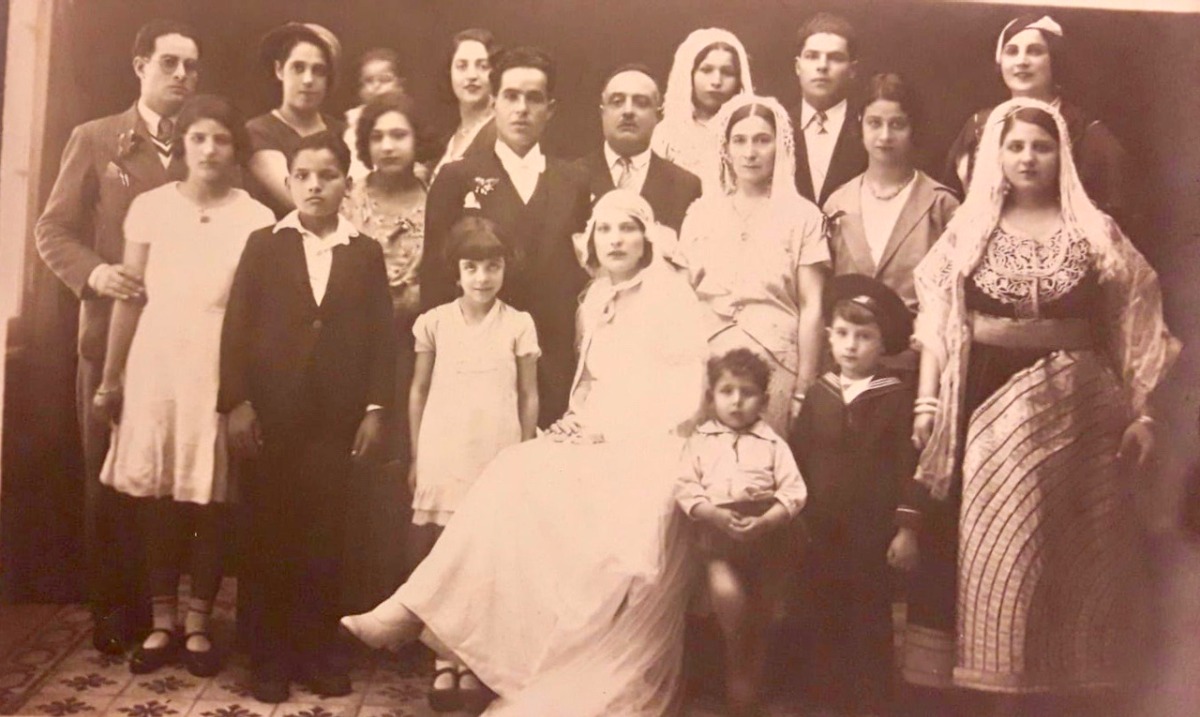
Family History Today: A Moroccan Jewish Genealogical Journey
“Join us for a fascinating talk with Raquel Levy-Toledano as she shares her remarkable journey to uncover the origins of her great-grandfather, born in Manchester. What began as a family mystery evolved into an international quest spanning Morocco, England, Portugal, the Azores, and Cape Verde, combining traditional archival research with genetic testing to reveal an unknown branch of her family—the Levy Belfsahi.
Along the way, Raquel connected with distant relatives around the world and shed light on the urgent need for more organized research on Moroccan Jewish genealogy. To help bridge this gap, she founded the Jewish Moroccan Genealogy group on Facebook, which now links over 400,000 profiles of Moroccan and Algerian Jews, reconnecting families and reconstructing a shared history.”
Monday, 3 November, at 5:00 PM ET
Sign-up Now!
Live on Zoom
Tickets: Pay what you wish - Free
About the speaker:
“Raquel Levy-Toledano was born in Morocco, then moved to France where she received her MD in gynecology and PhD in molecular endocrinology, followed by postdoctoral training at the NIH in Maryland. She is a board member of IAJGS, a board member of the Cercle de Généalogie Juive where she manages the Genetic Genealogy Group, a member of the General Assembly of the International Institute for Jewish Genealogy in Israel, president of NAJMA (Nos Ancêstres Juifs Marocains et Algériens) Genealogical Society, an expert curator of Geni’s Moroccan and Algerian Jewish family tree, co-administrator of the Avotaynu DNA project section involving North African Jews and founder of the Généalogie des Juifs Marocains Facebook Group, which has 13,000 members. She has published several articles in Généalo-J and other journals and has presented at numerous conferences and Zoom meetings.”
~~~~~~~
Our friends at Qesher in partnership with the American Sephardi Federation present:
Greek Jewry: At the Crossroads of Civilizations
“The presence of Jews in Greece dates back to antiquity; it is one of the oldest Jewish communities in Europe, with a unique and multifaceted cultural heritage. Greece became a major center of Sephardi culture and was home to the distinctive Greek-speaking Romaniote community, as well as Jews who had taken refuge there from across Europe. On the eve of World War II, the Jewish population of Greece numbered around 80,000; however, the Holocaust decimated this community. Today, the Jewish community is working to preserve its remarkable heritage. In this exploration, we will delve into this ancient, diverse, and enduring Jewish culture that has spanned more than two millennia and continues to resonate in the modern era.”
Sunday, 9 November, at 3:00 PM ET
Sign-up Now!
Live on Zoom
Tickets: $18
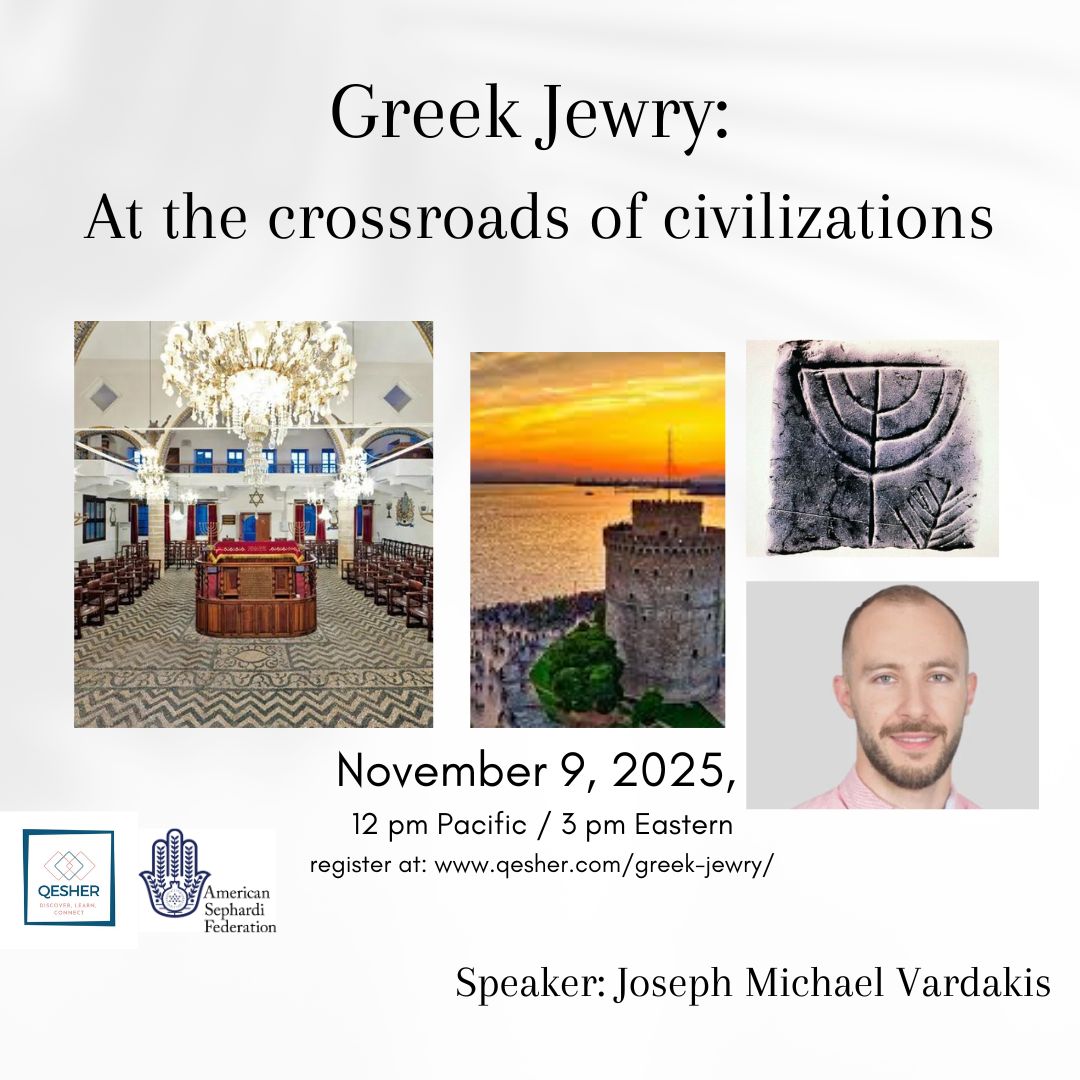
About the speaker:
“Joseph Michael Vardakis was born in Athens, Greece. He has a B.A in Psychology, an M.A in Psychobiology and is currently completing his M.Sc in Clinical Psychology. He has lived and studied in the UK, South Africa and Israel and is currently residing in Athens. He has been a student counsellor for the Ministry of Absorption for new immigrants to Israel and has also worked in an educational framework for the Jewish community in South Africa before his studies. On his spare time, he offers themed tours in Athens, including sites of Jewish interest.”
~~~~~~~
Our friends at Qesher in partnership with the American Sephardi Federation present:
Jewish Tour of the Balkans
“Join us for a virtual tour through the rich Jewish history and culture of the Balkan peninsula. Learn about the Romaniote and Ashkenazi communities who inhabited the region. We'll place particular emphasis on the Sephardic Jews of the Balkans who became the dominant Jewish community after 1492. We will highlight significant events and individuals from the Jewish history of Salonica, Sarajevo, Belgrade, Sofia, Dubrovnik, Bucharest, Zagreb, and Split. Find out about the Sephardic origins of proto-Zionism, the development of the Neo-Moorish architectural style, and the new Jewish holiday that Ottoman Sephardim invented in 1892.
In the second part of our meeting, we will present the annual Jewish heritage tours of the Balkans organized and led by Dr. Joseph Benatov of the University of Pennsylvania. Next year's tour schedule includes the following trips:
Jewish Bosnia, Croatia, Slovenia, and Trieste (Italy) – May 2026
Jewish Romania, Serbia, and Szeged (Hungary) – May 2026
Jewish Montenegro, Albania, and Corfu (Greece) – May/June 2026
Jewish Bulgaria, North Macedonia, and Greece – June 2026”
Sunday, 16 November, at 3:00 PM ET
Sign-up Now!
Live on Zoom
Tickets: Complimentary
RSVP required
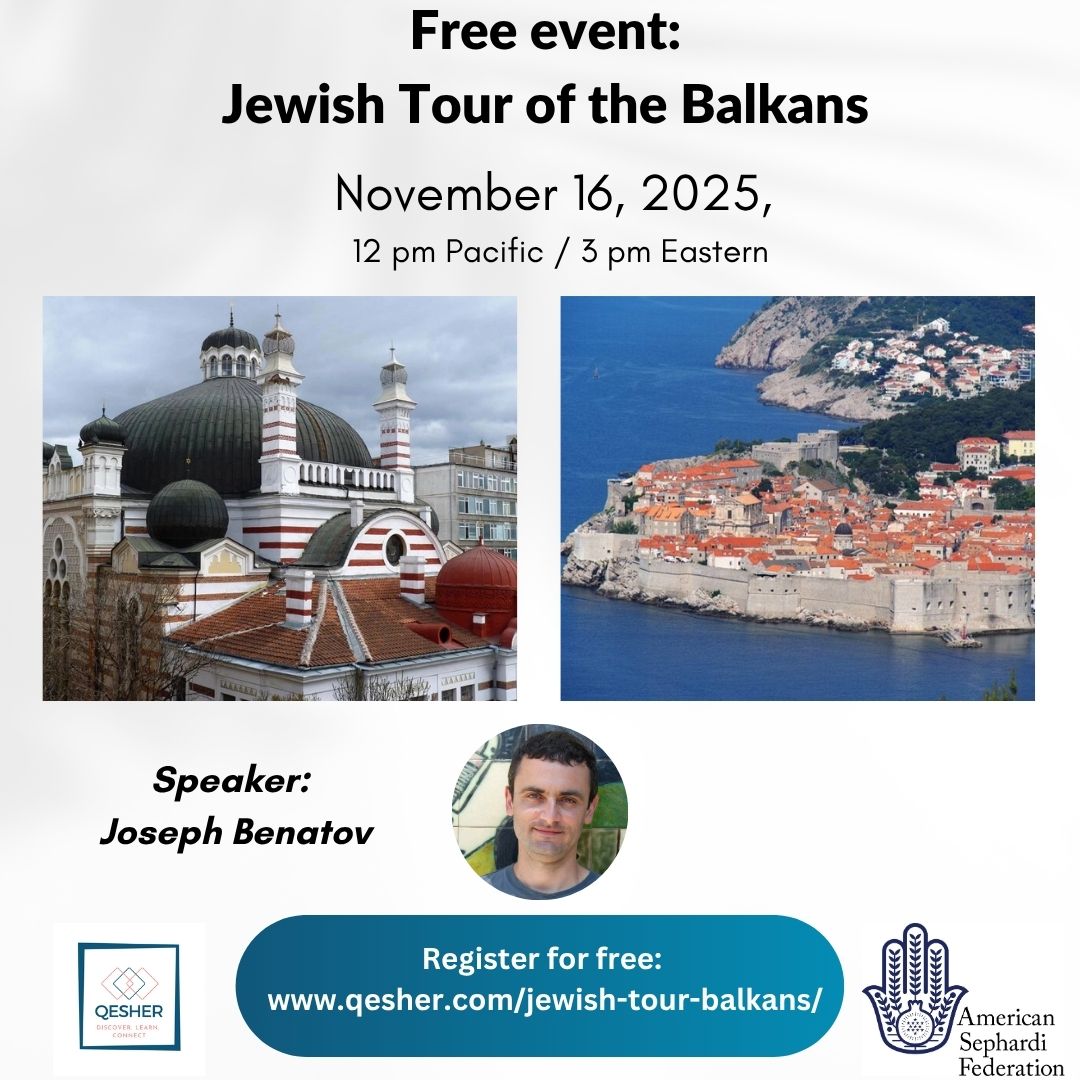
About the speaker:
“Joseph Benatov holds a Ph.D. in comparative literature from the University of Pennsylvania, where he teaches Hebrew. He is originally from Bulgaria and a member of Sofia's Jewish community. Joseph has over 15 years of experience leading travelers across the Balkans, including UNESCO representatives, 92ndStreetY visitors, JDC board members, and Anti-Defamation League officials. He lectures regularly on the history of Jewish life in Bulgaria and on Balkan Sephardic culture. Every summer Joseph leads Sephardic trips to the Balkans.”
~~~~~~~
Our friends at Fed Tanour, Inc in partnership with the American Sephardi Federation and Sephardic Mizrahi Q Network present:
The Magic of Moroccan Song
Discover the Magic of Moroccan Song: A Hands-On Singing Workshop
“At this FED event, we’ll share the warmth and flavors of a traditional Moroccan Friday night dinner, for a full cultural and musical experience.
Join Dr. Yona A. Elfassi for a one-of-a-kind Moroccan singing workshop, the first of its kind at FED Talks! Together, we’ll dive into ‘Hiya Hiya,’ one of Morocco’s most beloved songs, telling the story of a woman in love. Through this song, we’ll:
- Explore how love and desire are expressed in Moroccan music
- Unpack the lyrics and their cultural context
- Sing together in Moroccan Arabic
- We’ll also share a delicious homemade Moroccan Shabbat dinner!
No prior knowledge of Moroccan Arabic is required - just bring your voice, curiosity, and an open heart.
Get ready to sing, connect, and fall in love with the rhythms and stories of Morocco!”
.
Sunday, 16 November, at 6:30 PM ET
@Manhattan
(exact address will be provided upon registration).
Sign-up Now!
Tickets: $50 (Includes singing workshop and Shabbat dinner)
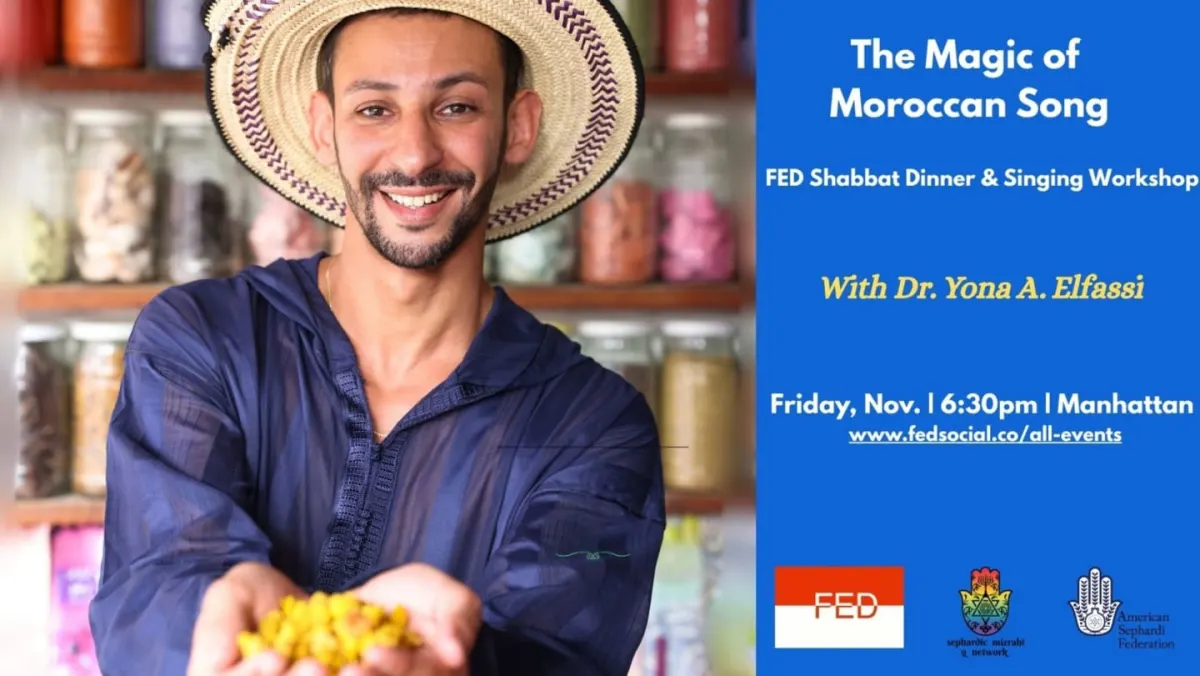
About the speaker:
“Dr. Yona A. Elfassi is a Moroccan-born educator, researcher, and content creator whose work bridges cultures, disciplines, and continents. He has been based in Israel for the past decade. He holds a dual PhD in Middle East Studies (Ben-Gurion University, Israel) and Sociology/ Anthropology (Sciences Po Bordeaux, France). Yona’s work has taken him around the globe, where he has been invited to lecture at leading universities and institutions. His academic journey transcends traditional boundaries, driven by a belief that research should also build connections and foster understanding. Beyond academia, he amplifies his impact through social initiatives, public engagement, and creative storytelling, including short films. Dedicated to exploring the complexities of Muslim-Jewish relations, the plurality of identities, and the preservation of indigenous cultures, Yona’s mission is to generate knowledge that inspires dialogue, empathy, and meaningful change across communities”.