In Honor of Iranians and Jews, “two nations that have suffered” grievously at the hands of the Iranian regime and who are both “on the front lines against the great evil of our time” and in building a future “freed from state-sponsored terrorism and hatred.” Watch a discussion with Yossi Halevi Klein and Roya Hakakian here.
Click here to dedicate a future issue in honor or memory of a loved one

Subscribe ◊ Upcoming Events ◊ ASF Sephardi Shop ◊ Donate ◊ Sephardi Ideas Monthly ◊ ASF Sephardi House ◊ Archive
The Sephardi World Weekly is made possible by Daniel Yifrach, Rachel Sally, Professor Rifka Cook, Maria Gabriela Borrego Medina, Rachel Amar, Deborah Arellano, & ASF VP Gwen Zuares!
Mass protests are threatening the stability of the evil regime in Tehran, which is violently suppressing dissent. This issue of Sephardi World Weekly seeks to provide readers with context for understanding what is happening in Iran and across the region. As always, our goal is not only to track the headlines, but to illuminate the underlying ideas, histories, and power structures that shape them, their relevance for our constituents, Greater Sephardic Jews, many with histories in the region, as well as to inform the broader American Jewish community.
Since 1979, long before the “12 Day War” and Pagers’ Operation, Iran’s rulers presented themselves to the world as champions of “anti-colonial” struggle, but the picture that emerges from the pieces featured in this newsletter is very different. Together, they show a regime that speaks the language of decolonization while practicing its own brand of neocolonial Islamist domination, projecting power, targeting and killing Americans, Israelis, Syrians, Yemenis, and others, erasing other peoples’ cultures, and attacking dissident writers like Salman Rushdie far beyond its borders while violently squashing dissent at home.
In the first item, Marjan Keypour Greenblatt and the ASF’s Executive Director, Jason Guberman, offer a conceptual map of the Iranian neocolonial project, tracing how the Iranian regime spent decades cultivating proxies such as the Houthis, exploiting internal fractures in fragile states, and combining military force, economic predation, and cultural manipulation to build an imperial sphere of influence. At the same time, their analysis reminds readers that what is often framed in Western discourse as a purely “local” or sectarian story is, in fact, a coherent and far-reaching strategy.
Other items connect this structural picture to lived experience and moral urgency. A piece from Sephardi Ideas Monthly delineates how the 2022 attack on Salman Rushdie that left the great writer blind in one eye, decades after Khomeini’s original death sentence, demonstrates that the regime’s war on free thought and open societies is neither symbolic nor confined to Iran’s borders. It is global, persistent, and lethal. Likewise, ASF Pomegranate Lifetime Achievement Award Honoree Roya Hakakian’s reflections, rooted in her own journey from a Jewish family in revolutionary Iran to life as a writer in the United States, highlight how ordinary freedoms taken for granted in the West look very different to someone who grew up under the Mullahs.
Read together, these pieces help clarify what is at stake today for Iranians resisting the regime, for minorities across the Middle East and North Africa, and for anyone concerned with preserving a pluralistic, democratic order in the face of Islamist authoritarianism.
“Transcending Western Myopia: Understanding Contemporary Middle Eastern Neocolonialism on its Own Terms”
By Marjan Keypour Greenblatt and Jason Guberman, The Brown Journal of World Affairs
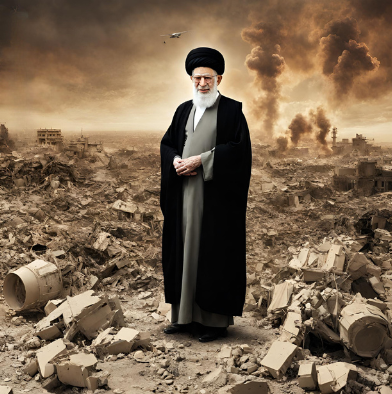
Symbolic rendering of Ayatollah Khamenei amidst the death and destruction wrought by the Iranian regime’s imperialism
(Image generated by the ASF)
In Feb., 2024, Marjan Keypour Greenblatt, the Founder and Director of the Alliance for Rights of All Minorities, and Jason Guberman, Executive Director of the American Sephardi Federation, contributed a piece to The Brown Journal of World Affairs delineating the various dimensions and theatres of operations of the Middle East’s actual neocolonial power, the Iranian Regime. While four Arab States (Lebanon, Iraq, Syria, and and Yemen) had fallen under Iran’s sway at the time, this was a controversial, almost unheard of argument to make in an academic journal, where the region’s only Jewish State was typically maligned with such ill-fitting terms.
In sketching their portrait of then-ascendant Iranian imperialism, Greenblatt and Guberman first confront the conventional view that assumes “decolonization… exclusively resulted from Western wounds.” This Western myopia “blinds us to the reality of contemporary neocolonialism in the Middle East, which is a phenomenon made in Iran.”
The perspective adjusted to see Iran’s imperialist ambitions, Greenblatt and Guberman delineate the process through which the Iranian colonial project wielded power in Beirut, Baghdad, Damascus, and Sana’a while projecting power as far as Africa and South America. In particular, they trace how the Islamic Republic of Iran (IRI) has implemented a four-decade long imperialist policy that “entails political interference, economic exploitation, military projection, demographic manipulation, and cultural indoctrination.”
Consider the Houthis in Yemen. The Iranians began backing the Houthis as early as 2009, and they were fully in the Houthi camp by 2014. And as civil war in Yemen continues
IRI heavily invests in the Houthi leaders, converging violence and financial corruption to increase its imperialist influence… while exacerbating regional unrest. The ensuing civil war has devastated Yemeni civilians, causing one of the world’s worst humanitarian crises with an estimated 377,000 dead. Houthi corruption and malevolent policies have contributed to famine, illnesses, epidemics such as cholera, environmental degradation, and population displacement.
But Iranian imperialism isn’t only military in character. It also works on a physical-cultural plane
Within Iran… the shrine to biblical personalities Esther and Mordechai at Hamadan has had its iconic ‘Jewish Star’ fence removed, suffered protests, lost its protected status, and been threatened and then attacked by Basij militia, who committed arson inside the subterranean synagogue in May 2020.
Ultimately, Greenblatt and Guberman argue that the Iranians are playing a double game that Americans need to see clearly
In their rhetoric, they condemn the United States as a colonial and interventionist power guilty of ‘global arrogance,’ just like many indigenous peoples do, but they refuse to recognize that Syrians, Lebanese, Yemenis, and Iraqis also have the right to self-determination and independence. In this way, IRI exploits decolonial dreams, while at the same time engaging in neocolonialism.
FEATURE: Roya Hakakian’s Iranian-Jewish-American Perspectives
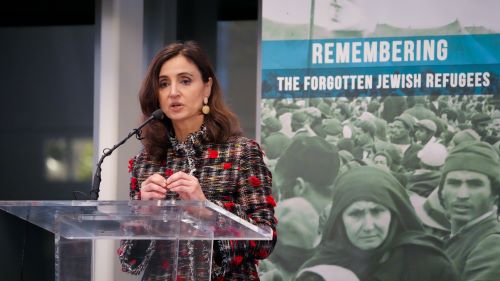
Roya Hakakian speaking at the ASF and World Jewish Congress - North America’s “Remembering the Forgotten Jewish Refugees,” Moise Safra Center, 28 November 2023
(Photo courtesy of Zakaria Siraj)
In April, 2024, acclaimed Iranian-Jewish-American writer and poet, Roya Hakakian, visited “Straight Ahead: The Omni-American Podcast,” co-hosted by the ASFs Director of Publications, Dr. Aryeh Tepper, and the Jazz Leaderhip Project’s Greg Thomas. The conversation with Roya explored the unique set of perspectives that Roya acquired while growing up in a Persian Jewish family in the “Islamic Republic of Iran” before moving to the United States as a young adult, where she soon established herself as a celebrated English-language writer. Roya’s work mediates between the rise of Iran and Political Islam, on the one hand, and the Western world, on the other. In this episode, Roya humorously explored how basic freedoms are often taken for granted by Americans while noting the importance of clearly seeing the challenge to democracy posed by Islamists around the globe.
“Salman Rushdie Survives: Islamism in Iran Revisited”
By Sephardi Ideas Monthly

Salman Rushdie
(Photo courtesy of Emory University)
Salman Rushdie survives. In Aug., 2022, he was brutally attacked and blinded in one eye at the Chautauqua Institution in western New York, just as he was about to give a lecture. Iran’s regime sanctioned the attack among its many attacks on individual liberty and national sovereignty across the globe.
The attack on Rushdie had been 33 years in the making. It started when then-“Supreme Guide” of Iran Ayatollah Khomeini published a fatwa inciting Islamists everywhere to murder Rushdie and everyone involved in the publication of his novel, The Satanic Verses. The Iranians even offered a bounty. Rushdie’s Japanese translator (Hitoshi Igarashi) was murdered, his Italian translator (Ettore Capriolo) and Norwegian publisher (William Nygaard) were critically injured after sustaining multiple stab wounds and gun shots, respectively, and his Turkish translator (Aziz Nesin) was nearly killed in an arson attack that claimed the lives of 37 mostly Alevi Muslims in what became known in Turkey as the Sivas Massacre.
Every year since 14 February 1989 Rushdie has received an annual “Valentine’s Card” reiterating his death sentence. That sentence has been publicly re-affirmed by current theocrat-in-chief Ayatollah Khamenei and Iranian state-controlled media on multiple occasions, most recently in an article published just a few days before the barbaric assault on Rushdie at Chautauqua, New York. That article also mentioned how the bounty on his life had been increased.
The Iranian regime’s vendetta against Rushdie cannot be viewed in isolation. Ayatollah Khomeini’s fatwa was a defining moment when much of the Western world failed to take seriously the rise of Political Islam and its ideological challenge to civilization. Worse, many were cowed and compromised instead of confronting the book burners and assassins. In ways presaging contemporary “canceling,” Rushdie was condemned, and the principles of the free and open society abandoned. As Iranians rise up against the regime, now again is a time for choosing sides.
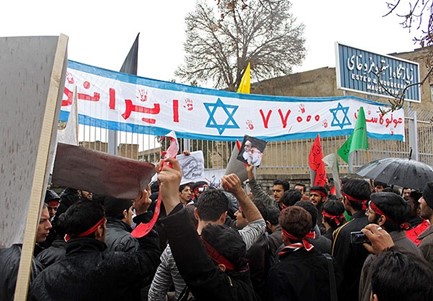
Basij (regime-controlled militia) hold aloft a picture of Ayatollahs Khomeini and Khamenei, Shrine to Esther & Mordechai, Hamadan, Iran, 21 December 2011
(Photo courtesy of Radio Farda)
The ASF has written about the national and religious leaders across the Middle East and North Africa (MENA) who are pushing back against Islamism, fighting for Islamic tolerance and rearranging the political map of the MENA region. We believe that lovers of political liberty and pluralism should also know about Islamism’s most influential thinkers and practitioners. This subject has special salience for Sepharadim who experienced firsthand the effects of the Muslim Brotherhood’s ideology in Egypt, Iraq, and Iran, and who sensibly worry about the proliferation of Islamist antisemitism in places like Los Angeles that have served as safe havens for MENA Jewish refugees.
If you haven’t done so, we invite you to read the June, 2022, issue of Sephardi Ideas Monthly about the Islamist connection that transcends the Sunni-Shi’a divide and helps explain the larger context of the attack on Rushdie: “Islamism in Iran: The Qutb and Khamenei Connection.”
~~~~~~~

Concealed: Memoir of a Jewish Iranian Daughter Caught Between the Chador and America
By Esther Amini
Esther Amini grew up in Queens, New York, during the freewheeling 1960s. She also grew up in a Persian-Jewish household, the American-born daughter of parents who had fled Mashhad, Iran. In Concealed, she tells the story of being caught between these two worlds: the dutiful daughter of tradition-bound parents who hungers for more self-determination than tradition allows.
Exploring the roots of her father’s deep silences and explosive temper, her mother’s flamboyance and flights from home, and her own sense of indebtedness to her Iranian-born brothers, Amini uncovers the story of her parents’ early years in Mashhad, Iran’s holiest Muslim city; the little-known history of Mashhad’s underground Jews; the incident that steeled her mother’s resolve to leave; and her parents’ arduous journey to the U.S., where they faced a new threat to their traditions: the threat of freedom. Determined to protect his daughter from corruption, Amini’s father prohibits talk, books, education, and pushes an early Persian marriage instead. Can she resist? Should she? Focused intently on what she stands to gain, Amini comes to see what she also stands to lose: a family and community bound by food, celebrations, sibling escapades, and unexpected acts of devotion by parents to whom she feels invisible.
In this poignant, funny, entertaining, and uplifting memoir, Amini documents with keen eye, quick wit, and warm heart how family members build, buoy, wound, and save one another across generations; how lives are shaped by the demands and burdens of loyalty and legacy; and how she rose to the challenge of deciding what to keep and what to discard.
Jewish Women from Muslim Societies Speak
Published by the American Sephardi Federation and Hadassah International Research Institute on Jewish Woman at Brandeis University
Jewish women from Morocco, Egypt, Turkey, Lebanon, and Iran were invited to share their personal stories. It could be said that these women's voices are from the last generation of Jews to have an intimate personal knowledge of the Muslim world, the enormous diversity within and among Middle Eastern Jewish communities.
We hope that these essays, told through the medium of vivid personal stories, will stimulate discussion about contemporary dynamics in the Muslim world and raise awareness of Jewish women’s history in North Africa and the Middle-East.
~~~~~~~
Upcoming Events or Opportunities
Our friends at Qesher in partnership with the American Sephardi Federation present:
Qesher Book Club:Tasting Faith
Jews of India - Unveiling Stories, Sharing Recipes, and Preserving their Vibrant Legacy
“Tasting Faith by Paushali Lass takes readers on a fascinating journey through the rich heritage of the Jews of India, told through the life of Ann Samson. From the warmth and vibrancy of her early years in India, where faith and tradition thrived, to the challenges of building a new life in Canada, Ann’s story reflects the resilience of the Jews of India and the broader Jewish diaspora. Written by both Lass and Samson, the book highlights the balance between faith and adaptation, the importance of education in combating antisemitism, and the often-overlooked experiences of the “Jews of the East.” Through food, tradition, and personal narrative, it celebrates a legacy of endurance and connection to Israel. Combining memoir, history, and culinary storytelling, it features recipes like Bene Israel lamb curry and masala chai, offering a rare perspective that unites Jewish and non-Jewish Zionists of Indian heritage in preserving Jewish identity and tradition.”
Tuesday, 20 January at 3:00PM EST
Live on Zoom
Sign-up Now!
Tickets: Complimentary RSVP

About the Authors:
“Paushali Lass is an intercultural educator, writer and international speaker of Indian origin, based in Germany. With a deep connection to Israel, Paushali’s work bridges Jewish and Christian communities, as well as cultures with a focus on education and faith-based initiatives. Passionate about culinary culture, Paushali likes to conduct culinary workshops that explore the intersection of food and culture.
Ann Samson, born in November 1941, grew up immersed in India’s rich Jewish heritage, blending Bene Israel and Baghdadi traditions. After earning degrees in psychology, and education, she moved to Toronto in 1966 with her husband, Solomon, where she overcame challenges in having her qualifications recognised. Ann became a respected educator, ultimately serving as principal of Timberbank Junior Public School and championing multicultural initiatives in the Scarborough Board of Education. She retired in 1998.
In 1977, Ann returned to India to explore the history of Indian Jewry, producing a white paper that raised global awareness of the community. She also participated in the First World Conference on the Jewish Family Heritage in Jerusalem, in 1981. Ann was a founding member and president of Congregation BINA in Ontario, has remained active in Beth David Synagogue, has led tours to India on Indian Jewish heritage to this day.”
~~~~~~~
Our friends at LESJC in partnership with the American Sephardi Federation present:
Fortuna’s Jewish Music for the Soul
“Join us for an online musical journey guided by international Jewish music sensation Fortuna, who will sing songs in Yiddish, Ladino, Hebrew, & Portuguese!”
Wednesday, 28 January at 7:00 PM
Sign-up Now!
Tickets: $10

About Fortuna:
“Fortuna is a critically acclaimed Brazilian Jewish singer-songwriter whose work draws on her Middle Eastern Judaic and Arabic roots to explore Sephardic journeys from Spain and Portugal. Over a 30-year career, Fortuna has bridged cultures and languages through eight independent albums, including La Prima Vez, Cantigas, and Mediterrâneo—winner of the 10th Sharp Music Award for Best Foreign-Language Album. Her album Novos Mares (2016) traces the journey of Jews from Aleppo, including the tribute “Branca Dias” to Anusim. She showcased Ladino music at the 2019 MIMO Festival in Portugal. She has performed at the São Bento Monastery with the Benedictine Monks Choir, at Kahal Tzur Israel in Recife, in Andrew Lloyd Webber’s Joseph and the Amazing Technicolor Dreamcoat, and she hosted Todos os Cantos, a 12-year world-music radio program. In June 2025, the American Sephardi Federation awarded her the Pomegranate Lifetime Achievement Award for Preservation of Sephardic Culture. Fortuna was back in NYC on 11 January to headline the ASF’s Salud i Beraha: The 9th Annual NY Ladino Day.”
~~~~~~
Our friends at Qesher in partnership with the American Sephardi Federation present:
Rediscovering Portuguese Secrets: Little-Known Jewish History that Changed the World
“Travel with author and historian Irene Shaland to Portugal and discover its fascinating Jewish history, much of which remains largely unknown. The Sephardic (or Spanish-Portuguese) Jewish heritage in Portugal has significantly influenced the country's development throughout the ages—from Roman and Visigoth times to the brilliant Age of Discovery; through the dark centuries of the Inquisition and persecution, when Jewish faith and traditions survived in secret; to World War II, when the country became a safe haven for thousands of European refugees; and into today’s small but blossoming Jewish community.
Drawing on extensive academic research and personal experiences during an extended stay in Portugal, Irene Shaland paints a vivid picture of the Sephardic Jewish experience in Iberia from Antiquity to modern times in her book Shaland’s Lisbon.”
Thursday, 29 January at 3:00PM EST
Live on Zoom
Sign-up Now!
Tickets: $18

About the speaker:
“Irene Shaland and her husband Alex, an award-winning travel photographer, have visited over 90 countries and enchanted audiences with their books, magazine articles, lectures, and photography exhibits based on their travels.
Irene’s new series dedicated specifically to Jewish history travel around the world was launched in September 2021 with the Shaland’s Jewish Travel Guide to Malta and Corsica: A Trusted Companion to Jewish History Explorer. The new Portuguese five book series is launched with the first one: Shaland’s Lisbon: An Illustrated Guide to Jewish History and Sites In and Around Lisbon, December 2023.
Alex Shaland, the author of Suburbanites on Safari (2019), and the series of popular children’s books Jackie the Penguin Goes on Safari (2022), and Jackie the Penguin Goes to Madagascar (2023), is an internationally-published photographer. Alex’s photographs appeared in various journals and other media in the U.S., Canada, France, Kenya, South Korea, and the U.K.”
~~~~~~~
Our friends at Qesher in partnership with the American Sephardi Federation present:
The Jews of the Greek Islands: Crete, Rhodes and Corfu
“Since ancient times, many of the thousands of sunny and breath-taking islands dotting the eastern Mediterranean Sea have served as a home for Diaspora Jews.
In this lecture, we will explore the fascinating and lesser-known history and traditions of three of the most famous such islands situated in modern-day Greece: Crete, the largest Greek island with its ancient Romaniote Jewish community; Rhodes, a Sephardic microcosm in the Aegean Sea; and Corfu, with its prolific Italian Jewish community in the Ionian Sea.
These historic and diverse communities enrich our understanding of the Jewish Diaspora and its remarkable saga of survival.”
Sunday, 1 February at 3:00PM EST
Live on Zoom
Sign-up Now!
Tickets: $18
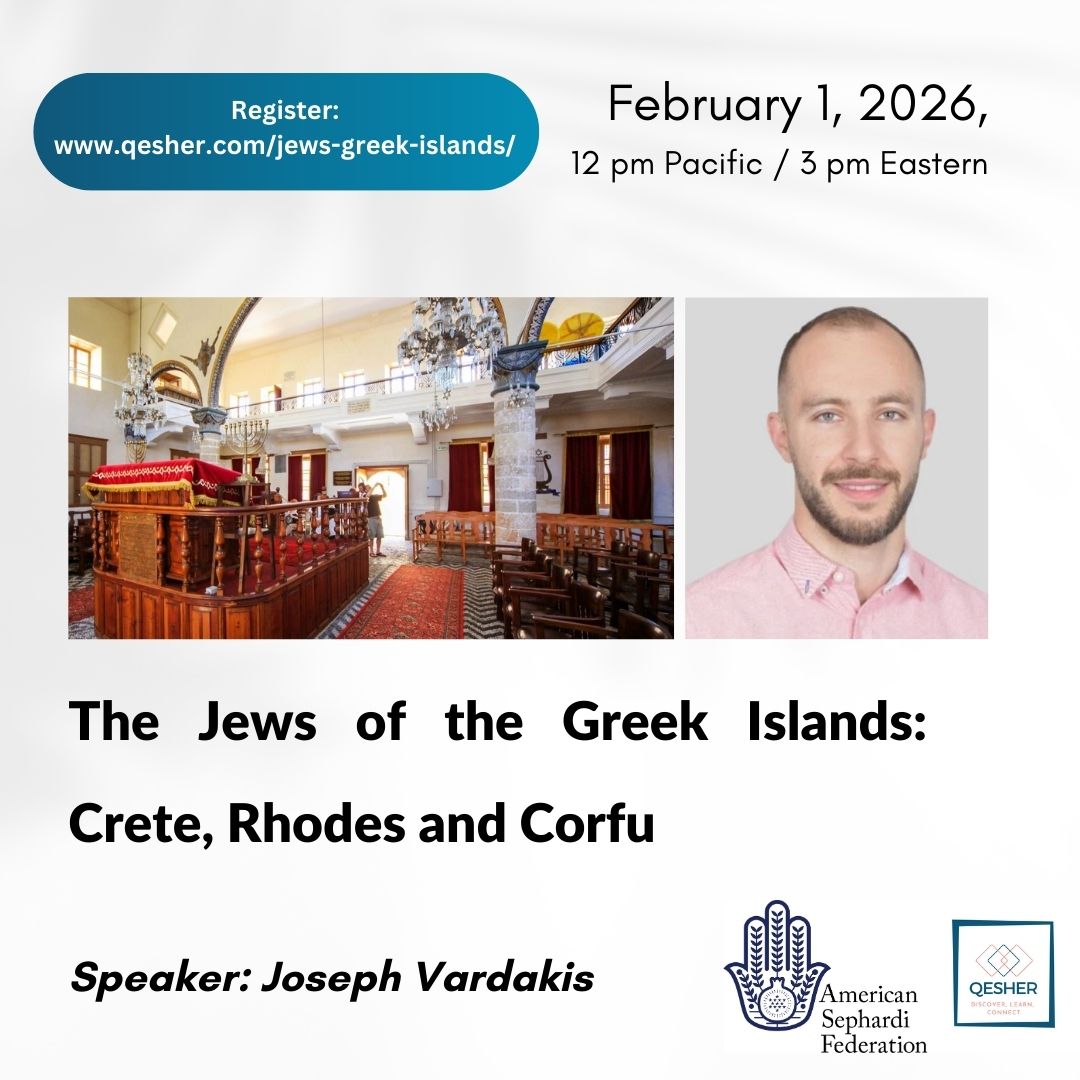
About the speaker:
“Joseph Michael Vardakis was born in Athens, Greece. He holds a B.A. in Psychology and an M.A. in Psychobiology, and he is currently completing his M.Sc. in Clinical Psychology. He has lived and studied in the UK, South Africa, and Israel, and he now resides in Athens.
Joseph has served as a student counsellor for the Ministry of Aliyah and Integration in Israel and has worked in an educational setting within the Jewish community of South Africa before beginning his academic studies. In his spare time, he offers themed tours in Athens, including visits to sites of Jewish interest.”
~~~~~~~
Our friends at Qesher in partnership with the American Sephardi Federation present:
The Jews of Pakistan and Their Forgotten Story
“The Jews of Pakistan were primarily members of the Bene Israel community. Until 1947, the entire region that is now Pakistan was part of the British Raj in greater India. Jewish families began settling in what is today Pakistan—mainly in Karachi, but also in cities such as Peshawar, Multan, and others. Some sources trace their presence to around 1818.
In 1893, the community built a large synagogue in Karachi, bigger than anything you can find in modern-day Pakistan. Jews lived peacefully alongside neighbors of all faiths and played an important role in society. However, after the partition of India and the creation of Pakistan in 1947, the community largely fled. Out of nearly 3,000 Jews, only a small number remained, and those who stayed mostly lived underground. The grand synagogue was eventually demolished, community records and books were dispersed, and descendants migrated primarily to India and later mostly to Israel. Today, only forgotten graves hint at the once-thriving Jewish presence.
This presentation explores the history and culture of the Jews of Pakistan and examines what remains of their legacy both within Pakistan and beyond.”
Thursday, 5 February at 3:00PM EST
Live on Zoom
Sign-up Now!
Tickets: $18

About the speaker:
“Eliaz Reuben-Dandeker is a 4th-generation Israeli, descendant of the leaders of the Bene-Israel community from the 18th century, the Kammodan Mocadem Divekars. He also has ancestors among the Bene Israel community of Pakistan. He is an author, archivist, documentary maker, lecturer, artist, and publisher. Eliaz is the founder and owner of Kammodan Mocadem Publishing House, and has published seven books, taking part in several more. He was also a co-founder of the Next Generation Group of Jewish-Indian activists in Israel and Masale, an inter-generational voyage of Indian Jewry in Israel and around the world. Eliaz has lectured and given interviews around the world on subjects such as the Jewish communities of India and Pakistan and PTSD related to combat experience.”
~~~~~~~
Our friends at 14th Street Y in partnership with the American Sephardi Federation present:
Kedmah Song Circle
“Join Yosef Goldman and Josh Kaye for an immersive evening of Middle Eastern Jewish poetry and song. Each month from January to May, we’ll delve into a single piyyut - a sacred Jewish poem - learn its melodies, and discover the stories and contexts that shaped it. Come sing, learn, and connect in community. All are welcome.”
On Mondays at 7:00PM EST
19 February
16 March
27 April
18 May
In-Person @ 14th Street Y
344 East 14th Street, NYC
Sign-up Now!
Tickets: $18
About the Event:
“Kedmah is a musical and educational collective devoted to Mizrahi Jewish poetry and song. Through teaching, performance, and communal singing, Kedmah invites participants to experience the vitality of sacred poetry that has shaped Jewish life across generations.
Yosef Goldman is a composer, vocalist, and spiritual artist drawing on Mizrahi and Ashkenazi devotional traditions to create transformative musical experiences. He co-founded Kedmah and serves as senior advisor to Hadar’s Rising Song Institute. His work has been featured at the Kennedy Center and Kimmel Center. As a rabbi and ritual artist, Yosef leads prayer and teaches sacred music across the spectrum of Jewish life.
Josh Kaye is a guitarist, oud player, and award-winning composer. He performs across the U.S. as a member of the Stephane Wrembel band and leads the Middle Eastern fusion project, Baklava Express. Josh has performed at venues such as The Town Hall, Dizzy’s Club, Blue Note, Symphony Space, and Lincoln Center.”