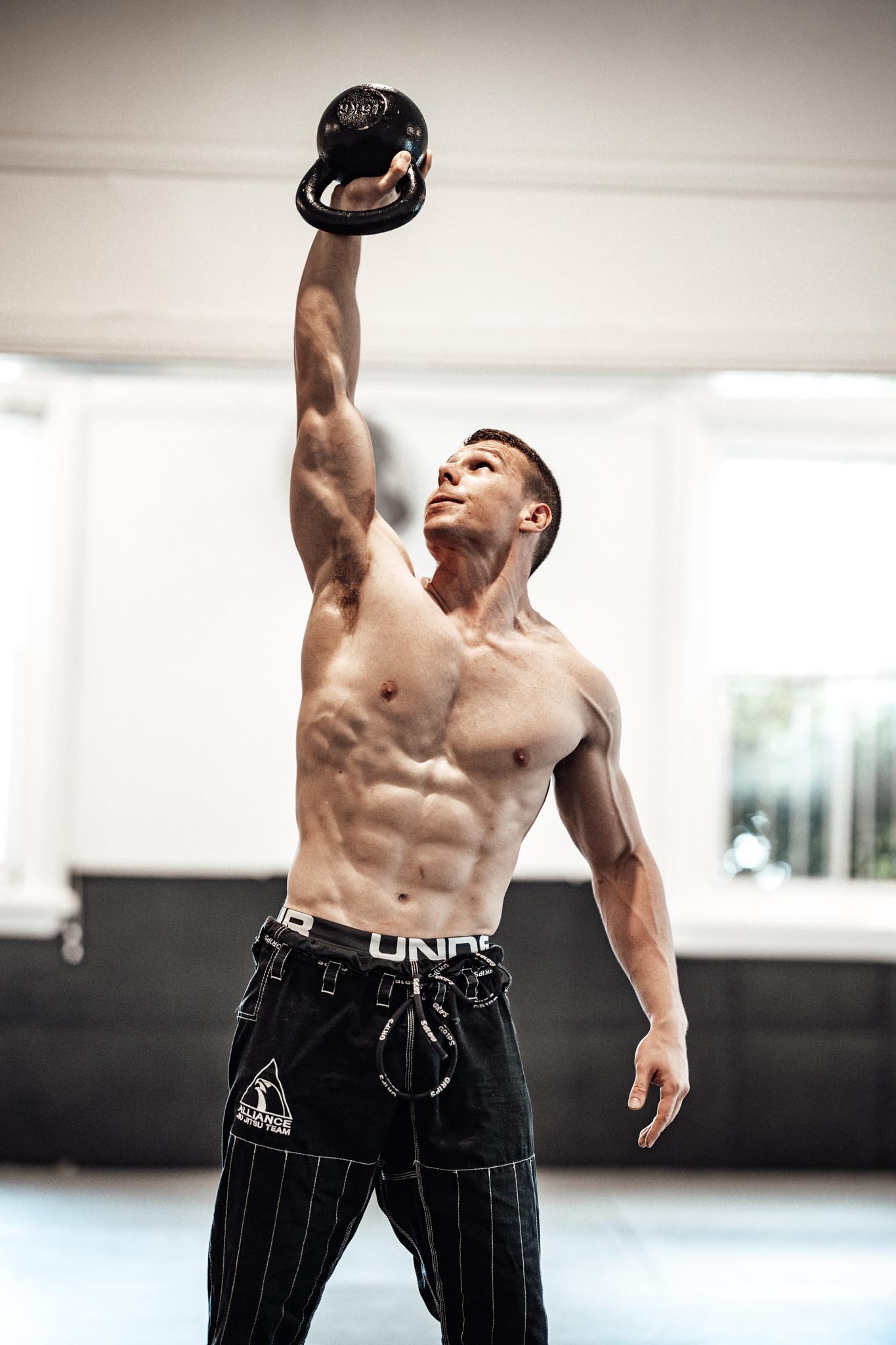
How to Train for Grappling Power
Read Time: 3 mins
Read the online version here (recommended)

Power is your ability to exert maximal force in as little time or with as much speed as possible.
The ability to apply grappling techniques with maximal strength and speed is a game-changer for your grappling performance.
The Types of Exercises that Develop Explosive Power
Ballistic training is a proven, highly effective method to develop explosive power for grappling.
Ballistic exercises are "explosive" movements where you accelerate against resistance rapidly.
Some examples of ballistic exercises are:
- Plyometrics
- Olympic weightlifting
- Olympic weightlifting derivatives
- Modified conventional lifts (i.e. speed deadlifts)
- Throws, slams and banded exercises
Olympic Weightlifting for Grappling
Olympic weightlifting is an entire sport that requires skill, time and effort to master.
Research has shown that Olympic weightlifting derivatives and exercises used to learn Olympic weightlifting produce the highest power output of any exercise modality.
As grapplers, we can take precursor exercises to help us develop power without actually learning Olympic weightlifting (e.g. the jump shrug).
The Two Phases of Power Development
Strength is a fundamental component of power.
Power = Force (strength) x Velocity (speed)
There is a high positive correlation between peak power and maximal strength.
There are two phases to developing power for grappling.
Phase One involves training strength to develop the recruitment of fast-twitch muscle fibres.
Phase Two involves training power to increase the firing frequency of your fast twitch muscle fibres (which should be at a greater volume due to the strength training in phase one).
Research has shown that merging strength and power training outperforms power training alone.
If You're Not Strong... Get Strong First
Here's the kicker: Power training will only yield maximal benefit if you've already achieved a base level of strength.
Studies have shown that people who are "relatively weak" see more significant benefits to their power production when they train exclusively for strength.
This makes sense when we revisit our equation of:
Power = strength x speed
To maximise your power, you must first achieve a baseline of physical strength. Here are some guidelines to aim for:
- Lower Body: Barbell Back Squat = 1.6x bodyweight
- Upper Body: Barbell Bench Press = 1x bodyweight
Building a Power Program
My preferred method for programming power is using a full-body upper/lower approach.
- Upper strength + lower power
- Lower strength + upper power
The exercises selected in your program should range from speed-strength to strength-speed.
This means selecting exercises that focus on pure speed with an element of strength (medicine ball throw) and exercises that focus on strength with an element of speed (trapbar jump shrug).
If you're looking for a program tailored to building power for grappling, check out BJJ Power, my 12-week full-body power program for grapplers.
Here's a sample workout from BJJ Power: Phase 1 | Week 2 | Day 1:
🔥The Warm-Up
Opening the Gate / Close to Gate - 10 each side
Heel to Toe Straight Leg Walks - 10 reps each side
Inch Worm - 5 reps
Shoulder Dislocates - 20 reps
Kneeling T-Spine Rotations - 5 reps each side
Mountain Climbers - 20 reps
Knees to Feet Vertical Jump - 5 reps
Burpees - 5 reps
💪🏽The Work
1a. Weighted Jumping Squats (alt: Bodyweight Jumping Squats)
- 6 sets x 10 reps
- RPE 8
- No rest
- 6 sets x 4 reps
- RPE 8
- 1.5 - 2 min rest.
- 3 sets x 10 reps
- No rest
2b. Sumo Deadlift (alt: Deficit Sumo Deadlift)
- 3 sets x 4 reps
- RPE 8
- 1-2 mins rest
- 3 sets x 10 reps
- No rest
- 3 sets x 30s hold
- 1 min rest
Conditioning Finisher
- 30s on sprint, 10 seconds rest x 4 rounds
- Your cardio equipment of choice (sprint treadmill, Ski-Erg, assault bike, stationary bike).
❄️The Cool-Down
Select 1 *with optional Box Breathing
- Your choice of mobility routine / follow along (see Mobility Follow-Alongs)
- 5-10 min stretch and relax
Check out BJJ Strong Online if you want a highly effective yet time-efficient workout program to improve your BJJ performance and reduce your risk of injury.
Get stronger, faster, and more powerful on the mats while reducing your risk of injury. Take my FREE Fitness Quiz here.
0 comments