Power factors - The on-page optimizations that really matter when thinking about better rankings on Google.
A couple of weeks ago, I teased this concept, so here it is properly:
These are the “POMO” (Position Of Most Opportunity) factors — the fast-moving on-page levers that can create outsized ranking gains without rebuilding an entire site.
Most SEOs overcomplicate growth. In reality, some of the biggest ranking wins still come from improving the fundamentals with precision.
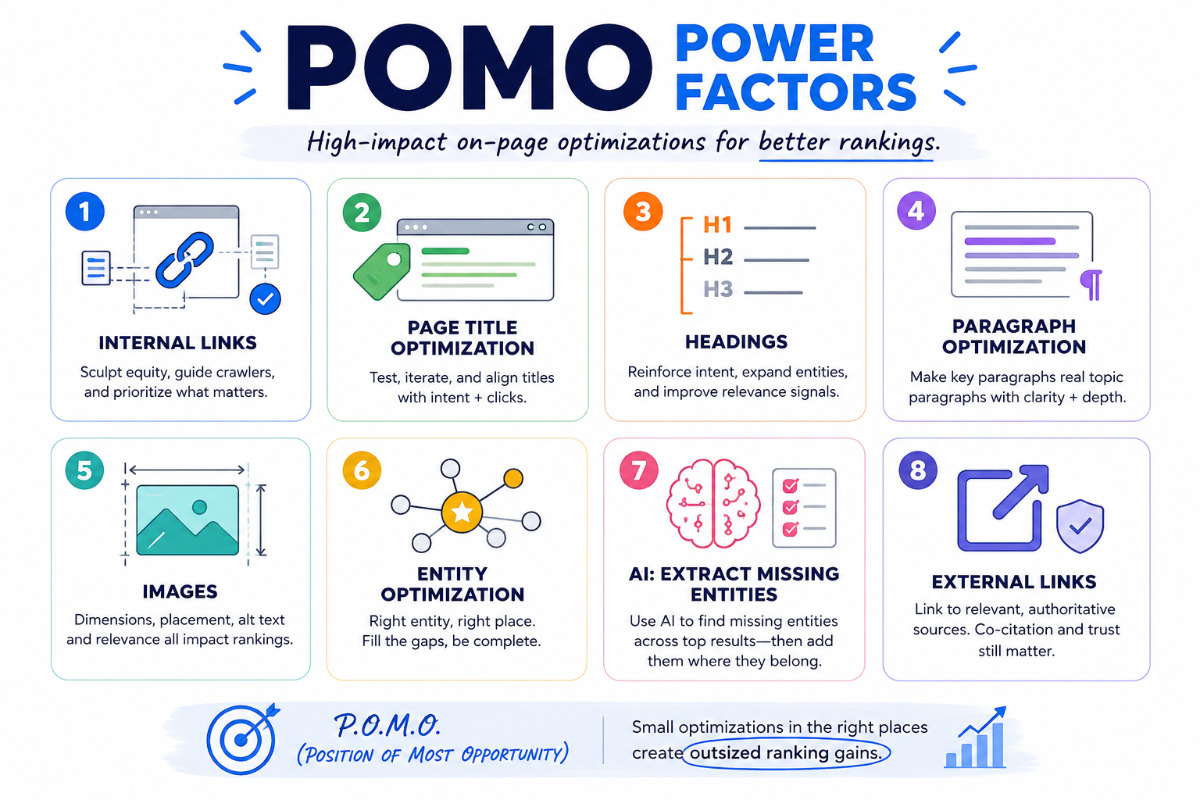
Here are the power factors:
1. Internal links
Obvious one, but most people still treat internal linking too broadly.
I’m not just talking about adding more links.
Selective internal linking, strategic anchor text, selectively using NoFollow, and even removing unnecessary links from your theme/navigation can all materially change how PageRank flows through your site.
Sometimes rankings improve not because you added more links… but because you stopped leaking equity to pages that don’t matter.
Look at:
- Navigation bloat
- Footer links
- Sidebar links
- Author archives, tag pages, and low-value utility pages
Internal link sculpting is still one of the fastest wins in SEO.
2. Page Title optimization
We talk about title tags constantly, but very few people genuinely test them.
I still see a weird fear in SEO where people think “if I change this and rankings drop, it’ll never recover.”
That’s not how ranking systems work.
Titles should be progressively optimized:
- CTR-focused variants
- Entity-first variants
- Modifier testing
- Query alignment
- Freshness angles
If you’re not A/B testing or iterating titles, you’re leaving easy gains on the table.
3. Headings (H1-H3)
Similar to title tags — easy wins everywhere.
Even when headings are “good,” they’re often not maximally useful.
Your headings should:
- Reinforce search intent
- Expand entity relevance
- Match query class
- Improve information retrieval signals
A heading tweak can often improve ranking without touching the full article.
4. Paragraph optimization
This one is massively underestimated.
The introduction paragraph, the paragraphs under your top 2-3 H2s, and your conclusion carry disproportionate weight.
These need to be REAL topic paragraphs.
Not fluff.
Not generic intros.
Not “In today’s digital world…”
You want:
- Immediate topical clarity
- Entity inclusion
- Semantic completeness
- Query alignment
Google often doesn’t need more content — it needs clearer content in the right positions.
5. Images
I’ve run hundreds of image tests over the years, and one thing still surprises people:
Image dimensions matter. A lot.
This was always obvious in Discover, but even in traditional rankings, increasing image size/upload dimensions has repeatedly improved performance — especially mobile.
Look at:
- Resolution
- Original dimensions
- Placement near key sections
- Relevant filenames
- Alt text
This isn’t magic, but it’s consistently under-optimized.
Pro tip? You can easily test your way into identifying the optimal number of images per page in your niche.
6. Entity optimization
I’m not talking about topic clusters or content hubs.
I mean old-school on-page entity placement.
Right entity. Right paragraph. Right heading.
Google expects authoritative documents to mention certain connected concepts/entities.
If they’re missing, your page can feel incomplete.
The play:
- Identify missing entities from top competitors
- Add them naturally into priority paragraphs
- Reinforce topical completeness
This is often the missing piece between page 2 and page 1.
7. Using AI to extract missing entities (properly)
This is where AI becomes genuinely useful for advanced SEOs.
Don’t use AI to blindly rewrite content. Use it as an extraction and gap analysis engine.
My process:
1. Pull the top 5-10 ranking pages for your target query
2. Extract headings + core body text
3. Feed them into AI with prompts like:
“Identify recurring entities, concepts, brands, subtopics, and semantically related terms that appear across these pages but are missing from mine.”
4. Ask AI to categorize:
- Primary entities
- Supporting entities
- Trust entities
- Comparative entities
5. Reinsert only the meaningful gaps into:
- Intro paragraph
- Key H2 sections
- Conclusion
What you’re really doing is building entity completeness faster.
AI helps you spot what Google likely expects without manually combing through every SERP result.
Important:
AI should identify gaps — not decide strategy.
You still need editorial judgment.
8. External links
Some SEOs swear by this. Others ignore it.
But yes — it helps.
Co-citation, topical association, and information retrieval systems all suggest that linking to relevant authoritative sources can strengthen contextual trust.
Not every page needs it, but strategic external linking absolutely belongs in modern on-page.
Think:
- Official sources
- Supporting research
- Topical authorities
- Highly relevant references
Done right, it reinforces relevance.
Final thought:
Most ranking improvements don’t come from “secret hacks.”
They come from systematically improving the highest-leverage positions on a page.
That’s why I call these POMO factors:
Position Of Most Opportunity.
Before you build more backlinks, publish 50 more articles, or redesign your site…
Look at the page itself.
Because sometimes the biggest gains are already sitting there — under-optimized.
0 comments