Technical SEO is still working—and I wanted to show how much impact it can have, even on smaller sites.
Here’s the case study I promised. Grab a coffee—hopefully it gives you a bit of motivation to revisit any technical gaps on your site ☕
How a Technical SEO Cleanup Took a 50-Page Site from 800 → 2,000+ Monthly Clicks...
At the end of December, this site was getting ~800 clicks/month and nothing was helping.
By March, it was doing 2,040 clicks/month.
- No link building.
- No new content strategy.
- No major redesign.
Just fixing what was already there.
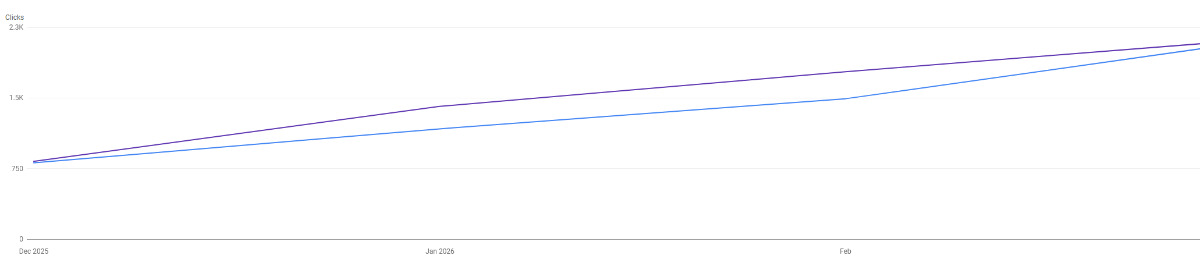
This was a ~50 page lead generation site targeting a national US audience. On the surface, it looked “fine.”
It wasn’t.
The Starting Point
Here’s where things stood:
Clicks: 811 (December)
Impressions: 66,200
Average position: 9.2
Fast forward ~3 months:
Clicks: 2,040 (March)
Impressions: 167,000
Average position: 6.4
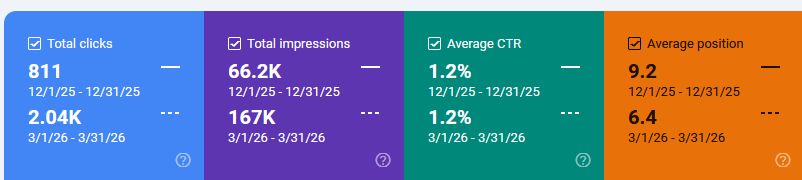
CTR didn’t change.
This is important.
Because it tells us the growth didn’t come from “better titles” or CTR tricks.
It came from better visibility and rankings.
What Was Actually Holding the Site Back
This wasn’t one big issue.
It was a collection of small-to-medium technical problems that compounded.
But a few stood out.
1. ~50% of Pages Were Orphaned
Half the site wasn’t properly linked internally.
That means:
- Google struggles to discover pages
- Internal authority doesn’t flow
- Important pages don’t get reinforced
For a 50-page site, this is massive.
This alone can suppress rankings across the entire domain.
2. Duplicate Page Titles Across ~30% of URLs
Around a third of the site had duplicate titles.
That creates:
❌ Keyword cannibalisation
❌ Confused ranking signals
❌ Lower relevance per page
This is one of those issues people dismiss as “basic hygiene.”
It’s not.
On smaller sites especially, this can materially impact rankings.
3. Site Structure Was Working Against It
There was no real hierarchy.
We introduced:
- 10+ parent pages
- Logical grouping of related content
- Better internal linking paths
- Breadcrumbs
This did two things:
✅ Improved crawlability
✅ Clarified topical relationships
Google doesn’t just rank pages—it ranks structures.
4. Internal Linking Signals Were Weak (and Noisy)
A subtle one.
The site was using generic anchors on design elements like:
- “Read more”
- “Learn more”
On smaller sites, especially ones with poor internal linking, this can cause issues.
We:
- Nofollowed generic anchors with a custom WordPress function
- This focused all internal links on descriptive anchors
This isn’t “2015 SEO.”
It’s about reducing noise and reinforcing relevance.
5. Theme-Level Technical Issues
This was probably the biggest underlying factor.
We fixed a range of issues at the theme level:
- Render-blocking resources
- Protocol-relative URLs
- Missing/invalid security headers:
- HSTS
- CSP
- X-Frame-Options
- X-Content-Type-Options
- <noscript> misuse in <head>
- Missing/invalid structured technical signals
None of these individually are “silver bullets.”
But together, they improve:
✅ Crawl efficiency
✅ Rendering
✅ Trust signals
And most importantly—they remove friction to rankings.
6. Crawl & Indexation Cleanup
A few notable fixes:
- Removed 5XX URLs from sitemap (small, but clean)
- Fixed orphaned URLs
- Expanded robots.txt (custom WordPress handling)
- Addressed canonical inconsistencies
- “Google chose different canonical than user”
Again—this is about alignment.
7. Content Baseline Improvements
No content overhaul.
Just raising the floor:
- Every page now has at least one image
- Improved image handling (dimensions, consistency)
- Added author profile + internal linking
These are small touches—but they matter.
Especially on sites that were previously “bare.”
8. Blog & URL Structure Fixes
We simplified things:
- Flattened blog structure (/blog/article/ instead of deeper nesting)
- Removed unnecessary pagination conflicts (next/prev vs similar posts)
- Improved internal consistency
Nothing flashy—just less friction. Things like this also matter more/less depending on the type and size of a site.
When Did Results Kick In?
Movement started ~1 month after implementation.
And notably:
This growth held through a core update.
That’s usually a good sign you’ve fixed fundamentals—not just ridden a wave.
Why This Worked
There wasn’t a single “aha” fix.
This worked because:
- The site was small → changes had amplified impact
- Technical debt was holding back existing potential
- Internal structure was fundamentally broken
Most importantly:
We didn’t add more—we fixed what was already there.
The Bigger Takeaway
A lot of sites like this don’t have a traffic problem.
They have a clarity problem.
❌ Pages exist, but aren’t connected
❌ Signals exist, but are diluted
❌ Content exists, but isn’t reinforced
Fix that, and rankings follow.
If You’re Running a Similar Site?
Especially in lead gen:
- You don’t need 500 pages
- You don’t need a huge link campaign
But you do need:
- Clean structure
- Clear signals
- Strong internal linking
- Solid technical foundation
Most sites miss at least 2–3 of these.
Want Me to Take a Look?
If you think your site might have similar issues, just reply to this email.
I’m happy to take a quick look and point out what’s likely holding it back.
No call needed 🤘
0 comments