 New Post from BiteofanApple
The Medieval Origin of the Ph.D. Dissertation
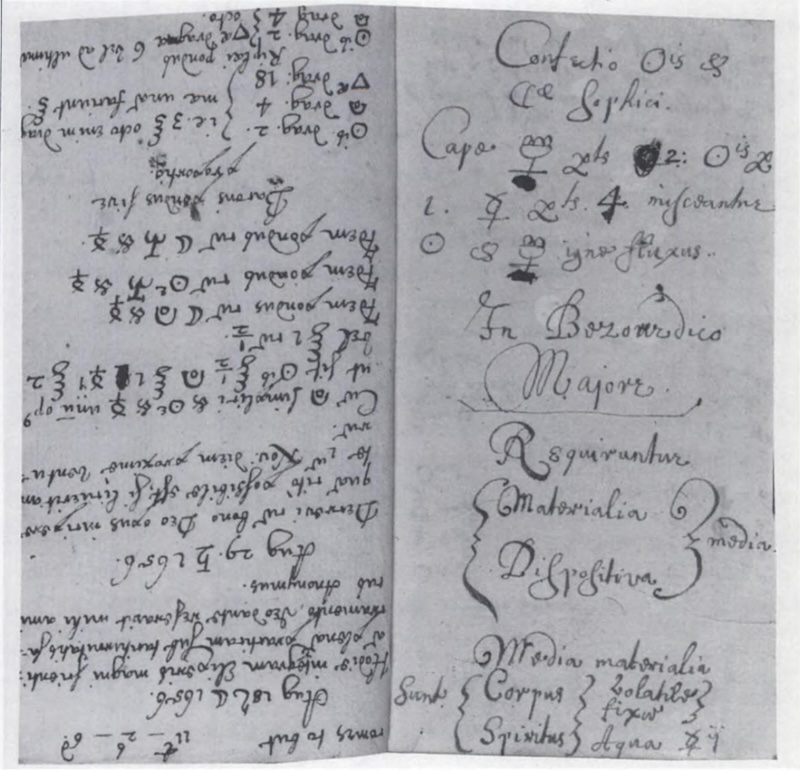
Radical change can seem small when seen up close. I was deep in the weeds, reading again about Mr. George Starkey, a doctor and alchemist living in London in the 1650s. Starkey's life has been a subject of some study by historians of science precisely because a lot of his work survives. We have his numerous published works, those of his contemporaries, and his especially valuable private work diaries.
It was in the passages of one of these diaries that Dr. Lawrence Principe and Dr. William Newmanpuzzled through precisely how Starkey and his collaborators (Newton, Boyle, and Van Helmont) formulated and practiced what would become the modern scientific method. Starkey, for example, records his experiments in a traditional Scholastic style. In those days schools taught using a method derived originally from Roman jurisprudence later adopted for use in theology: the disputation. There were multiple kinds of disputation, but in each two people debated the merits of a question or quaestio. The important change: Starkey's opponent is Nature herself. He worked with his alchemical furnace to burn, boil, and distill the essence of matter. Hence where Starkey's experiments fail he writes that his question has been refuted by the fire.
[Starkey] actually carried his Scholastic education into the laboratory and used it there. At the same time he augmented the standard divisions of argument with new categories more appropriate to his practical experimentation, such as his "Observations," "Conjectural Conclusions," "Notables," and "Hands-On Trials."
Newman & Principe, pg 171.
This divergence into Starkey's methods led me straight to the form and function of medieval Scholastic learning which was heavily theological, legal, and philosophical. The Scholastics held firm to the philosopher's maxim: When in doubt, draw a distinction, and we see Starkey do precisely this on several occasions.
This left me with a questio of my own: when did the disputation die off? Was that somehow tied up with the methods of science Starkey and others were developing?
This is the usual form of my research, and the dual blessing and curse of reading non-fiction. It raises questions, then provides footnotes as enticing breadcrumbs to follow to the answer.
0 comments