
The artist Marek Zulawski, translation & Polish-British culture
Hi,
This week, my father talks to his own painting... 🤷♂️
He wrote this short piece for the Warsaw Pen Club sometime in 1969. While translating it, it made me think that, like with many things in life, you might have intentions on how a plan will turn out, but you never really know.
---
So said the old man to his painting
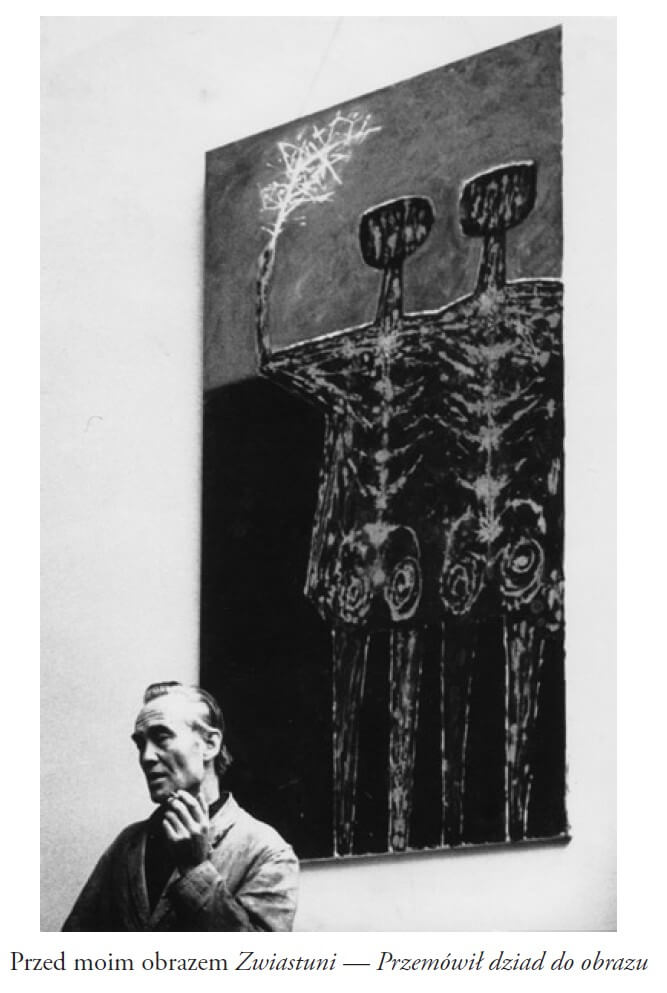
Marek with his painting, scanned from his autobiography
Gentlemen, please stop looking like skeletons immediately. That wasn't what I intended at all.
On the contrary, my intention was to express — so to speak — life energy. Yes, energy, spring, the dawn and all that... I don’t remember exactly, but it seems to me that you gentlemen were supposed to look something like a modern Cyril and Methodius — two young men with impeccable reputations, contrary to appearances, who visited Piast the Wheelwright to bring blessings and prophecies about his future dynasty. But you do not look like figures entrusted with a mission like that at all.
You look like rotten corpses standing on end, and it's unclear how you're able to raise that one hand you have at your disposal.
Incidentally, the tuft you're waving was supposed to be an olive branch. Apart from that detail, it was meant to be a sketch for a serious painting with purely formal qualities. The olive branch somewhat complicated the matter, introducing unnecessary symbolism from the start, even though in the 20th century this sort of symbolism is almost obligatory, given that in every country everyone seems to be calling for peace while simultaneously participating in the most terrible massacres known in history...
But you gentlemen aren't listening to me at all. You're standing with your backs to me. Maybe you're looking toward a so-called better future and are only accidentally showing your bare ribs. But since when is red the colour of hope? A long time ago, I think hope was the colour green.
I've only now noticed that you're fused together. Some kind of Siamese twins probably, if you'll allow me to compare. If there's any symbolism in that too — I really don’t know what it might be. It brings to mind Ying and Yang, Ormuzd and Ahriman, Cain and Abel, Good and Evil, Life and Death — the eternal dualism of inseparable but opposing principles that constantly fight within man and cause the incurable neurosis of all humanity. The positive principle and the negative principle.
From a psychoanalytic point of view, man is a nervous and sickly creature, and that's precisely why we are the only animals that create culture. Culture and mythology are ways of combating fear.
Yes, fear of death. From a psychoanalytic perspective, man is the only creature obsessed with death, and that differentiates him from animals. Hence the concept of immortality. Civilisation guarantees us collective immortality, but individual immortality, gentlemen, we must provide for ourselves. That's why we have sex, literature and art.
Of course, there are other points of view. This image might have a completely different meaning. Perhaps you gentlemen — still fused with clay — have just risen from a mass grave, an institution so typical of our century. And now you are naturally showing off your spines with pride, proving perceptibly that man alone amongst the vertebrates can be resurrected because he is destined for eternal life.
One way or another, we'll probably never find out what you really represent. I'm left forced to accept the principle of multiple meanings in Art, in Science, in Temporal Life — and in the afterlife too.
---
The London & Warsaw that never were
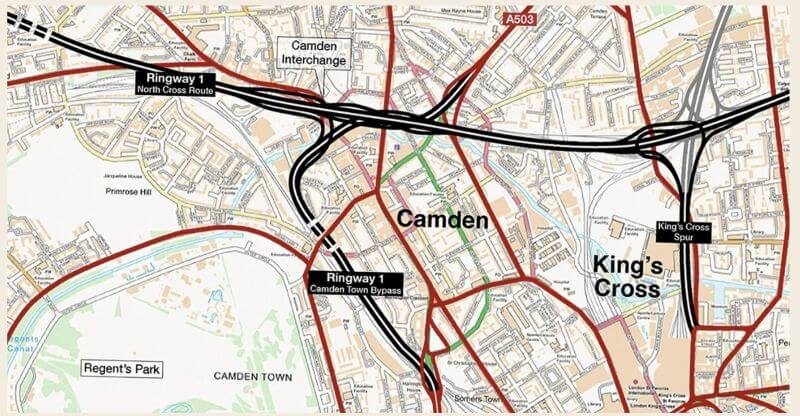
A friend living in Poland found this fascinating article on Londoncentric about the the 1960s plan to cover London in motorways - the only remnant being the Westway from Paddington to White City. He noted not only how awful London would be had this plan fully gone ahead, but also how this sort of plan was applied to Warsaw post-war.
Warsaw is indeed covered in big roads and junctions that split up its neighbourhoods. What the city would have looked like without all the destruction of WWII is something that fascinates many artists and architects, but I suspect the city authorities, especially during the communist era, would still have been happy to put all those motorways on it. (For the curious, the website Warszawa1939.pl has hundreds of photos of pre-war Warsaw.)
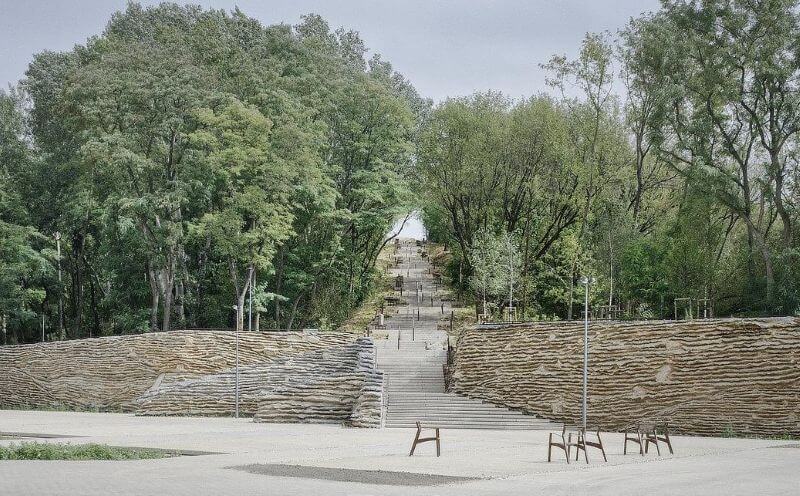
But then of course, there are some things about modern Warsaw that are hard not to like. I recently worked on the English half of a book about the Warsaw Uprising Mound, a newly refurbished park built on top of a massive pile of rubble left over from destroyed buildings. I highly recommend visiting, if you can.
---
That's all for this week. Many thanks for reading. If you want to support the newsletter, please forward it to a friend or donate here.
Adam
Adam Zulawski
TranslatingMarek.com / TranslatePolishMemoirs.com / Other stuff
👉 Help fund the translation of Studium do autoportretu via Paypal 👈
Sent this by someone else?
0 comments