
What happens in Vegas is supposed to stay in Vegas. But not this trade secret...
I'm in a private mastermind in 2012, hosted by Hiten Shah, co-founder of Crazy Egg.
During Q&A I ask him why his company publishes content that has nothing to do with site analytics.
He tells me, there's only so much content you can make about analytics before you run out. And there's only so much analytics content your market will want to consume. You need a reason for the undecided visitor to come back to your site.
Then he says everyone interested in website analytics is also interested in every other topic related to doing business online. And a lot of people interested in online business will eventually want to know something about analytics.
Very few people only want to learn about analytics for their business.
So by creating content for a massive audience, he and his business partner drive millions of unique visitors to their sites and filter them down to find customers for their software.
Hiten tells me that having a very wide funnel at the top produced far more customers at the bottom than when they aimed only at their ideal client.
What he said broke the rule I'd been following.
You know the rule. Keep the content tight so you don't attract an audience of non-buyers. Every hour you spend reaching someone who will never hire you is an hour wasted.
Every social media platform tests your post on a small sample of people before it decides what to do with it. If that sample doesn't stop and spend time on it, distribution ends there.
Those testers aren't your ideal client. They're people the platform guessed would like your content.
Write a post that only your exact buyer could love and the test group scrolls right past. The platform determines people don't want your content.
None of these social media algorithms are trying to find your client. They're trying to keep millions of people glued to their feed as long as possible. Content built for a hundred people works against that.
Your ideal clients would have loved your post. But they never saw it.
Now think about Know, Like & Trust.
Everyone repeats it like the three parts are equal. Know is the only one that matters. Someone who doesn't know you exist has nothing to like or trust. They will never buy from you. Not because your offer is wrong, but because they don't know it exists.
Which brings me to something I've taught for years. You have two audiences.
One buys from you. The other spreads your work and legitimizes your authority.
The second audience shares your post with someone who does buy. They mention your name in a Slack channel you'll never see. They make you look like the person everyone already knows about, which is most of what authority actually is.
And your buyers are sitting inside that second audience, reading the same things they read.
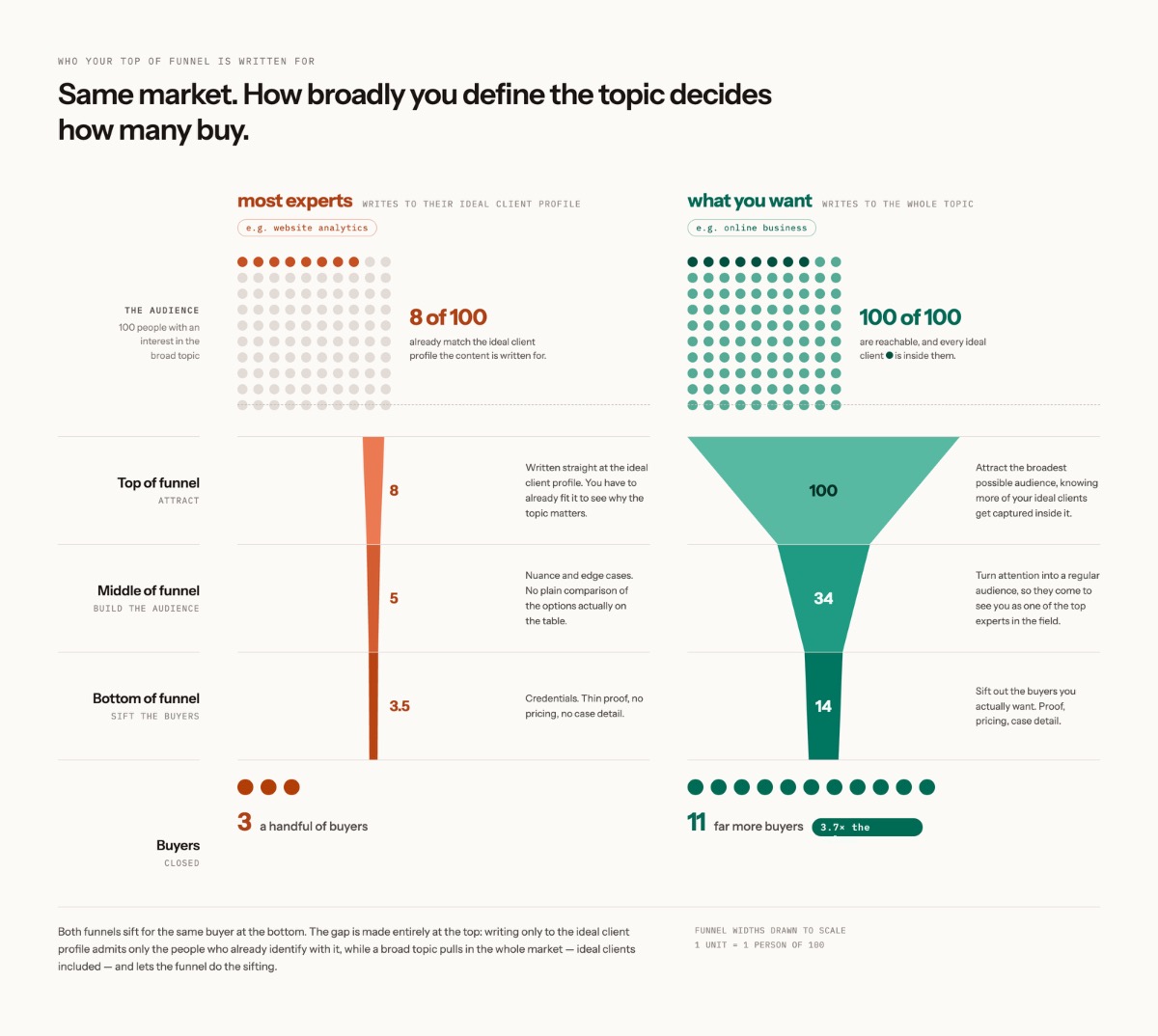
Below is what most expert content funnels look like when you draw them. A pipe with a slight flare at the top. Barely wider than the outlet.
What you want is a funnel that's enormously wide at the top with a small outlet at the bottom. The width is what gives the outlet something to filter.
How wide can the top get?
Wider than you think. I got sucked into an article about Rolex last week. It was talking about how their authorized dealers turn people away who are standing there ready to buy, and I'm reading this thinking about how much Rolex spends advertising around the world.
Seriously, I looked it up...
Rolex is the official timekeeper at Wimbledon and every other tennis major, plus every Masters 1000 event under those. They have The Open and the Ryder Cup in golf, along with junior tournaments nobody televises. They sponsor show jumping in Dublin, Rome, Geneva and Calgary. Their name is on the Argentine Open in polo, on ski racing, and on a 24 hour sports car race in Florida.
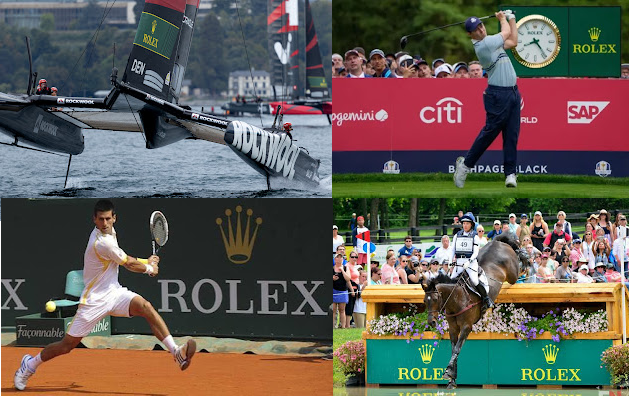
They only sell about a million watches a year.
Wimbledon, just the British broadcast, generated 267 million hours of viewing over two weeks. Add the rest of what they sponsor globally and you're somewhere north of two billion sets of eyes on the Rolex crown every year.
Why advertise to reach people who will never be able to buy?
Because to get people to spend a hefty premium on a watch, you've got to give them something far more valuable than keeping time... you give them status. And status only works if there's far more demand than supply. Rolex spends hundreds of millions annually to get 2 billion people to desire owning one of the million watches they'll sell.
Expertise works the same way. Simply solving a client's problem is equivalent to the manufacturing of a watch. It functions. But to get paid what you're worth (aka value based pricing) your clients have to believe you are the only expert for their situation. For a watch, this means status. For an expert it's called authority.
So what do you make content about to capture a broader audience?
Your expertise is narrow. It has to be, or nobody would pay for it. But this caps your audience at the people who already know they have the problem. You need a bigger subject that your buyers are already interested in, and there are three ways to find one.
Hiten went to the beginning of the niche. His buyers cared about site analytics, which is a small piece of a much bigger subject called doing business online. He made content for the bigger subject. Look at what your buyers had to be interested in before they could ever be interested in you, and go make content about that.
Some people find it by drawing a Venn diagram of three subjects they can speak to and working with the overlap. In practice the overlap is hard to land, though once you have it you'll never run out of things to publish.
The third way is to start narrow and climb. Alex Hormozi made sales and marketing content for private gym owners, then sales and marketing for businesses generally, and now he talks about running a business of any kind. You get your reps in front of an audience where you know the answers and widen as you gain traction.
Ask one question of everything you publish. How many people could possibly care about this?
If the answer is only your buyers, you already know what will happen to that content.
t
PS. Top of funnel puts you in front of people who've never heard of you. Next week is middle of funnel, where you turn them into an audience that looks forward to hearing from you. The week after that is bottom of funnel, where you find out which of them came to buy.
PPS. Read last week's email about how to monetize the broad audience that won't ever become a client.
0 comments