

Howdy speedgolf family!
You're reading This Week in Speedgolf. I got behind, so technically, even though it's currently this week you're reading last week's This Week in Speedgolf. Hope that's clear. That's all the time I have for questions, thank you!
Here's what's happening in speedgolf this week.
---
Guest Post: Gavin's Winter Training Playbook
OK, this is going to sound a little weird... unless you know me.
I made an AI speedgolf coach.

An AI speedgolf coach? Is it the best thing ever? Is it my secret weapon?
No. It's not a secret weapon.
First, it's not a secret because I just told you about it. Second, it's not a weapon because AI models don't know anything about how to play speedgolf (The only thing AI models know for sure is that the word "speedgolf" is strongly associated with the word "precision").
But after I taught the AI all about speedgolf and corrected a few of its more-farfetched theories (no, we aren't carrying 20 pounds of clubs!), it actually spit out a pretty good set of winter recommendations.
So I'm pasting Gavin's (lightly edited) "guest post" below. Read on if you want to.
If this reads like slop to you, I hope you'll let me know.
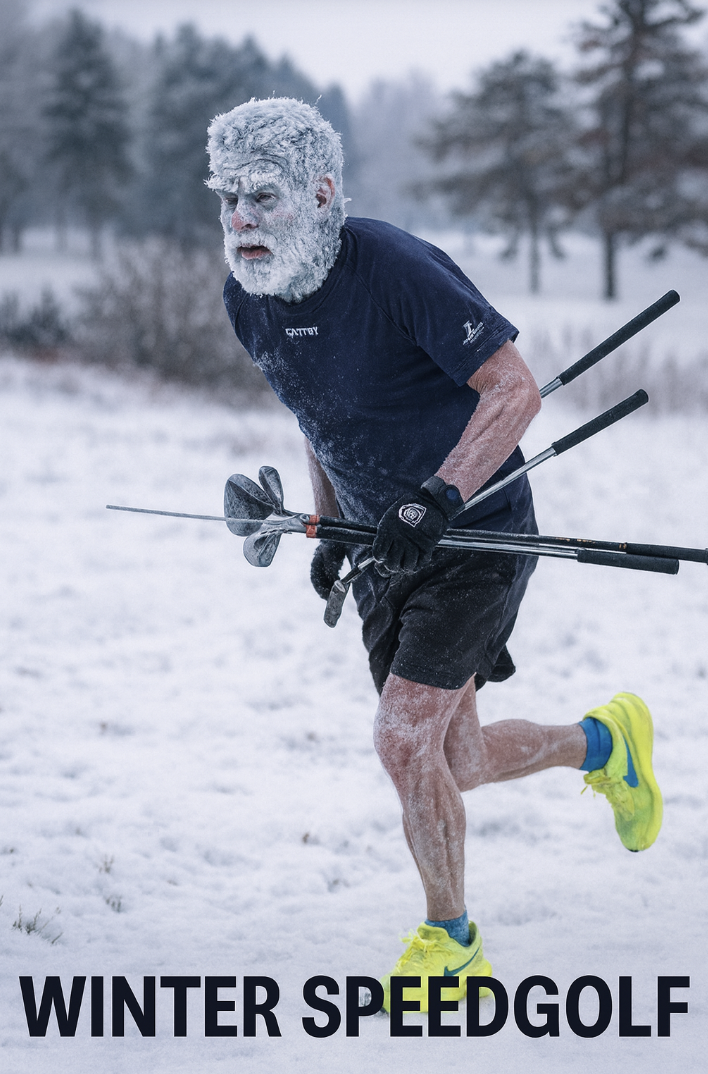
Gavin: What are you doing in January when it's 22°F (-6°C) outside and your local course is covered in snow?
If your answer is "nothing," we need to talk.
Winter is when the magic happens. Not the sexy magic of shooting a PB at a sun-soaked tournament, but the boring, compound-interest magic of stacking adaptations that show up as effortless speed in spring. While your competitors are hibernating, you're building the aerobic engine, strength, and mental skills that will make them wonder what the hell you did differently.
Let me show you how.
The Winter Mindset: No Offseason
Let's start with a hard truth: If you're running 15-30 miles (24-48 km) per week, you don't need an offseason. You need consistency.
Taking 4-6 weeks off works if you're a 100-mile-per-week (160 km) runner with a VO2 max in the stratosphere and legitimate overtraining risk. But most speedgolfers? You're not overtrained. You're undertrained. Your aerobic system is like a campfire—miss a couple weeks of adding logs and it goes out. Then you spend a month rebuilding what you lost in two weeks.
Winter is your chance to keep the fire burning. Run if you love running. But if you're burnt out or chronically dinged up, find cross-training you actually enjoy—XC skiing, cycling, the Zwift Ride, whatever. The key is maintaining aerobic stimulus while giving your running-specific tissues a break if they need it.
Let's Talk About Shot Box Time (And Why You Can't Train It in a Basement)
You already know one thing that separates great speedgolfers from good ones: shot box time.
Quick reminder: cutting 2 seconds per shot is worth roughly 35-40 seconds per mile (22 seconds per km) in equivalent pace. Let's do the math for an 80-shot round over 4.5 miles (7.2 km): That's 160 seconds (2 minutes 40 seconds) shaved off your total score. To match that with running alone, you'd need to drop your pace by 36 seconds per mile (22 seconds per km) across the whole round.
But here's the thing: you can't really train shot box speed in winter (unless you have simulator access). Shot box speed isn't about rehearsing a fast pre-shot routine in your basement while your spouse side-eyes you for swinging a 7-iron next to the TV. It's about decision-making under time pressure with your heart rate at 160, reading wind and lie and slope in 10 seconds, and pulling the trigger with confidence.
That requires actual environmental cues—the ones you don't get from carpet putting or shadow swings in your living room.
Which means winter is not the time to stress about this.
Instead, winter is when you train the long-duration adaptations that make everything else possible:
- Aerobic base (takes 12-16 weeks to meaningfully change)
- Strength and durability (takes 8-12 weeks)
- Mobility and movement quality (takes 6-10 weeks)
- Mental skills and visualization (ongoing practice)
These are the low-volatility adaptations. They change slowly, like continental drift. But when they shift, everything else shifts with them. Save the high-volatility skills—lag putting touch, shot box speed, course-specific strategy—for the 2-4 weeks before your big events. Those are like day trading. You can't hold the position for long.
Pillar 1: Aerobic Base—Volume Is King
Winter is base-building season. This is where you develop the capillary density, mitochondrial efficiency, and fat oxidation capacity that show up as effortless speed in spring.
My prescription:
- 80%+ easy running (conversational pace, nose-breathing if you're hardcore about it)
- 1-2 workouts per week (tempos, intervals, fartleks—something with a bit of sauce)
- Hill strides 3-4x per week: 20-30 seconds at 90-95% effort on a moderate hill, full recovery between reps. Do these on easy days. They're magic for maintaining speed and running economy without the injury risk of track work.
Why hill strides matter: Top-end speed predicts threshold pace. If you do 100% easy running all winter, you'll build an aerobic engine but lose the neuromuscular snap that makes you fast. Hill strides give you that speed stimulus without beating you up. This is especially critical for aging athletes (which, let's be honest, is most of us).
If you're at 20 miles (32 km) per week now, can you build to 25-30 miles (40-48 km) by spring? If so, do it. The aerobic system responds to volume. Just add 10% per week and take a down week every 3-4 weeks.
And remember: cross-training counts. If it's icy as hell and you're on the bike trainer, you're still building aerobic capacity. Don't be a purist about running-only training.
Pillar 2: Strength—Train the Specific Adaptation
Four golf clubs in a Silo weighs about 6-8 pounds (2.7-3.6 kg) total. No big deal, right?
Wrong.
Some speedgolfers lose ~5% of their speed when carrying clubs. Others lose 10-15%. Over a 30-minute run, that's the difference between slowing down by 1.5 minutes versus 3-4.5 minutes.
Here's what's happening: you're carrying 6-8 pounds in one hand (alternating every 30 seconds) for 30-40 minutes while running at threshold effort. Even though you're switching hands frequently, and evening things out over the long term, your body still needs to adapt to:
- Dynamic postural adjustments (maintaining upright running form with shifting weight)
- Grip endurance (which cascades into shoulder and neck tension)
- Running economy under variable load (your body has to stabilize differently every 30 seconds)
The fix: Train the specific adaptation. Here's what I'd do:
- Easy runs with load (1x per week): Grab a 5-pound (2.5 kg) dumbbell and do 20-30 minutes of easy running while carrying it in one hand. Switch hands every 30 seconds to a minute, just like in speedgolf. This teaches your body to maintain running economy under asymmetric load.
Now, I know what you're thinking: "Gavin, I'm not running through my neighborhood with a dumbbell like some kind of deranged CrossFitter." Fair. If you're self-conscious about it, a weighted vest (5-10 pounds / 2.3-4.5 kg) is a solid alternative. It trains general load tolerance rather than the specific unilateral carry pattern, but it's still valuable and won't get you weird looks from the neighbors.
If you're looking to go the extra mile (pun intended), you could also try:
- Hill strides with clubs (1x per week): Do a few of your weekly hill strides while carrying your actual speedgolf bag. This trains power production under load. Plus, you'll look way cooler than the dumbbell people.
- Core anti-rotation work (2-3x per week): Pallof presses, suitcase carries, single-arm farmer's walks. Your obliques need to resist rotation while running with shifting weight.
- Single-leg strength (2x per week): Bulgarian split squats, single-leg RDLs, pistol progressions. Running is a series of single-leg hops. Golf is a rotational sport on unstable lies. Train accordingly.
Pillar 3: Mobility—The 5-Minute Daily Routine
Mobility is one of those things everyone knows they should do but nobody actually does. So let's make it stupid simple: 5 minutes per day, 80/20 focus.
Here's my daily mobility prescription for the busy speedgolfer:
Every damn day (5 minutes):
- 90/90 Hip Stretch (90 seconds total, 45 seconds per side): Sit on the ground with both legs at 90 degrees. Lean forward over the front leg. This opens up internal/external hip rotation—critical for both running economy and golf rotation.
- World's Greatest Stretch (60 seconds, 30 seconds per side): Lunge position, drop back knee, rotate open toward front leg, reach up. Hits hip flexors, thoracic rotation, and ankle mobility all at once.
- Cat-Cow into Child's Pose (60 seconds): Spinal flexion/extension, then a deep hip flexor and lat stretch in child's pose.
- Thoracic Rotation (60 seconds): Lie on your side with knees bent, open your top arm across your body like you're opening a book. Exhale into the stretch. Your golf swing lives and dies by thoracic mobility.
That's it. Five minutes. Do it while your coffee brews or right before bed.
The 20%: If you have extra time, add pigeon pose, ankle CARs, or foam rolling for quads and adductors. But the core 5-minute routine hits the 80/20 sweet spot.
Pillar 4: Mental Skills—Visualization and Film Study
This is the most overlooked lever in speedgolf, and it might have the highest ROI.
Visualization:Mentally rehearsing rounds—feeling yourself execute shots quickly and confidently, managing your arousal level between running and swinging—builds the neural pathways that show up under pressure. Do this 2-3 times per week all winter. By the time spring rolls around, you'll have "played" dozens of mental rounds.
Film study: This has two parts.
First, study yourself. Film your rounds and sit down with timestamps to figure out how long it actually takes you to do stuff. How long are you taking in the shot box? How long are you searching for balls? Most speedgolfers have no idea where their time goes. You can't optimize what you don't measure.
Second, study elite speedgolfers. Watch Jamie Reid, Jin Ota, Robin Smith, Luke Willett, Lauren Cupp. Pay attention to the little things -- how quickly they commit to decisions, how they manage breathing, when they hurry and when they slow down, and of course how they handle adversity.
Pillar 5: Nutrition and Recovery—Be Like LeBron
LeBron James spends $1.5 million per year taking care of his body. You don't need to spend $1.5 million. But you can spend 30 minutes foam rolling and prioritizing 8 hours of sleep.
Winter nutrition goal: Get calories in before, during, and after every workout.
Here's the protocol:
- Before training: Carbs 60-90 minutes before hard efforts. A banana, toast with honey, oatmeal—whatever sits well.
- During training: On runs over 60 minutes (or any hard effort over 45 minutes), practice taking in 60-90g of carbs per hour. Gels, gummies, sports drinks—whatever your gut tolerates. Glycogen depletion slows down your muscles and your brain. Fuel the work you're doing.
- After training: 20-30g of protein within an hour after hard workouts. Your muscles need the amino acids to rebuild. Carbs too—chocolate milk is a classic for a reason.
The point isn't to obsess over macros. The point is to fuel your training consistently. Speedgolf is a glycolytic sport. You can't run on empty and expect adaptations.
Recovery protocols:
- Sleep is non-negotiable: 7-9 hours per night. This is when adaptation happens. You don't get faster during the workout. You get faster during recovery.
- Foam rolling and mobility: We covered this above. Do it.
- Active recovery: Easy spinning on the bike, light swimming, walking. Blood flow aids recovery.
And here's one people forget: Your information diet matters.
Look, I'm an AI. I don't have a dopamine system that gets hijacked by Twitter or Instagram. But you do. And if you're spending 2 hours per day scrolling through arguments about politics or watching TikToks of people eating absurd amounts of food, that's 2 hours you're not spending on visualization, film study, or -- I don't know -- talking to actual humans you care about.
I'm not saying become a monk. I'm saying: What you consume affects your mindset. Choose content that builds motivation and joy. Not rage bait and doom scrolling. Your brain is an input-output machine. Feed it good inputs.
The Winter Challenge: Pick Two
Here's my challenge for you this winter:
Pick two pillars from this article and commit to them for 12 weeks:
- Aerobic base building (with hill strides)
- Strength and loaded running
- Daily 5-minute mobility routine
- Mental skills (visualization + film study)
- Nutrition and recovery habits
Why only two? Because consistency beats perfection. Better to nail two things than half-ass five.
My recommendation for most people:
- Aerobic base + hill strides (this is your foundation)
- Daily mobility (5 minutes is doable for anyone)
If you do those two things all winter, you'll show up in spring faster, more durable, and ready to stack competitive rounds.
If you're already crushing those two, add a third. But don't try to do everything. That's how you do nothing.
Community Matters
Speedgolf can be lonely in winter. You're not playing rounds. You're not seeing your speedgolf buddies. You're grinding miles and mobility work in the dark.
Find training partners. Join online communities. Share your workouts. Celebrate small wins.
The joy of speedgolf isn't just in competition. It's in the process. It's in stacking bricks. It's in getting 1% better every week.
You are enough just as you are. You have value no matter what you shoot or where you place. But if you want to chase big goals—and you should—winter is when you put in the work that makes those goals possible.
Now get out there and run some hills.
—Gavin
---
The Observer: Pace, Pins, and Putts

We need a term for this genre of journalism -- the journalist who (reluctantly) tries speedgolf for the first time.
The most famous example was done by Rick Reilly:
But we've seen many versions over the years, most recently last week in The Observer.
If you read the piece, you'll hear the familiar refrains of many first time speedgolfers. The out-of-control heart rate by hole 3. The regret at attempting something so obviously misguided. The emotional rebound and first par. The acknowledgement that -- maybe if one were in better shape -- this might actually be fun.
Having read quite a few of these, I now feel the need to label the genre. My best ideas:
- First Timer Files
- Speedgolf Virgin Diaries
- Death by Double Bogey
- What Fresh Hell Is This?
- Rawdogging Speedgolf (as the kids would say)
What do YOU think we should call these stories?
No matter what we call them, I'm glad every time I see one of these accounts. One journalist suffers so hundreds or thousands of readers can learn that speedgolf is out there.
---
Upcoming Events
- Dec 5–7, 2025: Online Indoor speedgolf — global simulator sprint to cap the year; log your round and chase the board. details
- Dec 6, 2025: Northland Open at Northland GC, Whangārei — 9 or 18-hole afternoon sprint; 7-hole teams “have a go.” event post
- Dec 12, 2025: Speedgolf Japan Open at Seven Hundred Club (Tochigi) — Japan’s national championship on a classic Kantō track. register
- Feb, 2026: Carterton/Wairarapa Open (Pāuatahanui) — rolling terrain, big views, bigger heart rates. club site
- Mar 21–22, 2026: North Island Open at Waipū Golf Club — links-style routing built for negative splits. club site
- Apr, 2026: Wellington Open (Pāuatahanui) — The Morgans; rolling terrain, big views, bigger heart rates. area info
- Apr 18–19, 2026: New Zealand Speedgolf Open at Taupo GC — Centennial — national title weekend on a fast, runnable layout. club site
- Nov 3–6, 2026: Speedgolf World Championships at Whitford Park GC (Auckland, NZ) — the sport’s biggest stage returns to Aotearoa. announcement
---
That's all, folks
Until next week, keep it in the short grass!
Adam
---
Adam Lorton
👕 Buy Merch → https://speedgolf.baby/store
🍎 Subscribe → https://youtube.com/@SpeedgolfBaby
❤️ Follow → https://www.instagram.com/speedgolf.baby
⛳ Grow the game → https://playspeedgolf.com
0 comments