

Hi friends,
As I suspected, I don't have childcare coverage for bedtime tomorrow, so I won't be able to lead Satsang on New Years Eve. Usually when I can't make it folks have been meeting anyway to meditate and share Dharma conversation, but I wonder if given the holiday most folks will be out anyway.
Let us know in the comments under the FB post if you would like to gather, and I'll see if there's a quorum. If not, I'll just suggest we break for the week and resume next Tuesday the 7th.
Blessings for a safe and joyful Christian new year! (...  see last week's post below about the global dominance of Christian holidays...)
With mettā,
Sean
From Satsang, Tue 12.24.24
Being a Post-Christian Buddhist
It is, of course, Christmas week, not just for Christians, but for many, many folks in the world who don't personally practice the Christian faith. For instance, I just had three days off work from my Buddhist meditation center employer even though these days are not special in Buddhism. So... thank you! But this indicates something about the way Christianity has come to dominate the world beyond its own faithful. The force of Christian influence in our culture is extraordinary, and while in my very secular coastal bubble it feels like it's on the decline, it is very much in power in much of the rest of the country, and in huge parts of the world.
I was raised Catholic, and converted to Buddhism in my early 20s as I found a far more relevant and coherent psychology for myself and my social views there, and a more effective core ritual and body of practice. One of the main complexities in western Buddhism is between folks who were raised in Buddhist families and communities and those who convert. This is especially prominent in the Americas and Europe, where widespread Buddhism is only 150 years old or so, but Buddhism has always been full of converts, from the very beginning.
The Buddha made a point of evangelizing groups of ascetics by debating their teachers, and most of the early followers of the Buddha had previously been followers of other spiritual disciplines. And everywhere the tradition went, it competed against local faiths, creating tensions, assimilating, differentiating, and everything in between. Everywhere it went, it changed the culture as folks adopted its extraordinary perspective on life and death.
This is a religion built to convert into—the core ideas are both compatible with many different cultural perspectives and at the same time alien to all of them in similar ways. Renunciation and letting go are radical pretty much everywhere.
But being a convert Buddhist in a Christian culture creates very specific tensions. As an example, Christianity has at its heart an idea of history in which both our individual lives and the historical arc of our species drive toward final judgment and an end to time. American Christianity at the moment has very strong End Times tendencies. This isn't just abstract theology. Ideas that the world is nearing its end actively affect politics and social movements in the U.S., and the officially secular nature of our democracy is belied by the fervor with which nearly everyone in our government professes passionate Christian faith. How might a Buddhist understanding of time and life as endlessly circular interact with this kind of apocalyptic view of purpose and imperative? Salvation by the intercession of Jesus is core to the apocalyptic narrative, so even if we participate in Christmas in a completely secular way—which of course lots of folks do without internal conflict—it is still a Christian holiday celebrating a Messiah who in many Christian traditions is meant to return at the end of time to battle Satan and save the souls of true believers.
The practices of Buddhist meditation and ritual are inseparable from the religious understanding they are meant to support. The Christian world recognizes this more clearly than many folks outside Christianity do, which is why there's been backlash against even "secular" mindfulness. If you can relieve your own suffering through recognizing and uprooting its sources in your own views and clinging, what role does Jesus have? The individual empowerment at the heart of the Buddha's message is directly at odds with the core message of Christianity that only Jesus saves—you can't save yourself.
There is of course beautiful interfaith work happening between Christian mystical teachers and Buddhist teachers, and with even a bit of non-dual insight, the theologies can be brought into some alignment, but they remain substantially different views of life, death, and meaning. And I think highlighting the differences rather than stretching to find convergence points supports Buddhist converts to bring more specificity to our practice and strengthen our understanding of the distinctive view of the Four Noble Truths and the principle of kamma.
Buddhism is an outsider religion here, as it has been many times in its history. Its core views and practices are still radical, and it takes determination to hold the radical view of the Dhamma in the face of omnipresent Christian norms. We can really see this in Buddhist meditative practice. When religions become mainstream, their practices evolve to keep them acceptable with the mainstream, even though all religions started with more extreme practices. And since Christianity is the mainstream here, Buddhist meditation has started to take on Christian influences, particularly in how individual psychology and self-judgment has become so central. In some places mindfulness has become so mainstream that its meditations have almost completely dissolved into conventional pop psychology.
At the same time, it is still young in the Americas, and being filled with lots of converts it still has a lot of edgy, difficult practice in it, to its credit. Awakening isn't easy, and the intensity of Buddhism's deep meditations and trance rituals can still be felt, even as surface approaches to mindfulness and emotional intelligence based in the Dhamma are seeping into every level of the culture.
Meditation: Mettā to Classes of Beings
Talk: Being a Post-Christian Buddhist
Teaching Schedule
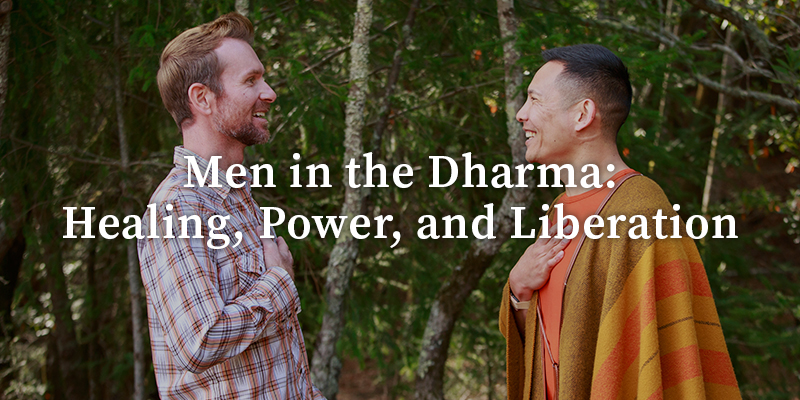
Men in the Dharma: Healing, Power, and Liberation
Spirit Rock: Class Series for Men
5 Thursdays, Jan 9 – Feb 6, 2025 | 7-8:30pm PT | Online
Dāna & Volunteering
Our ability to offer as much as we can in this beautiful tradition of gift economy depends on your support. If you have the means to support our Saṅgha financially, please do so. Your gifts make scholarships possible for those with less resources to attend retreat, support our preservation of the teaching archive on YouTube and a podcast (coming soon!), and make it possible for us to offer everything we do as accessibly as possible.
In addition to monetary gifts, consider the gift of your time as a volunteer for the Saṅgha. Volunteer work, called sevā, or "service," is a powerful and subtle practice that builds community, creates connection, and helps make the Saṅgha a spiritual home, not just a venue for teaching events. We are expanding our volunteer group, and looking for help with a number of administrative projects, including visual design, website maintenance, retreat management, and outreach. Email us if you're interested in volunteering.
Ongoing Saṅgha Spaces
Tuesdays 7:30-9pm (Pacific), weekly
Meditation, talk, discussion
Book Club: Read the Dīgha Nikāya, the Long Discourses of the Buddha
Fridays 8:30-10am (Pacific), monthly
Talk, inquiry, discussion
Next session: Jan 17
Saṅgha Facebook group
Recordings, discussion, Q & A
All are welcome
May our practice be of benefit to all.
0 comments