

Friends,
I haven't gotten to do deeper writing for a while, so I'm going to try out a new format for these emails, with short excerpts from recent talks instead of longer personal notes, plus reminders for the Book Club and other events. I'll still send out a longer note whenever one wants to emerge.
Blessings to each of you in all your turnings, and our sweet world so full with beauty, horror, and change.
Mettā always,
Sean
Tonight at Satsang, Tue 5.5.26
Transpersonal Positive Regard
Let's think of the brahmavihāras (the divine abodes of friendliness, compassion, joy, and equanimity) as aspects of "unconditional positive regard"—the phrase coined by psychologist Carl Rogers to describe the judgement-free supportive environment most conducive for healing.
The heart of the brahmavihāras is to make this feeling universal, beyond liking and disliking, personal or group relatedness, or other affinities. So let's call it "transpersonal."
Seen in this way, the BVs are less about healing our individual attachment patterns or our preferential ego states as regards other people, but transcending our ego preferences and states entirely. In a not-spiritually-bypassing way, of course.
How do we do this? And why would we want to?
The Fractal Body
From Satsang, Tue 3.24.26
My proposal is that we think about each layer of the social system as a kind of body, and they all operate in similar ways, like a fractal: the individual, the family, the community, the culture, the species. Each one of them you could think of as a body or a kind of individual. That individual has dukkha (pain, suffering, distress). It has patterns (kamma), and those patterns can be contained and resisted through restraint, understood and processed through inquiry, and finally come to rest in a shifting of the deep worldview. I use R.I.P. for this: Restraint (sīla), Inquiry (samādhi), Peace (pañña).
Part of what I think is interesting about doing this inquiry at the cultural level is that it can help us to not externalize the ailment onto a few corrupt individuals or one terrible political party. It's really easy to say: we're the good, democratically-oriented folks, and they're the bad, fascistically-oriented folks. That's a little bit like saying, in my internal body, I'm the good superego that believes in justice and fairness, and there's my bad id trying to take power. But it's all me. And I want to have compassion for the part that is speaking harshly. Before I can disidentify with it—see it as not my self (anatta)—I have to own it as my material to work with, my dukkha.
I think that's true at every level of the system. A lot of beautiful cultural work happens when we see the whole cultural body as a system, rather than saying there's bad guys and good guys. We say: what's the dynamic here? That's the inquiry piece. Of course there has to be restraint as needed: laws, social norms, shame, morality of many kinds. But the pattern is only really unwoven with inquiry.
What are the ways, as a larger culture, that we do inquiry? How do we come to understand what's happening? Part of this is the work of public intellectuals: books and shows and podcasts that look at a problem and really unpack it; free journalism, free speech. If we're going to do inquiry into the sources of collective traumas, we have to be able to talk about them, discuss them, investigate them, know their history, know where they came from. Understanding in the cultural body means sharing narratives.
Another part of inquiry is similar to how I can't just understand intellectually where my internal hateful self-talk came from, or any other individual harmful pattern. There has to be a felt, transformative experience of understanding. There has to be an emotional quality to it.
Notice the places at the largest cultural level where there have really been shifts in understanding and narrative. There are ideas that were once contentious that have now become normative. To the extent that chattel slavery is broadly unacceptable in a way that 150 years ago it was broadly acceptable, that's a shift toward peace based in understanding the suffering of a certain kind of action. First the harm was named by activists, then restrained by law, then understood emotionally through passionate investment and the spreading of the narrative, and finally the new wisdom became a kind of norm—even if a fragile one, and the work not yet done. That's what we're looking for.
Think about the cultural body as a body that practices the Dhamma. When the whole culture becomes mindful of something, what does that mean? When everybody suddenly becomes aware of a thing, something surfaces in the whole system that then has the potential to shift. Deeper change doesn't happen fast, but that's true in us as individuals too.
Rest In Peace to all painful systems on all levels, in all fractal expressions of our being.
Meditation: Awareness of the Senses Through the Whole Body
Talk: Healing Cultural Saṇkhāras: Tyranny, Oppression... Fascism, part 1
Upcoming at the Book Club
The Verses of the Elder Nuns (Therīgāthā)
Next session: May 29, 8:30-10am PT
The new Book Club series is focusing on the verses and stories of the Elder Nuns, the Therīgāthā, using Susan Murcott's beautiful book First Buddhist Women alongside the Sutta Central translations. Murcott is a wonderful feminist scholar and translator, and we're reading her stories and commentary alongside the verses themselves, and some relevant other discourses about the first bhikkhunīs.
The book club is included in Saṅgha membership and it's a lovely, smaller gathering. The reading is usually light, and no worries if you don't get to it. We do a short meditation, I talk through a text, and we have time for discussion and sharing. All Saṅgha members are welcome at the book club, and dropping in is fine.
This month's reading is about Paṭācārā, whose story is one of the most affecting in the canon. She was a layperson who lost her entire family, including her husband and two children in a series of terrible accidents, and was driven mad by grief. Encountering the Buddha she finds the way through this terrible trauma and becomes revered for her effort and power in practice.

Join us in spiritual friendship.
We need community, and safe spaces for spiritual practice, now more than ever if we are to find strength and wisdom to act in service of collective well-being. In an age of dislocation, isolation, and overwhelm, coming together with sincere practitioners and seekers of true peace may be one of the most radical things we can do.
Our saṅgha—spiritual community—is an ongoing group of practitioners from around the world who gather weekly on Tuesday nights and monthly for a Friday morning book club.
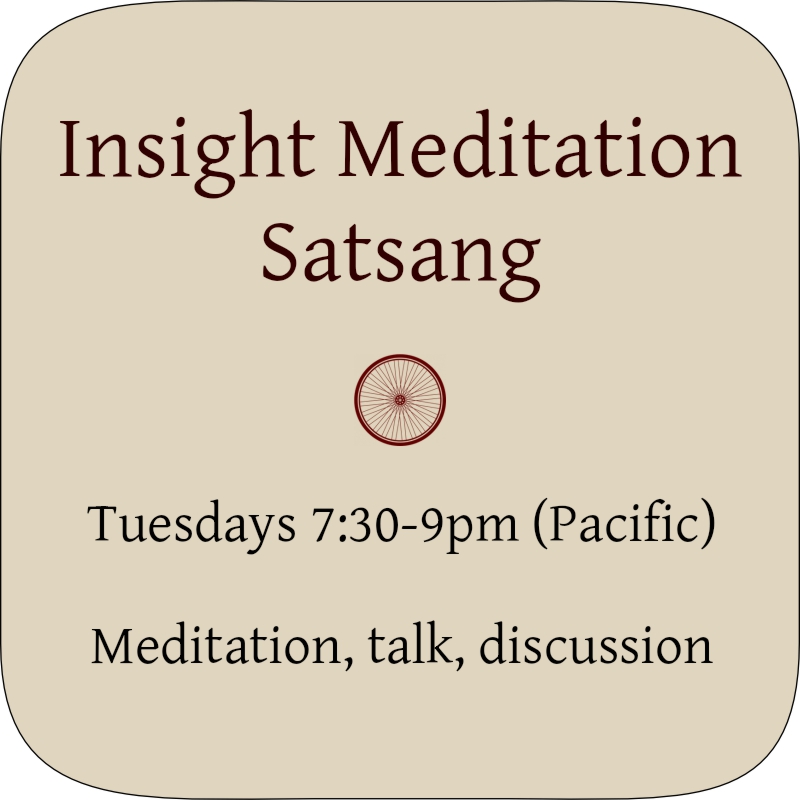

All are welcome, and we offer Saṅgha access always on Gift Economy (dāna), with accessibility and inclusivity our core commitment.
Enjoy a Free Meditation Course
Setting Out on the Path: 30 Days to Begin or Renew Your Practice aims to get you back on the cushion in a way that’s pleasurable, sustainable, and nourishing for your path.
0 comments