How to Introduce Kukoo Montessori Toys to a Baby Who Ignores Everything
You set the toy down. Your baby glances at it for half a second, then turns to stare at the wall — or worse, tries to eat the shelf.
Sound familiar? If you've carefully chosen a beautiful wooden Montessori toy and your baby completely ignored it, the instinct is to assume you did something wrong. You didn't. What you're seeing is completely normal infant behavior, and there's a simple framework for working with it instead of against it.
Here's what's actually going on — and how to introduce Montessori materials in a way that meets your baby where they are.
Is it normal for babies to ignore Montessori toys?
Yes — and it's actually a sign their brain is working exactly as it should. Babies under 6 months are still developing the hand-eye coordination and sustained focus needed to interact with a physical object intentionally. Before that window, they're mostly processing sensory input: light, sound, faces, your voice.
What looks like ignoring is often your baby doing something else entirely — absorbing their environment, tracking movement at the edge of their vision, or simply winding down. Dr. Maria Montessori called this the "absorbent mind": the idea that very young children take in everything around them, even when it doesn't look like active learning from the outside.
This is why the Montessori approach for infants focuses on observation before intervention — watching what your baby naturally reaches for before deciding what to offer.
What age do babies actually start engaging with Montessori toys?
There's a wide range here, and most guides don't break it down enough. The honest picture by age:
0–3 months: Your baby isn't ignoring toys — they genuinely can't interact with them yet. Visual contrast (black and white patterns), gentle sound (soft rattles), and your face are the most meaningful "materials" at this stage. Hanging a simple object mobile above their play mat is appropriate; expecting them to reach for a toy is not.
3–6 months: Grasping starts. Simple rattles, wooden rings, and teethers become interesting because your baby can finally hold something. Expect 2–5 minutes of engagement — that's a full session, not a failure.
6–9 months: Cause-and-effect begins to click. A ball that rolls away, a container that makes a sound when shaken — these become genuinely captivating because your baby is starting to understand they made that happen. This is when object permanence starts to emerge too, which is why peek-a-boo becomes endlessly amusing.
9–12 months: Independent problem-solving arrives. Simple puzzles, stacking rings, nesting cups — these match where your baby's brain actually is. Expect focused bursts of 5–10 minutes, interrupted by movement.
If your baby is in the 0–3 month window and ignoring everything except your face, you're not behind. You're on schedule.
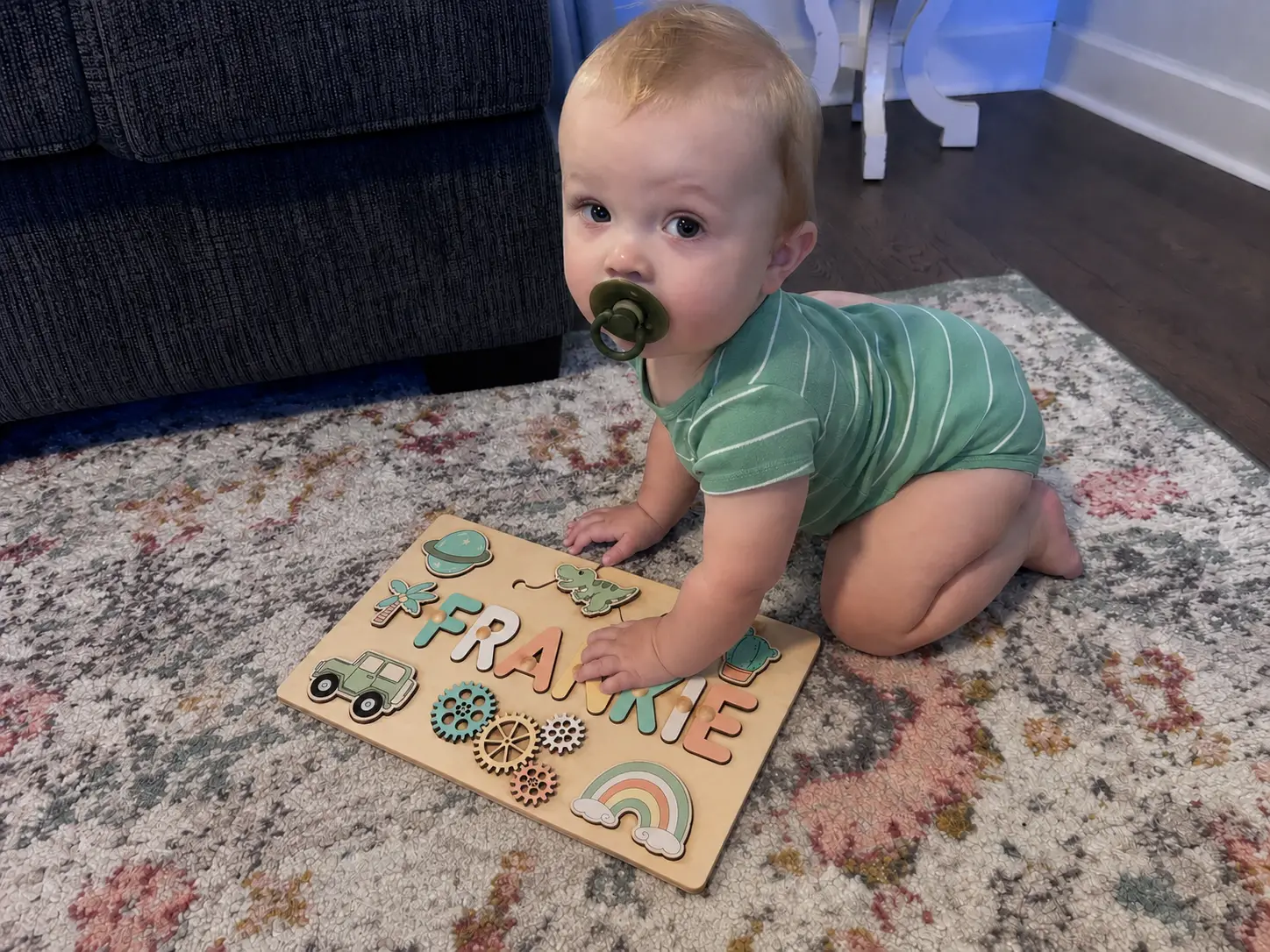
Why does my baby seem bored even when I offer new toys?
The most common culprit isn't the toys — it's the environment. When too many objects are visible at once, babies (like adults) experience a kind of decision fatigue. The Montessori principle of the prepared environment isn't just aesthetic philosophy; it's a practical tool for focus.
One parent who reached out to the Kukoo Montessori community described putting twelve toys on a low shelf "so my baby would have choices." The result: her daughter would look at the shelf, then crawl away to investigate the laundry basket instead. When she reduced the shelf to three items, her daughter sat and worked with each one for nearly ten minutes straight.
What to try: Limit the visible play space to 3–5 objects at most. Rotate what's available every week or two rather than keeping everything out. Less isn't deprivation — it's a condition for deeper engagement.
How do I actually introduce a new Montessori toy without it being ignored?
The introduction matters. Babies learn through observation — they watch you before they try something themselves. This is the "three-period lesson" in Montessori practice, simplified for infants: show before you expect.
A gentle introduction sequence that works:
1. Sit at their level. Get on the floor, not looming over. Your baby's attention goes where your attention goes.
2. Handle the toy yourself first. Pick it up, turn it over, tap it gently. Don't say much — let the object speak. Babies this age are wired to imitate; what you show interest in, they become curious about.
3. Place it within easy reach, then step back. Don't put it in their hand. Don't wiggle it at them. Set it down 6–10 inches away and wait. That gap creates the motivation to reach.
4. Let them explore without commentary. Resist the urge to narrate everything ("look at the rattle, it makes a sound!"). Narration is wonderful, but constant verbal input can actually interrupt the internal focus your baby is building.
5. End before they're done. If your baby is still engaged, gently transition away from the toy rather than waiting until they've lost interest entirely. This keeps the association positive.
Does the type of toy actually matter, or is any toy fine?
It matters more than most parents expect. The specific quality that makes a Montessori material effective is control of error — meaning the toy gives the child honest feedback without needing an adult to step in.
A stacking ring that doesn't stack unless the sizes are right tells your baby something is off. A shape sorter that won't accept the wrong shape teaches through the object itself. Compare that to a toy that plays music any time it's touched regardless of what your baby does — there's no feedback loop, and therefore no learning structure.
Research highlighted by Kukoo Montessori's work on hands-on learning reinforces this: the physical manipulation of objects — touching, mouthing, banging, transferring — is how babies under 12 months build the neural pathways that later support language, problem-solving, and self-regulation. A toy that removes that manipulation loop (by doing the "interesting" part for the child) removes the learning.
What this looks like practically:
- Natural wood over plastic — the weight and texture give honest sensory information
- Single-purpose over multi-feature — one skill at a time supports deeper focus
- Open-ended over prescriptive — a ball can become many things; a toy that only makes one sound cannot
What if my baby only wants to mouth or throw the toy?
That IS engagement. Mouthing is a primary sensory exploration tool for babies under 12 months — your baby isn't dismissing the toy, they're running a full sensory analysis on it. Temperature, texture, weight, taste (yes, taste) — these are all data points their brain is collecting.
Throwing and dropping is the same logic, but for cause-and-effect. Between 9 and 12 months, many babies enter what Montessori educators sometimes call the "dropping phase" — tossing things off the high chair tray repeatedly. This is genuinely purposeful: they're testing whether gravity is consistent. (It is. They're checking.)
The right response to both behaviors is calm observation, not redirection. If the toy is safe for mouthing, let them mouth it. If they drop it, hand it back once or twice before gently moving on. Your calm signals that the exploration is welcome.
How long should I expect a baby to play with a Montessori toy before they're "done"?
Much shorter than you'd think — and this is where a lot of parents interpret normal behavior as failure.
Attention spans by age:
- 3–6 months: 2–4 minutes per object
- 6–9 months: 4–8 minutes
- 9–12 months: 6–12 minutes, sometimes longer with a highly engaging activity
A baby who engages with a toy for 3 minutes and then moves on is not bored — they completed the work. The Montessori view is that these brief but focused cycles are the building blocks of longer concentration later. You don't train attention span by forcing longer sessions; you build it by respecting the natural cycles and letting them end cleanly.
What you're aiming for is quality of engagement, not duration. A baby who deeply focuses on a wooden ring for four minutes, turning it over and mouthing the edge, is getting more out of that session than one who half-looks at a noisy electronic toy for twenty.
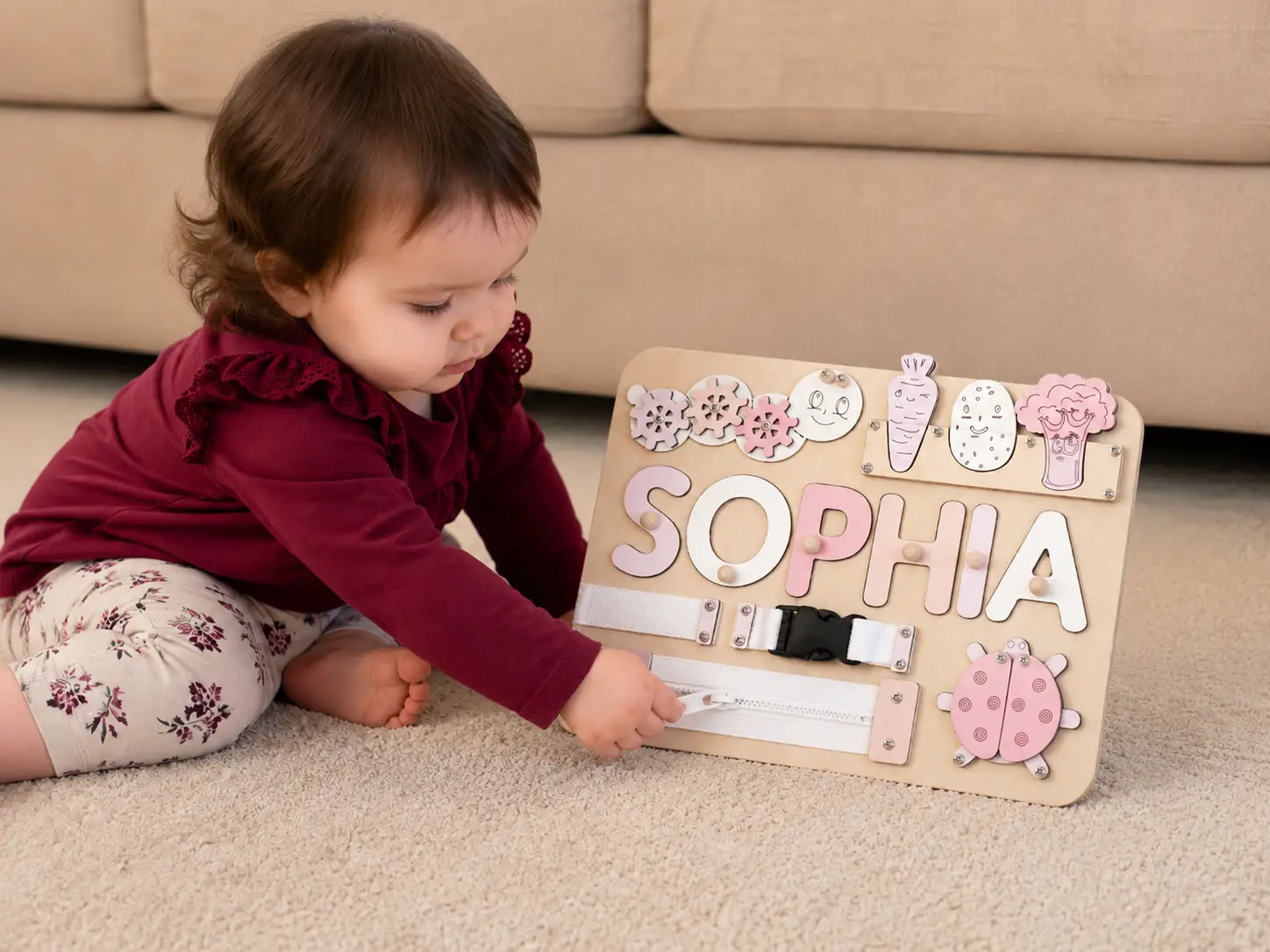
What if nothing is working — my baby just seems uninterested in objects altogether?
First: breathe. Most babies in the 0–6 month range are far more interested in faces and voices than in any object, however beautiful. That's developmentally correct.
If your baby is past 6 months and genuinely showing no interest in reaching for or exploring objects, it may be worth a conversation with your pediatrician — not because something is necessarily wrong, but because they can assess whether sensory processing or motor development factors are worth looking at. The Zero to Three organization has useful milestone resources if you're trying to calibrate what's typical.
For most babies, though, the answer is simpler: meet them where they are. If objects aren't interesting yet, lean into what IS — your face, simple songs, gentle movement. The objects will become interesting when the developmental readiness arrives.
Some parents in the this parent community have found that their baby's first real engagement happened not with a planned "play session," but mid-routine — during tummy time, or while waiting for a diaper change, when a wooden ring happened to be within reach and nothing else was competing for attention. Removing the pressure — and the performance — often unlocks the curiosity.
[IMAGE: Parent and baby doing tummy time together, wooden toy placed near baby's hands, casual home setting]
Common mistakes parents make when introducing Montessori toys
Offering too many at once. Three to five visible activities, rotated regularly, is the sweet spot. More creates overwhelm.
Staying too close during play. Your proximity can actually inhibit exploration — your baby may default to watching you rather than engaging with the toy. Try positioning yourself a few feet away, present but not hovering.
Swapping too quickly. If a toy gets one session of no interest, it doesn't mean it's wrong for your baby. Try it again three or four times over a week or two. Readiness can shift quickly at this age.
Introducing toys when the window is wrong. Overtired, hungry, overstimulated babies will ignore everything. The 15–20 minutes after a nap and a feed, when your baby is alert and calm, is when the magic happens.
Expecting silent focus from a baby who needs movement. Some babies explore while crawling around a toy, not while sitting still in front of it. Engagement doesn't always look like stillness.
FAQ
Why does my baby prefer the box over the Montessori toy? The box has more honest sensory variety — it crinkles, folds, tears, fits over things. Your baby isn't rejecting the toy; they're drawn to whatever offers the most interesting feedback in that moment. This is actually very Montessori in spirit. Rotate the toy back in a few days.
How many Montessori toys does a baby actually need? Fewer than you think. A well-chosen set of 4–6 age-appropriate activities, rotated every 1–2 weeks, is sufficient for most babies 0–12 months. The goal is depth of engagement, not variety of options.
Can I do Montessori with my baby if I don't have a designated playroom? Absolutely. A low shelf (or even a cleared corner of a room), a small mat on the floor, and 3 appropriate objects is a complete prepared environment for a baby. The philosophy scales to any home.
Is it okay to play WITH my baby using Montessori toys, or should I leave them to explore alone? Both have a place. Shared play — especially showing your baby how to handle a toy through your own calm exploration — is a legitimate and important part of Montessori in the early months. Independent exploration grows as your baby develops confidence. Neither is "more Montessori" than the other.
My baby is 10 months and only wants to pull up on furniture. Are Montessori toys even relevant right now? Yes — but adjust what you offer. Floor-level activities that your baby can access while standing or cruising (a ball they can push, a simple peg puzzle at low height) work with the movement rather than against it. Gross motor development and fine motor development happen simultaneously; honoring both is very much in line with Montessori principles.
If your baby has been ignoring everything you offer, the most useful reframe is this: they're not ignoring — they're not ready yet, or the conditions weren't quite right. That's a much easier problem to work with.
The team behind Kukoo Montessori built every toy in their collection around exactly this principle — materials that wait patiently for readiness, then reward it fully when it arrives. No batteries needed. No performance required.
And if you're looking for where to start: the 6–12 month window is when most babies show their first real, sustained engagement with Montessori objects. A simple grasping toy, a single wooden stacker, and a soft ball on a low shelf — that's all you need.
Some parents find it helpful to connect with other families navigating the same learning curve — spaces like findaspring.org parent communities can offer honest, peer-level perspective that's harder to find in a product guide.
The wall your baby is staring at right now? It'll still be there tomorrow. The wooden toy, waiting patiently on the shelf — that's when things get interesting. ❤️