Manhattan Modelers | August 2025 Newsletter
Aug 04, 2025 8:06 pm

Newsletter | August 2025
Hello Manhattan Modeler,
This year has flown by so fast for me I didn’t have a chance of getting this newsletter out in a timely way. A result is that some of these articles seem a bit old. I have become very interested in layout operations and have been doing as much of that as I can. I have found that actually operating these model train layouts have clarified what I want to do with my own layout.
My train club, the NYSME had their month-long spring open house, and I think I only made it to one weekend. Already there is talk about the winter open house. Time marches on. Some of the other events that took up my time were planned and others not.
At the end of February mentally I was riding high from what I thought was a wonderful February Manhattan Modelers Meeting in the Bronx. Hosted by the ever-gracious Phil Monat we had a great time. We had a great turnout with 16 members to view this incredible layout.
My father had a real health scare that required me to drop everything and go down to spend time helping my parents. I was able to replace two broken toilets, help donate many boxes of books to their local library, organize a wheelchair ramp installation and the goal is to get them moved to near my sister in New Jersey within this year. A big project.
I have wanted to organize a trip to the Danbury Railroad Museum for the group to see the NYC electrics. Also, I think it would be great to see the SONO switch tower museum. I have found I am just not organized enough to get this ball rolling. Some kind of mental block is keeping me off balance. So instead of just pushing back this newsletter further and further back. I want to get it out. So as a result, no planned trips are included in this newsletter.
Expect another newsletter soon. I have one mostly written. I can’t promise a planned trip. In any given weekend, I can’t really devote more than one day to my hobby, or my family would stop recognizing me. Lol.
I hope you have a chance to take a break and maybe some travel. Have a great rest of your summer.
-Andy Estep

As always, if anyone has an article that you think would be interesting to other Manhattan Modelers members I would love to include it in the next newsletter.
Would there be interest in making some Free-Mo type Modules?
I have been looking at Free-Mo HO or N modules for a while and I like the concept. Would anyone else be interested in making a module or two. It would be nice to have something to take around and display. I have found a few places around the city that would be happy to display some of our models. It would be nice to have an operable layout section to show. I would be happy to discuss the idea.
I am about to start building an N scale Ttrak module of the section of the High Line between 23rd and 24th streets with the two ended siding. If anyone else was interested maybe we could make more of it.
Please email me [email protected]
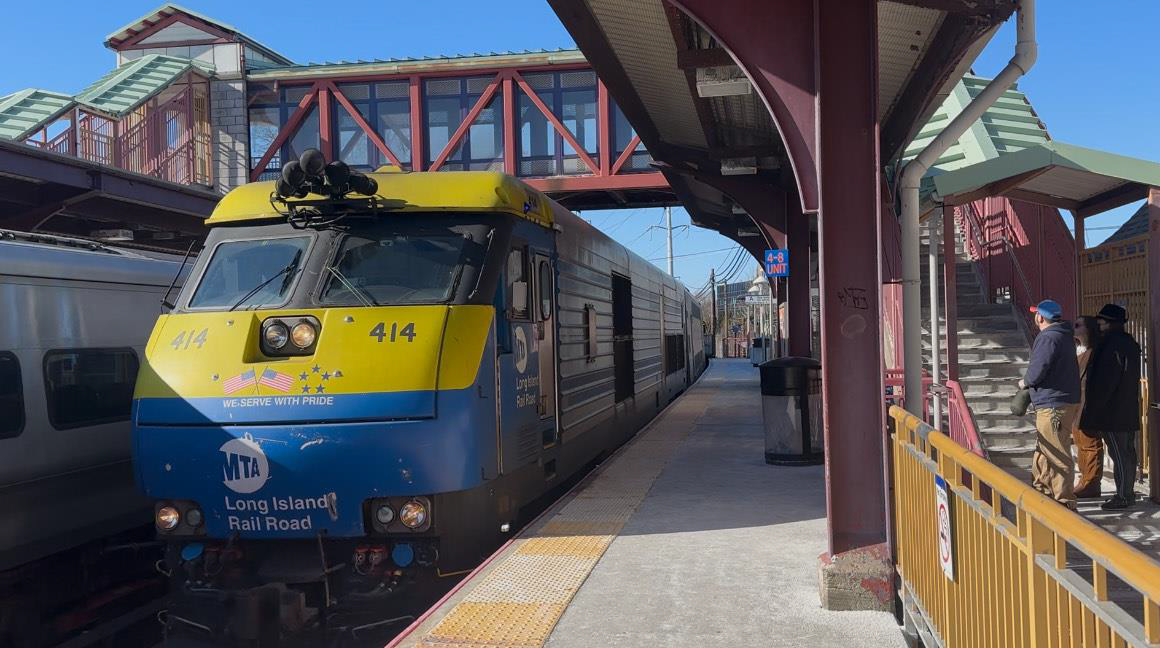
Saturday February 22nd the Sunrise Trail Division NMRA had their winter meeting In Kings Park Long Island. I had decided to take the train from LIRRs Grand Central Madison Terminal because I had not used it. My train went to Jamaica where I changed to another which took me to Huntington. At Huntington the passengers must all de-train and a new train pulls in after waiting in the pocket just past the platform. Here EMD DE30AC leads a train of C3 bilevel cars.
Long Island Rail Road is the only operator of these 1998 built units which are strictly diesel powered as well as the very similar looking EMD DM30AC which can switch from 3rd rail electric power to diesel. These are numbered in the 500 series and can operate into Penn Station.

Visit to the “Last” Open House of the NJ Hi-Railers
Andy Estep
A handful of us went to the Sunday February 16th open house at the NJ Hi-Railers. This event had been billed as the last open house for this massive 3 rail O scale club because the building had been sold, but they have since then announced that they would have one more (March 16th 10-4). They have announced that they have purchased a new building near the Boonton Railroad shops of the United Railway Historical Society of NJ.
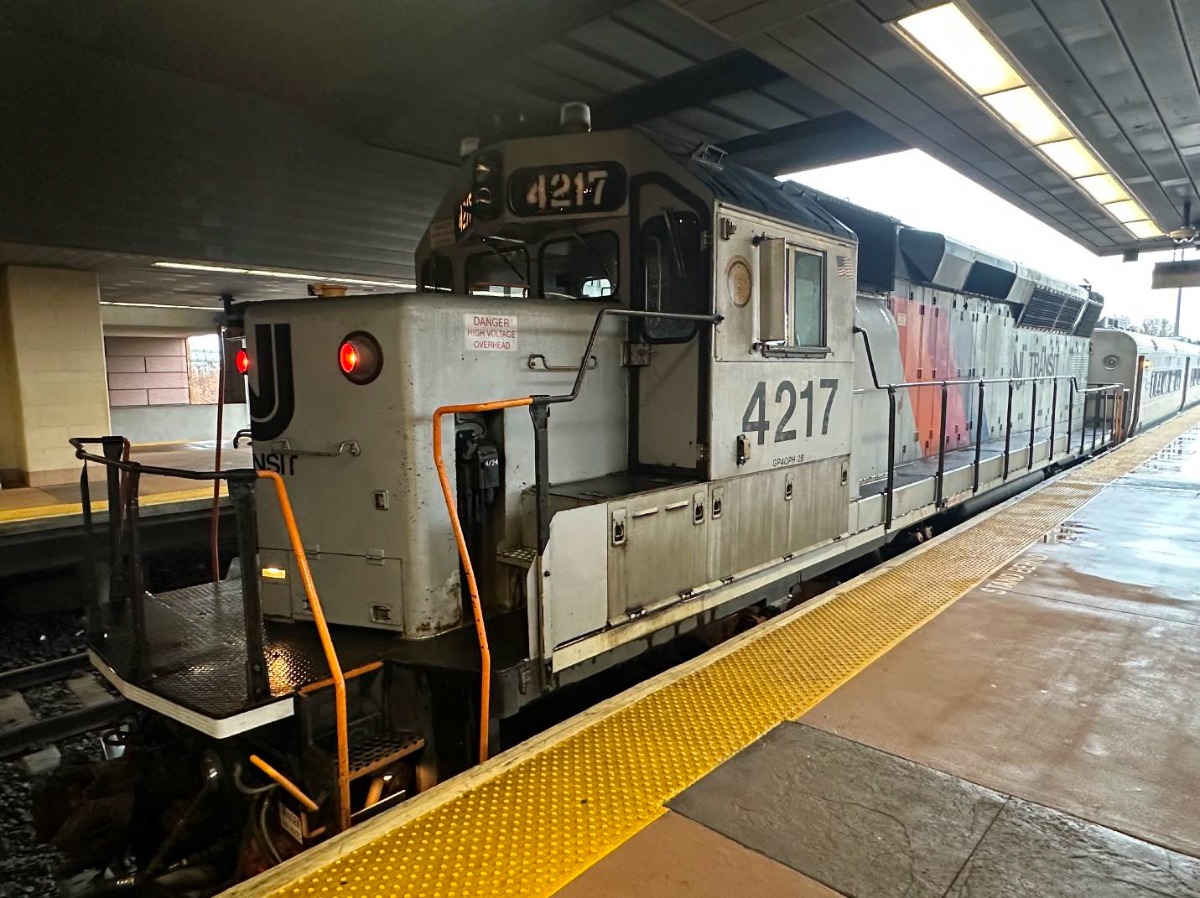
Here is NJT EMD GP40PH-2B #4217 at Secaucus, NJ. It had just pushed our train back from a very snowy and rainy Hawthorn, NJ after visiting the NJ-Hi Railers. This engine was originally built for Penn Central in the 60’s.
Brad Smith, Heath Hurwitz and Andy Estep caught a North East Corredor NJT train from Penn Station to Secaucus, NJ. There we transferred to a train on the old Erie Main Line to Hawthorne, NJ where we were met by Andy Brusgard who had kindly offered us a ride through the snowy/rainy day to the club.
The club’s address is 185 6th Ave. Patterson, NJ, 07524. It is on the top floor of a large former mill building in an industrial area. It is a long walk from the Hawthorne NJT station and an even longer walk from the Patterson NJT station.
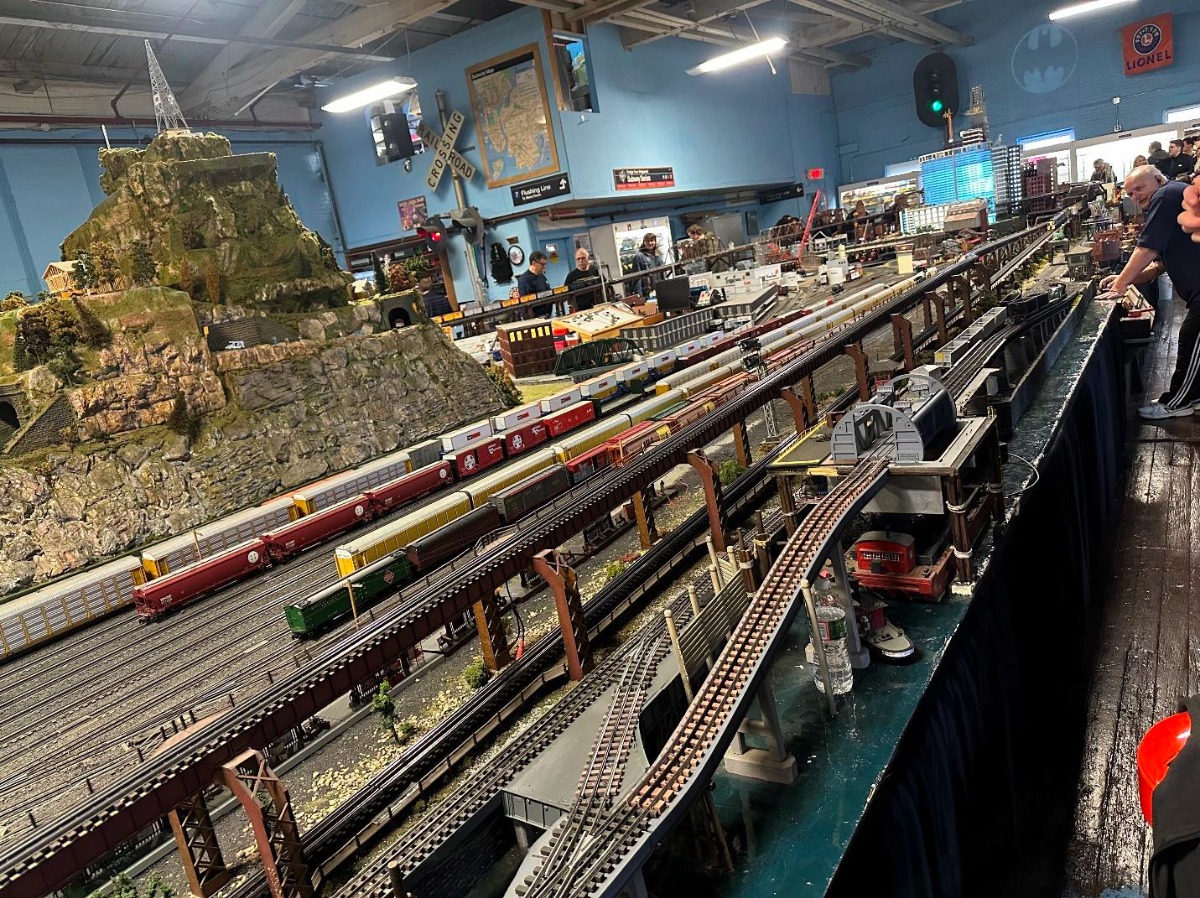
Here along the viewing aisle of the 250 ft side of the layout is very impressive. Here is a view of one of the storage yards. The main runs on the elevated track here and in the foreground is a working rotary coal dumper. After the car is unloaded the cars uncouple rolling automatically down the inclines.
The NJ Hi-Railers Club was started as a modular club which moved into their 250 ft by 50 ft space on the top floor of a former silk mill building in 2002. They incorporated as a club in 2004 and started rebuilding a former 30ft by 60 ft home layout into the start of a permanent section of the modular layout. The group grew from 10 to 40 members in 2003. They decided to remove the modules and replace them with a New York Subway section.
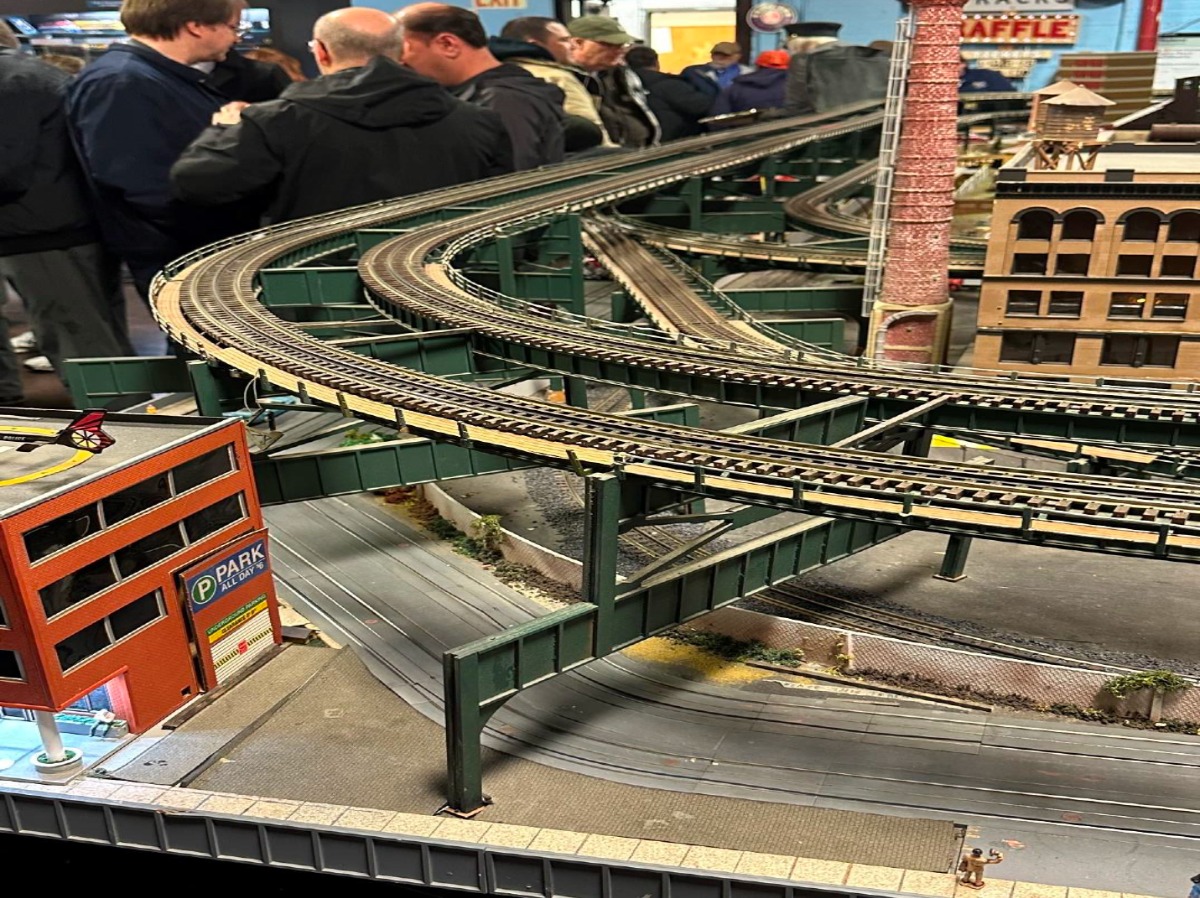
Here is a nicely modeled layered Subway El weaving up and down around buildings. At street level is a trolley track. The crowds show how popular this layout is. I spoke for a while with a man who drove from Ottawa, Canada to see it one last time.
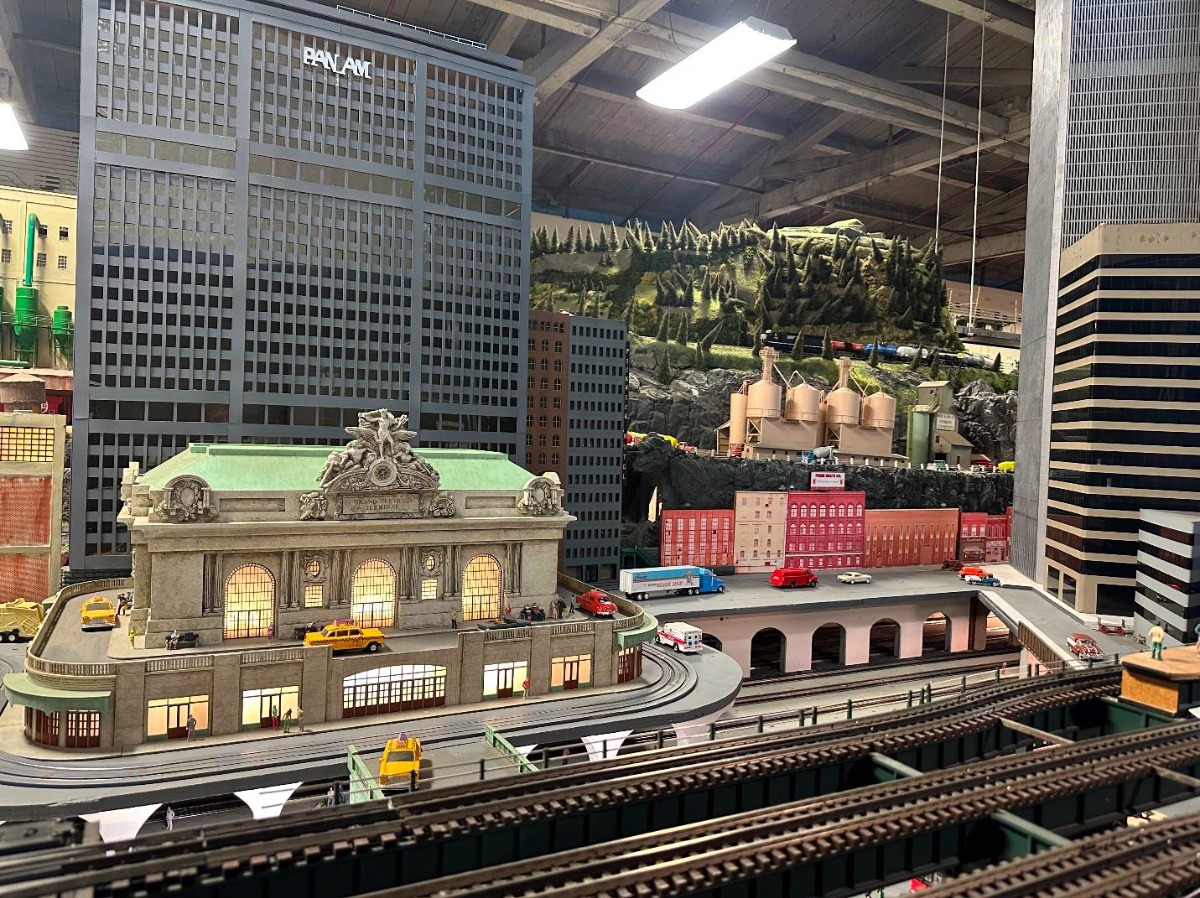
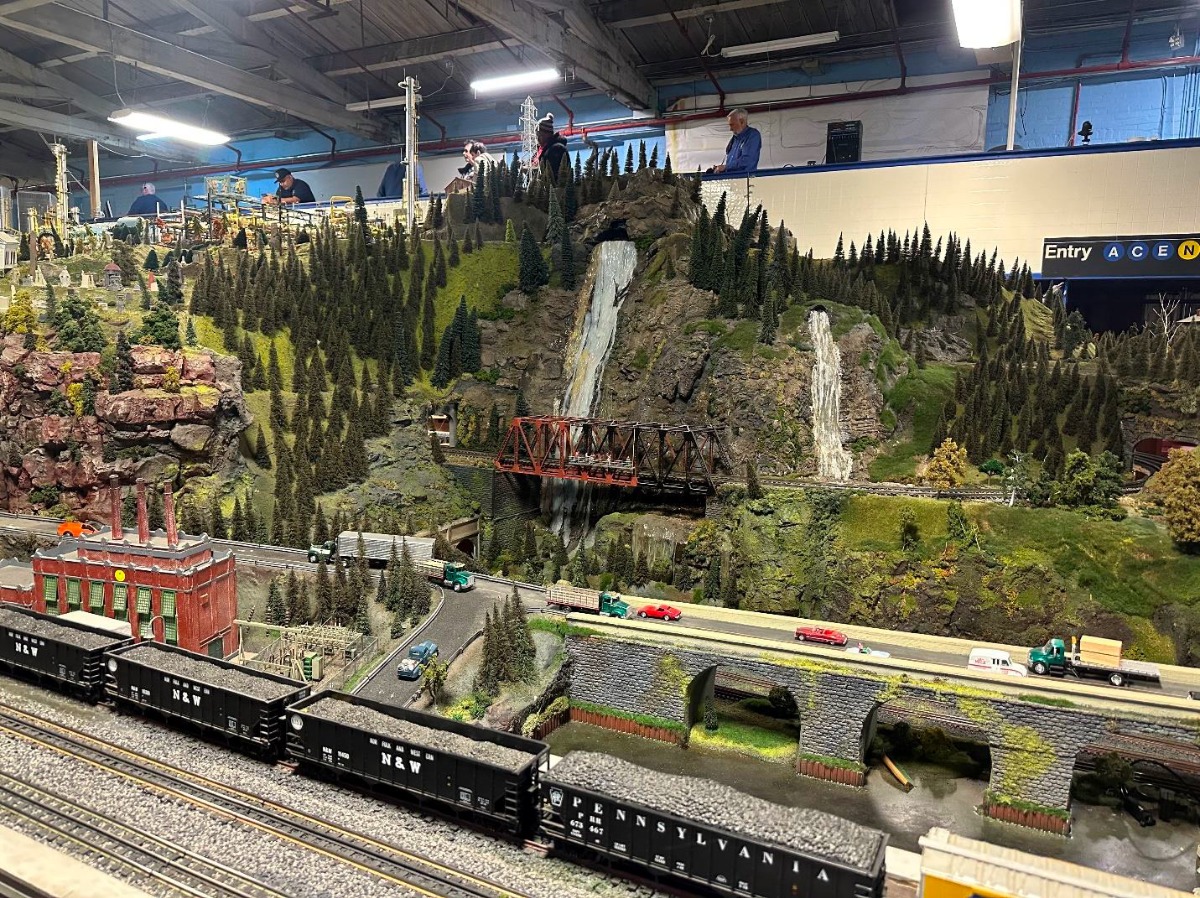
Here is an example of the rural scenery section of the layout. This towering mountain in the central part of the layout has an elaborate gas refinery on top of this over 10-foot-tall tree and rock covered mountain. There is an operator’s balcony in the background. You can see club members operating their trains from it.
Besides the large layout they have a Standard Gauge layout that had been owned by Tom Snyder host of the “Late, Late Show”. They also have the prop layouts from the “Soprano’s”. The largest object that has been donated to the club is the Model Board from Grand Central Terminal showing all the track of Metro North. It is 120ft long. There is also a large kitchen and meeting and dining area
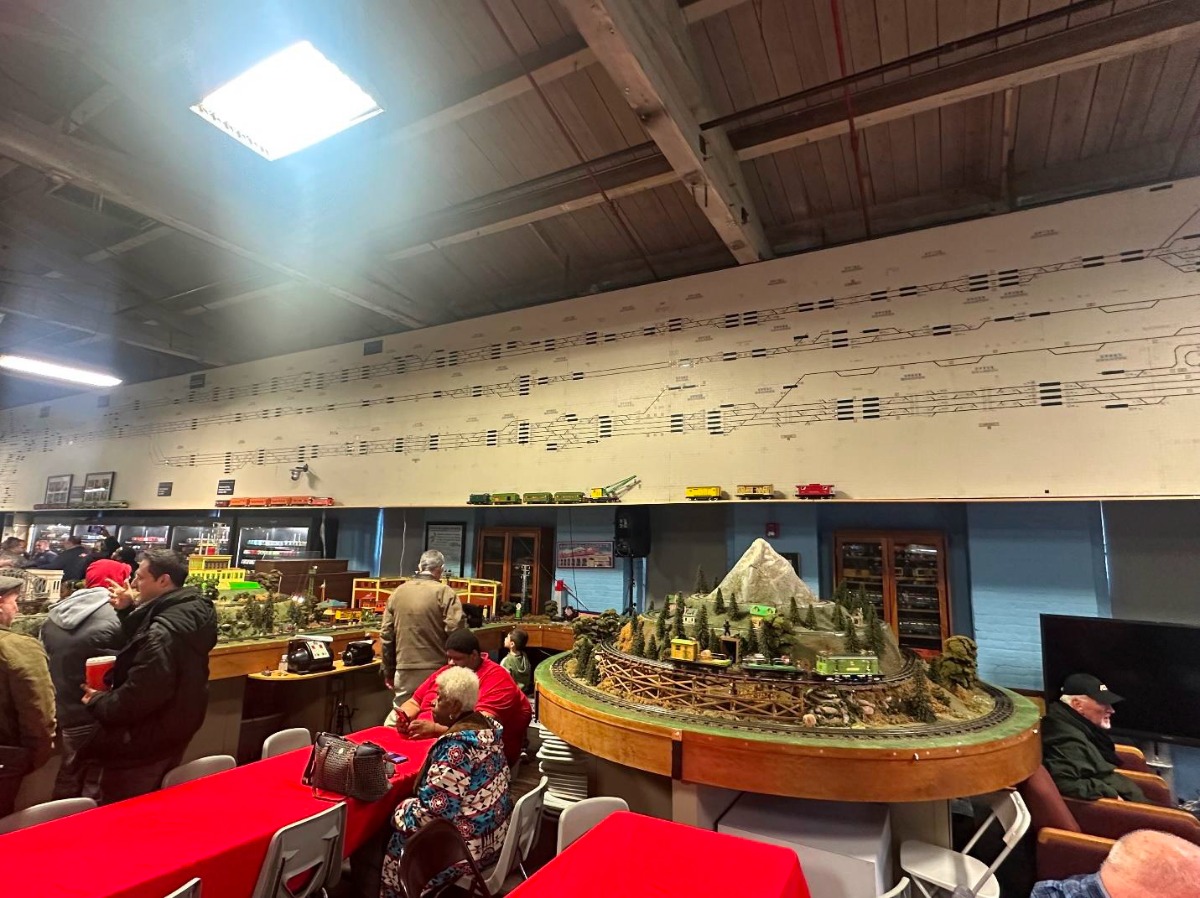
Tom Snyder’s very nicely made prewar Lionel standard gauge layout is in the foreground. High up on the wall is the massive Metro North Railroad model board which used to be in Grand Central. It shows all the trackage on the railroad and where the trains were. At 120 feet long this board is too large to fit in the picture.
Large glass cabinets surround the room filled with hundreds of the models of the 70 members. It is interesting to see the different collections in their display cabinets and how the club members focus on one area or have a much wider area of collection. I found myself really studying the models in the cabinets when things caught my attention.
There were a few collections that were focused completely on subway cars. Which is not surprising considering how much of the layout had a subway focus. A few cabinets had a focus on a single railroad like New Haven, Pennsylvania, Erie and New York Central.
One cabinet that caught my attention was one with Tropicana reefer cars. I have always had an interest in the so called “Juice Train” because I grew up along the RF&P Railroad which this train ran over. There were more paint schemes for these cars than I was aware of in this case.
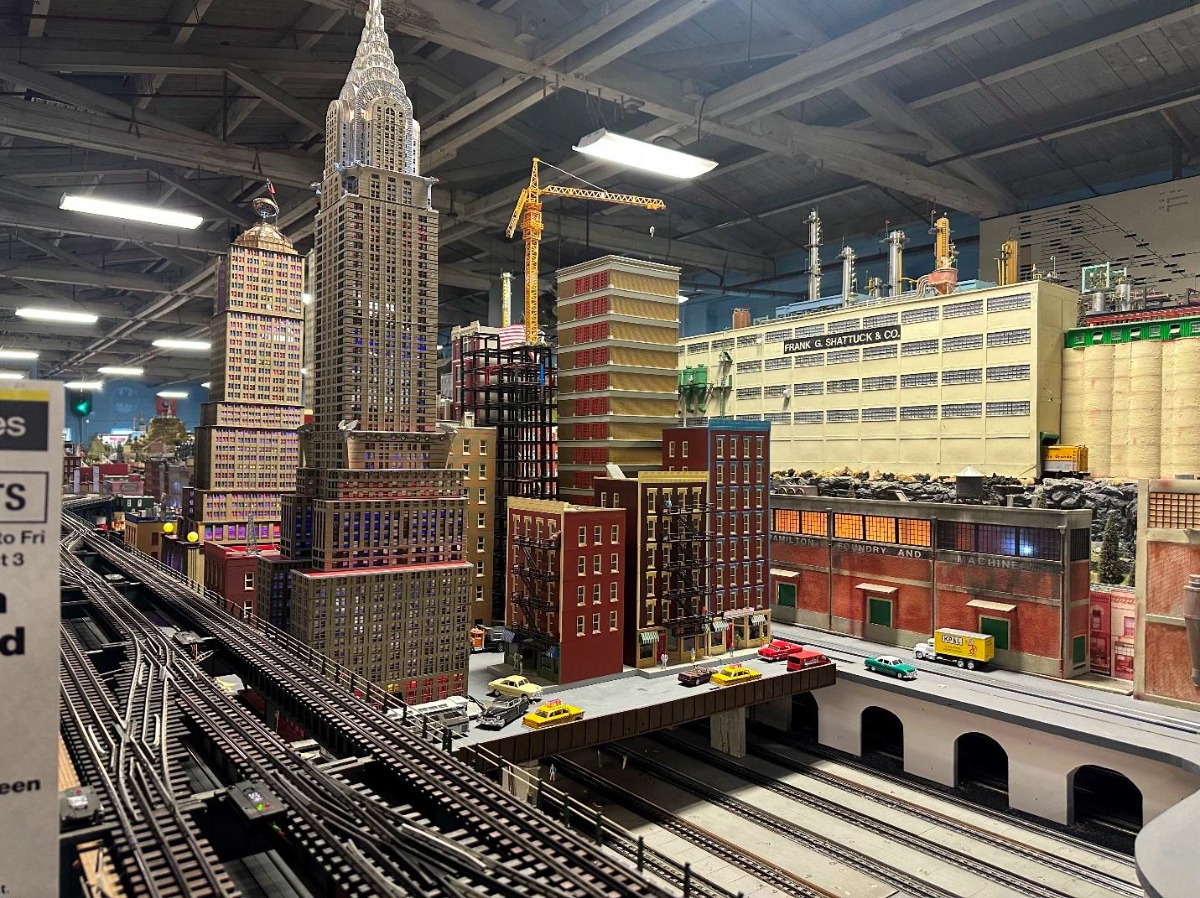
There is a whole section of the layout that represents Manhattan. Here is a section of Subway El and a daylighted section of Park Avenue with some recognizable buildings filling in the skyline.
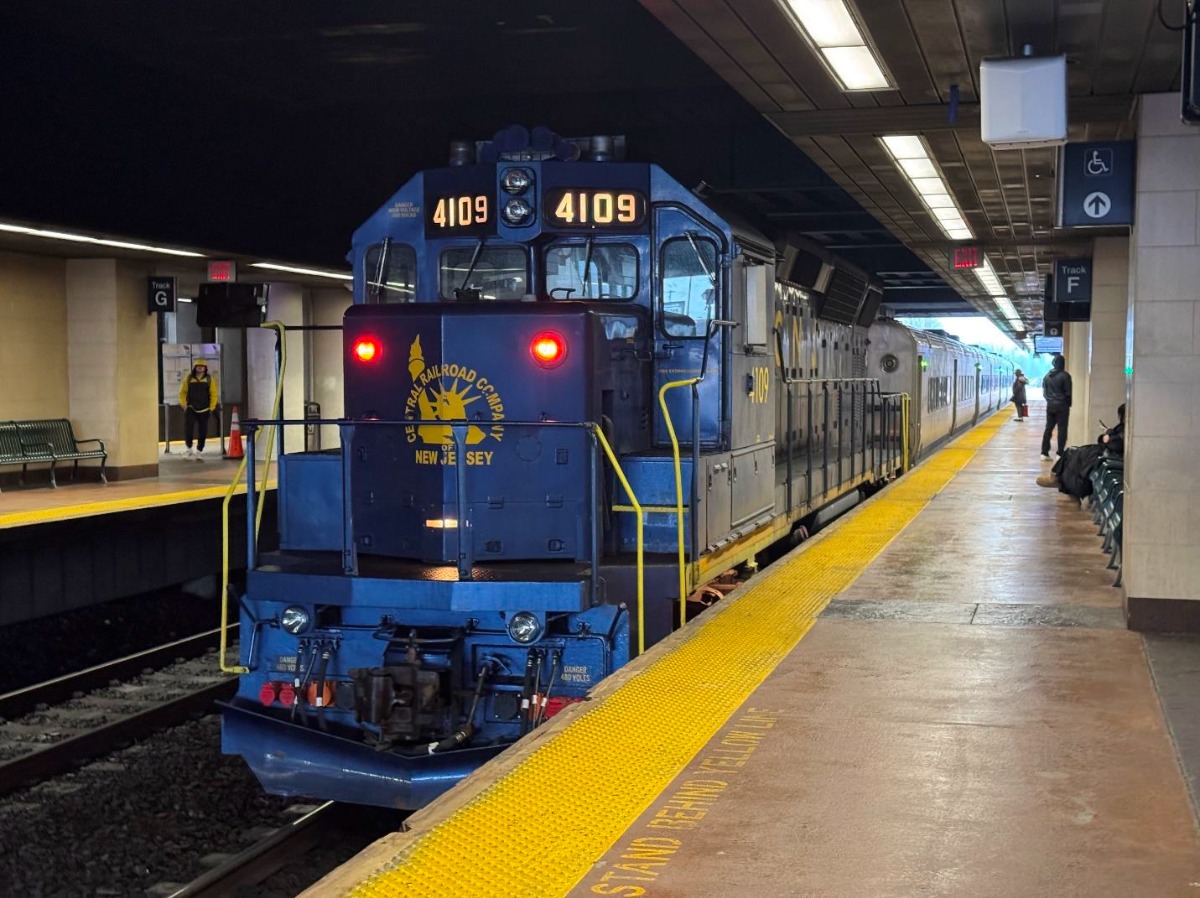
Brad Smith took this picture of NJT EMD GP40PH-2 #4109 in heritage CNJ paint scheme at Secaucus, NJ as he made his way back from visiting the NJ Hi-Railers. This is one of the units inherited from Conrail at the beginning of NJT in 1983 and was built for CNJ

This is the 2nd feature covering the different rail terminals around the city. For this instalment of terminal talk we are jumping into the wayback machine to visit a long-gone mass transit storage terminal. Terminal Talk
This small train storage yard was made for the New York Elevated Railroad. It was first built post-American Civil War when the earliest elevated tracks were expanded and converted from cable driven trains on a back-and-forth single-track shuttle to a two tracked steam powered line. The elevated line terminus was the ferry terminal at the battery.
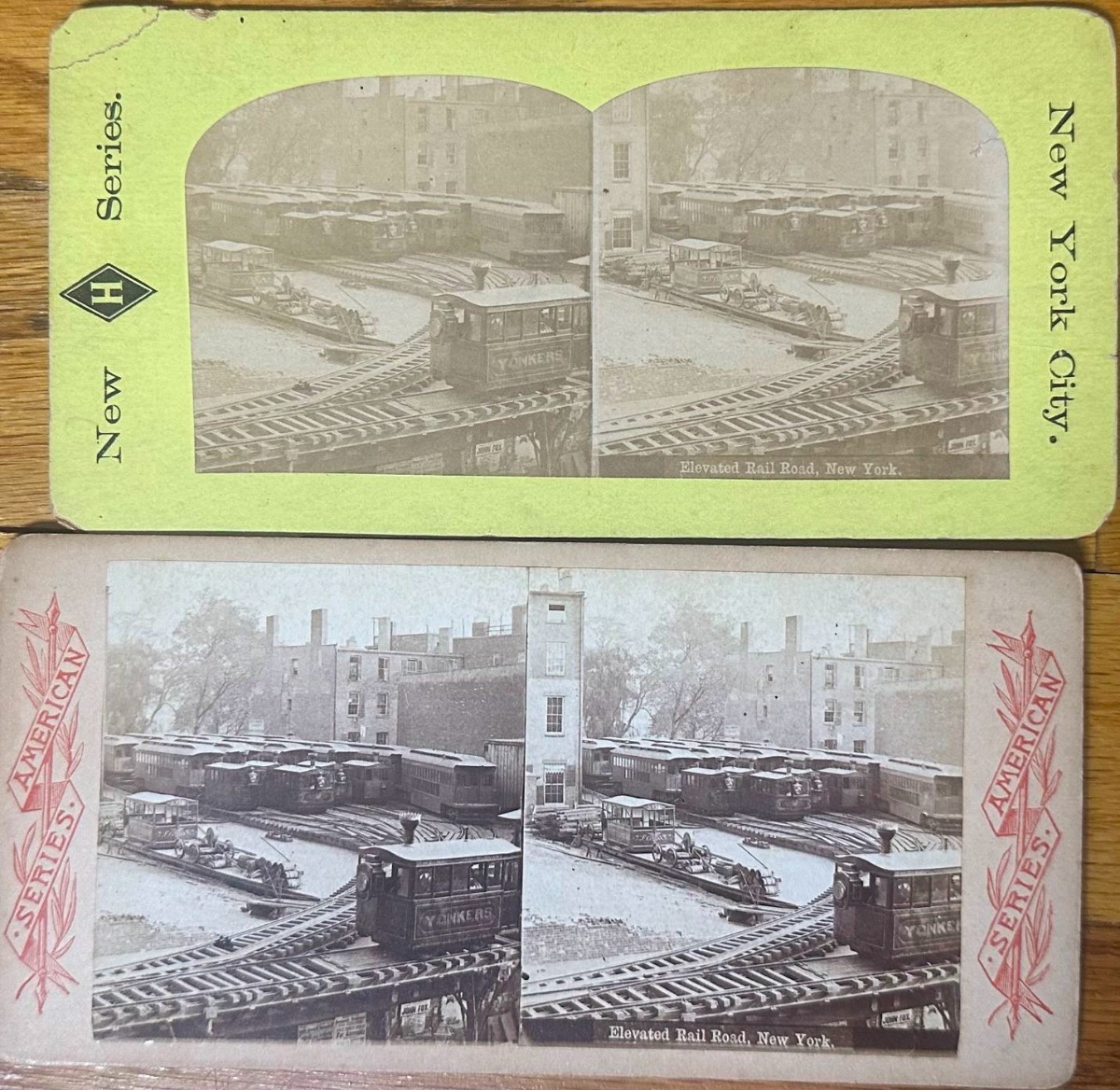
I have a small collection of stereographs of early NY transit subjects. I have two of this yard because each one is cropped differently some with more information.
This elevated railroad coincided with the development of early photography. Lucky for us, elevated railroads were a popular subject and stereograph photographs, and post cards were popular enough that some are still around to find on eBay and antique stores.
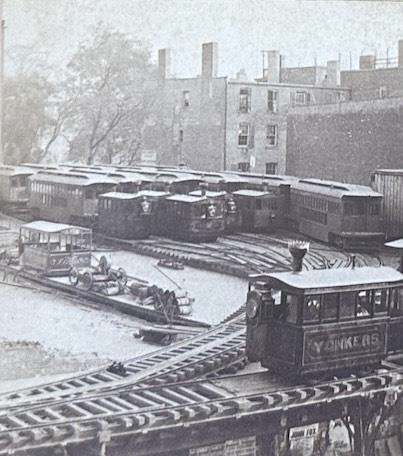
This enlarged image of one side of the stereograph shows a lot of details of this small five track yard. There is a lot of variety in the engines. Different paint schemes and lantern designs. Each train seems like it is two shadbelly cars and a dummy except track 2 from left has 2 engines, track 4 has a very plan look to it, track 5 train is engine in. On the loading dock on the left there is a engine body without an engine, a hand cranked work car and behind a switch stand are many small barrels of what I assume are grease for tightly curved track. The whole yard is planked so workers can more easily walk around.
Once I saw this I fell in love with this image. A neat thing that is an artifact that it is a stereo photograph is that there is a little bit more information in each image due to the offset to make the 3D image with the viewer. I have also found a separate image of the same scene that has a little more information of what the ground level looked like. A wall with many, many advertisement posters. The whole yard is located on the second floor and there was material storage and machine repair shops on the ground level.
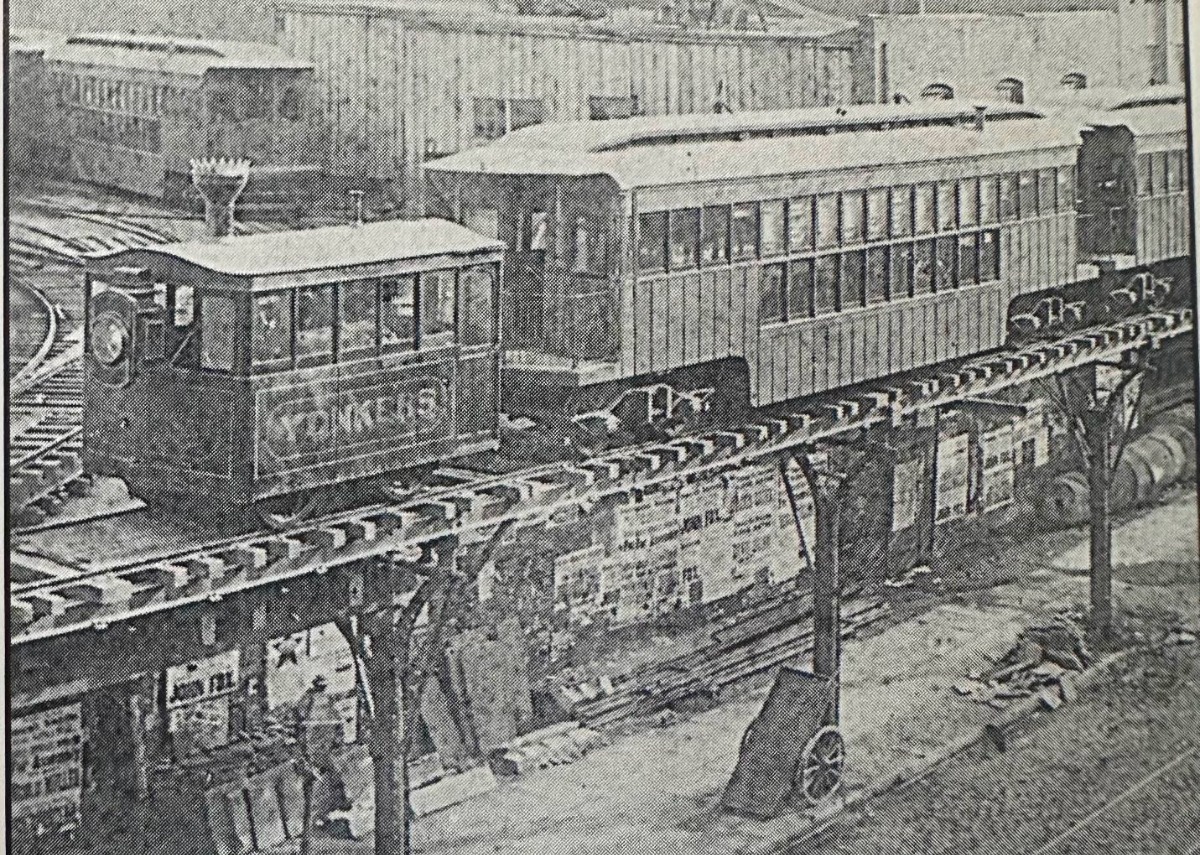
The posts holding up the track in this image are the oldest design and are from the failed first attempt at elevated RRs in NYC which was cable drawn. The condition of the sidewalk and the posters covering the walls are interesting. You can see the rails of the street railroad in the Belgian block pavement at the bottom right.
A bit about the equipment. The steam engines are 0-4-0 ST steam dummies with a center rotating jack shaft to drives the rods. The enclosed shell was intended to not frighten horses. New York City has a long history of street running engines with this fully enclosed body.
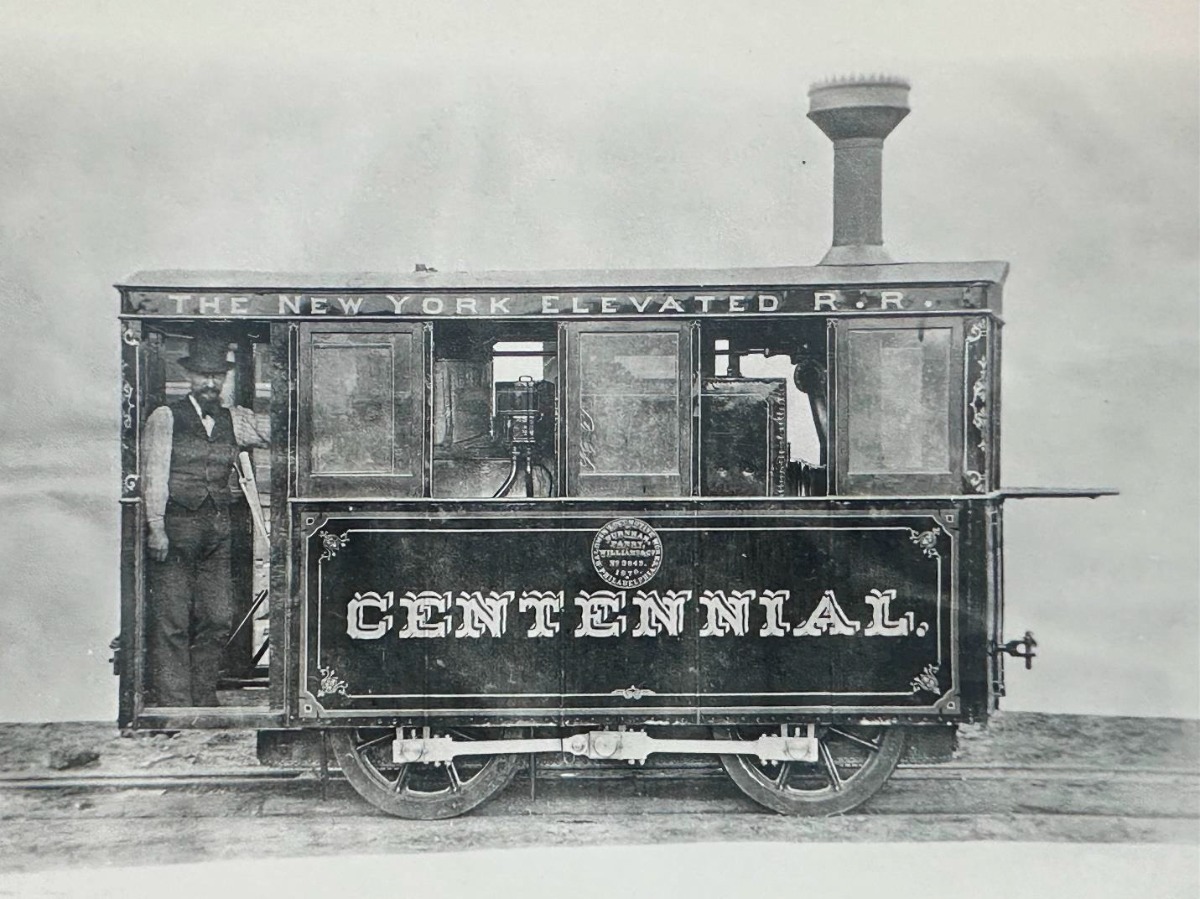
This steam dummy engine was an entry into the 1876 American Centennial Fair in Philadelphia. In 1876 The New York Elevated RR had 15 engines and 21 cars.
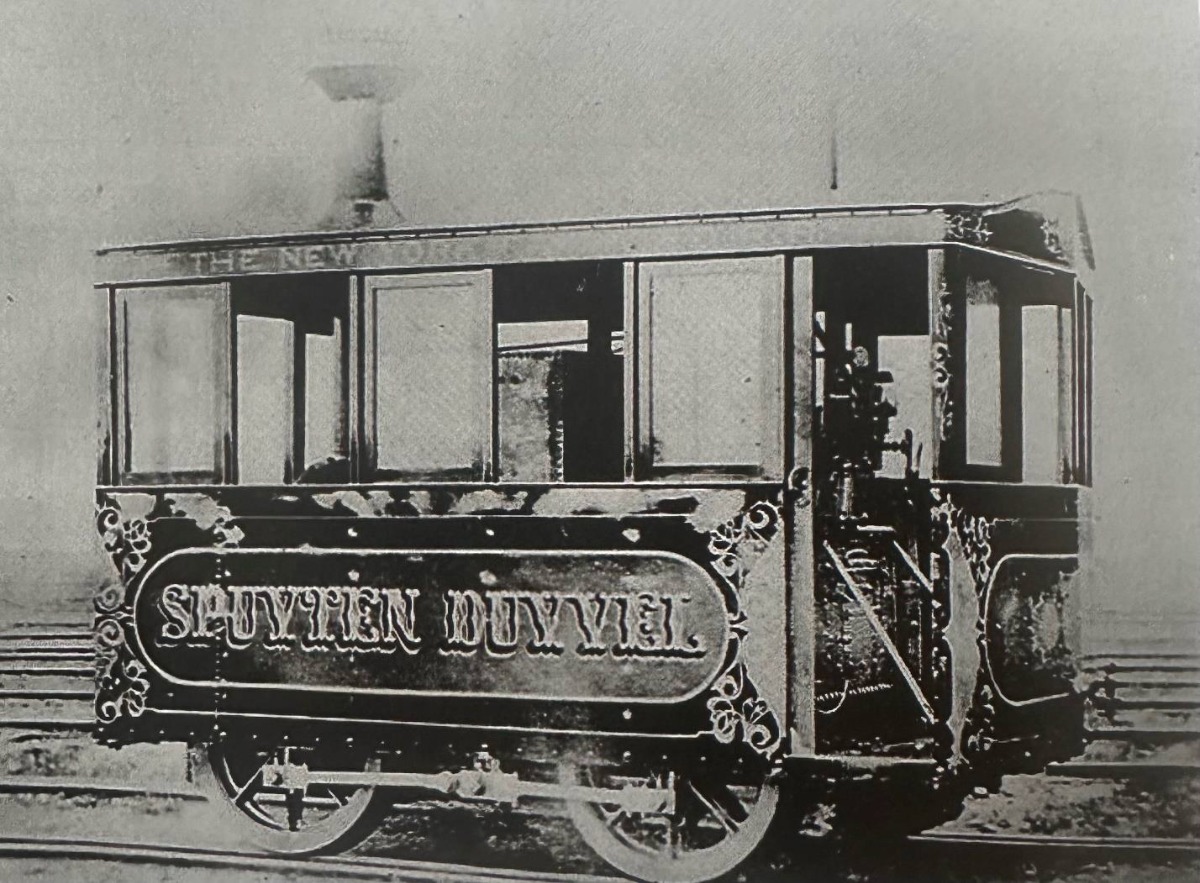
This image of the “Spuyten Duyvel” shows both the elaborate paint scheme and the optimism that the railroad would eventually reach the top of Manhattan. Apparently, the primary color of the engines was a maroon.
The last engines to arrive in the city with these dummy bodies are the five New York Central class B-60 Shays delivered in 1925 to run up and down 11th Ave from 34th Street Yard to St John’s Warehouse.
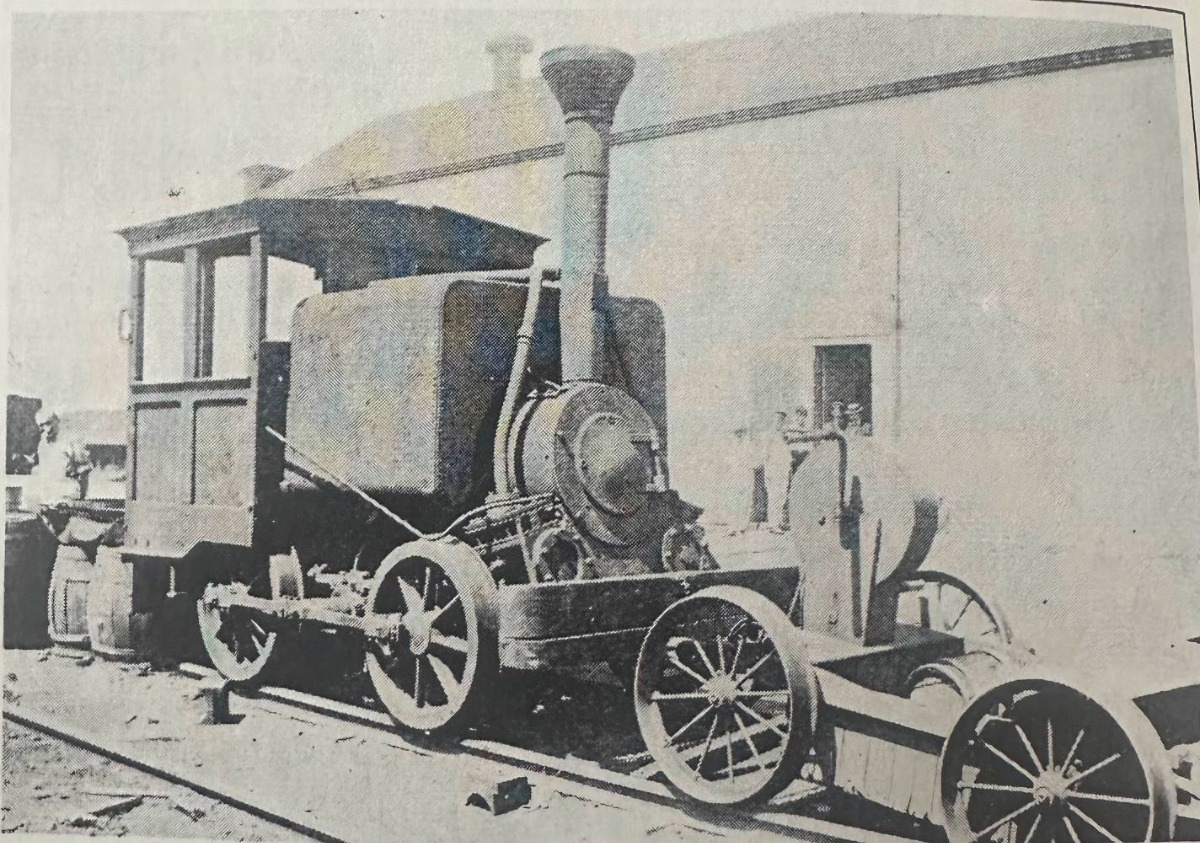
Here is a Steam Dummy as a shop switcher near retirement with most of the shell removed. It gives a better idea of how these were made. Internal cylinders and a huge saddle tank. The hand cranked inspection/work car in front of it looks the same design as the one sitting on the loading dock at the center of the initial image of the Greenwich Street yard.
The passenger cars have a lowered center lounge area, built this way in theory to reassure riders that riding the EL was safe and the cars would not tip off the tracks. These cars ended up being referred to as Shad-belly cars because they mimic the shape of the fish. The second order of EL cars did not have this feature and instead had a center door for quicker loading.
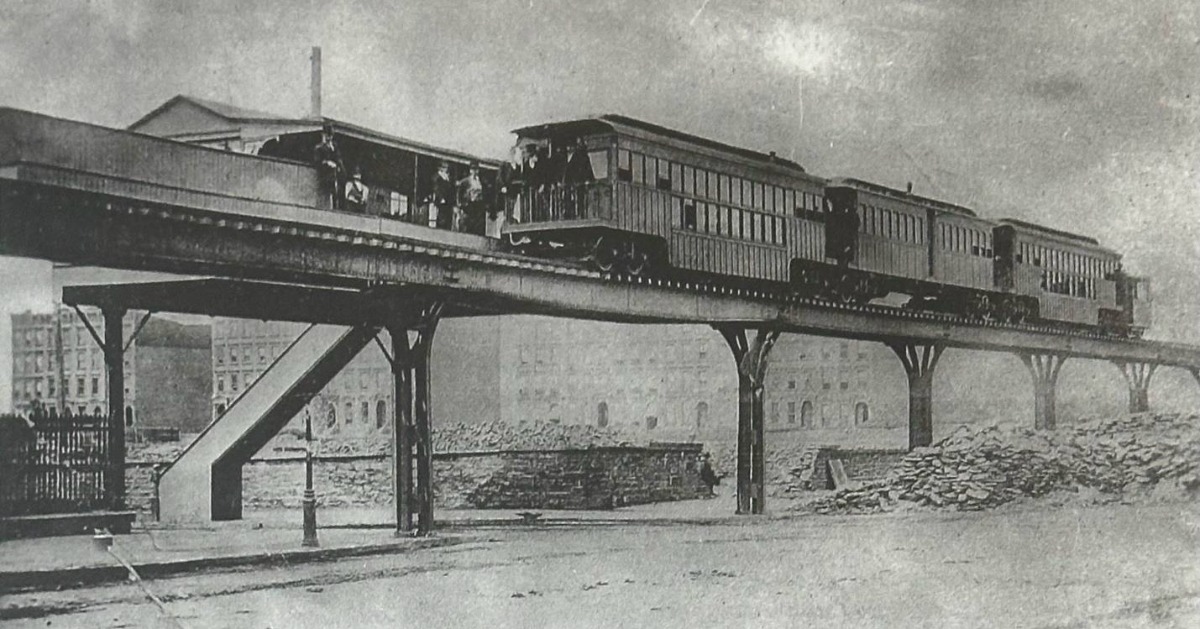
I do not know what station this is, but it dates slightly later than the yard image because the trains are now a car longer and the center car is of the new design with a center door and no lowered section. My research is that the passenger cars all had stoves to heat them in the winter as well as curtains in the windows. As you can see in this image all the sashes could open for ventilation. The cars were painted a cream yellow with dark red lettering on the letterboards and some gold accents. Truck side frames were olive green.
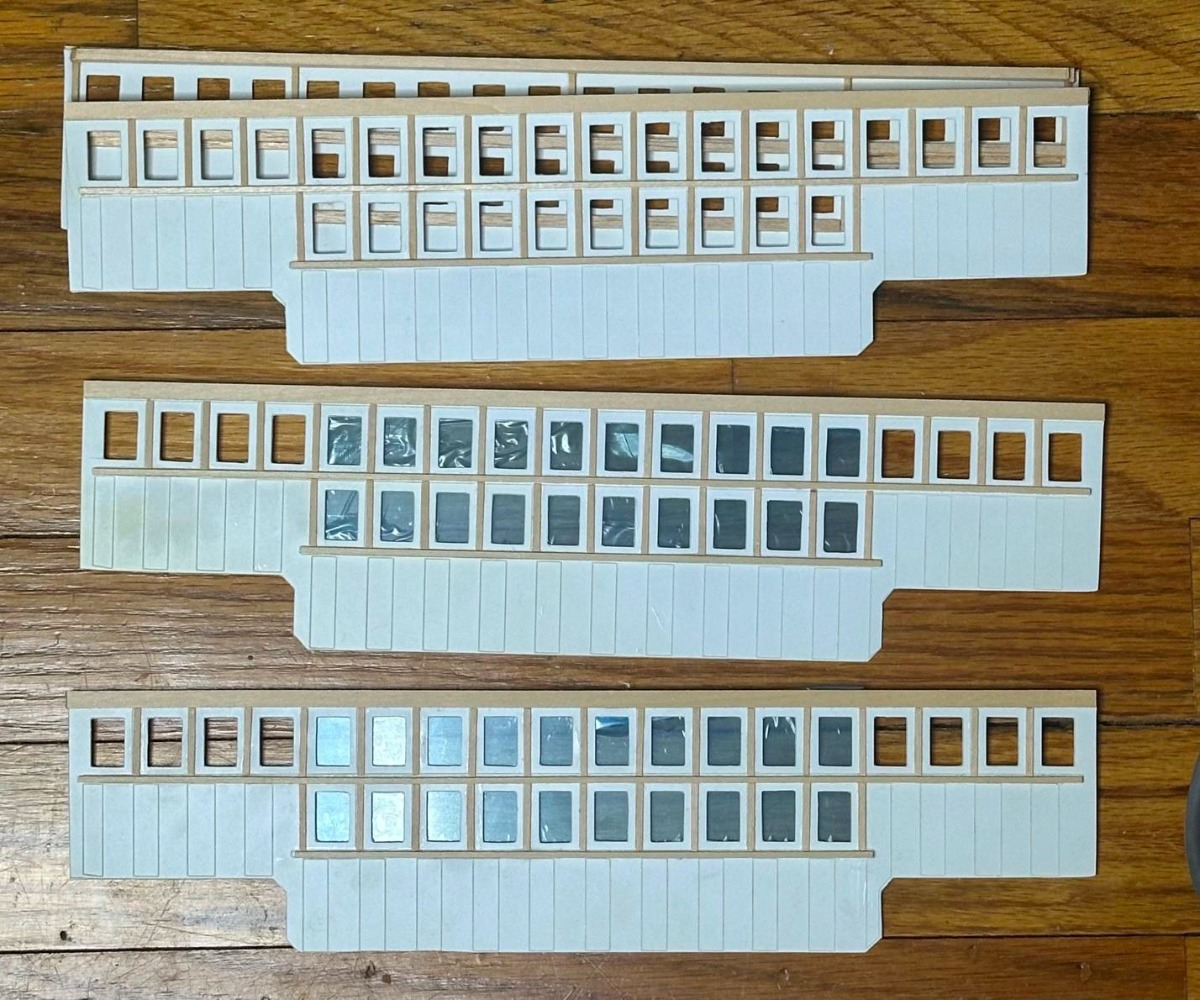
This is one of my (too many) projects. I have been making models of the Shadbelly cars in O scale. This is the second attempt. My first was based on some car builders drawings but I realized too late that the finished cars had a different number of windows. Whoops. Now that I have more research on this project ill have to dig them out again.
I have been looking for the location of this terminal for years with the idea of maybe making a little diorama of it. This yard at only 180 feet deep is a size that I could make a model of it that would fit in my apartment even in my chosen scale of O (under 4 feet deep).
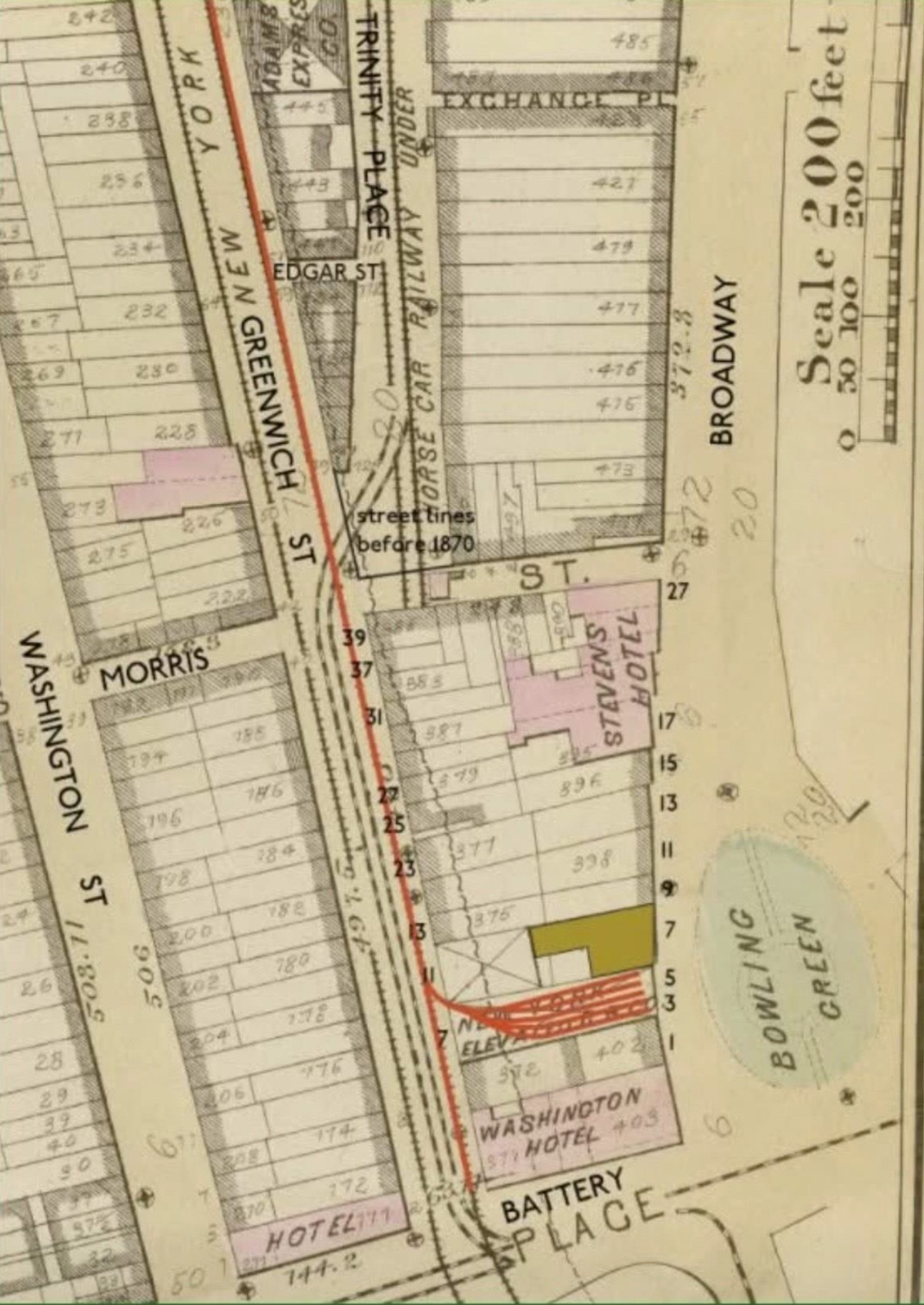
The only information I had was that it was located on Greenwich Street. I don’t know why but I had assumed it was further north near Jefferson Market, and I had been pouring over old maps under that assumption with no luck. I have seen that this image does come up on social media about once a year. It came up last month and the very first reply in the comments was someone posting a map of its location. This little yard was located near the oldest part of the city, the southern tip. It spanned the block between the start of Broadway and Greenwich Street. The tall trees that are visible in the image at the back of the yard are in Bowling Green!
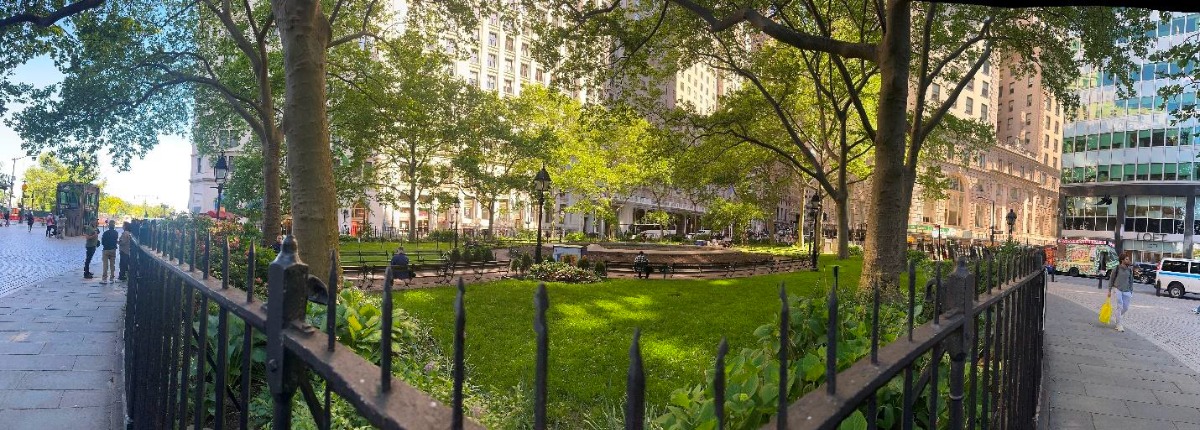
This is Bowling Green. This area has been a city park since1733. An interesting fact is that cast iron fence dates to the 1770s. It was erected to protect an equestrian statue of King George III. The people of New York pulled the statue down in protest in 1776. At the same time the statue was pulled down, they cut the crown topped finials off the posts. You can see the haphazard and rushed saw marks on the metal of these posts to this day. The railroad yard would have been at the building opposite, in the center of this image about where the lamp post is. From the back of the elevated train yard you would have been able to look down on to this park.
I went down to the area to see what if anything was left. I know that one block north of the shown map is Trinity Church which would have been there in the 1870’s as well. I was surprised to find that the same addresses remain in the buildings that replaced most on the map. The topography does seem the same. Much of this area has been replaced with new buildings since the 1870’s and the biggest transformation was the various ramps for the Brooklin-Battery Tunnel added to the area since the 1950’s. The block west of Greenwich Street is completely replaced by Brooklyn Battery ramps.
Another thing I found surprised to find a few survivors in the blocks just north of the yard site. Three buildings that would have been present in 1872 are still extant. This neighborhood became known in the 1870’s as “Little Syria” because of the many Syrian immigrants settling in the area. Two adjacent surviving buildings are on Trinity Place. The ground floors are much altered and are now tourist souvenir stores, but the upper floors retain their 19th century appearance. These buildings would have been visible from the EL trains.
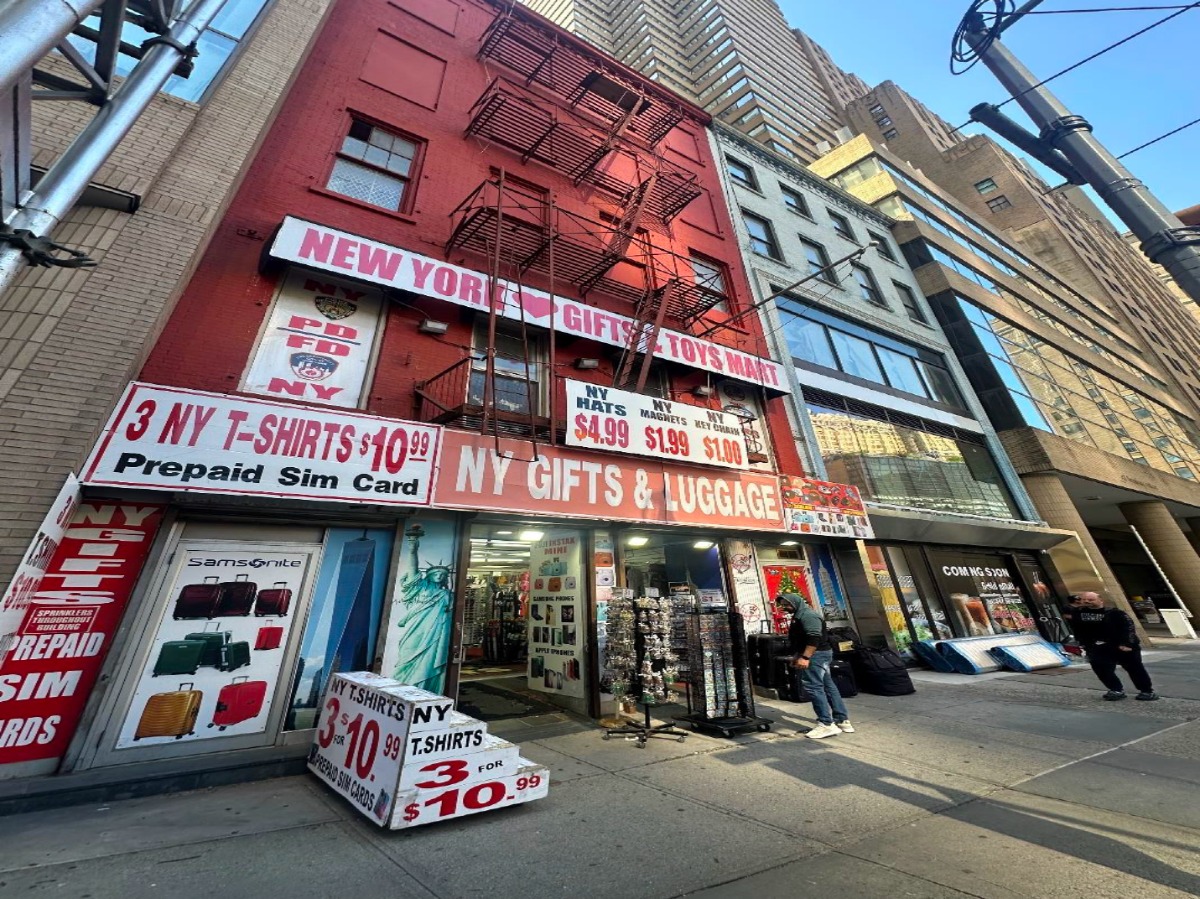
These two much altered buildings on Trinity Place would have been visible from the elevated trains near the Greenwich Street Yard. They appear on the map as number 427 and the unnumbered building to the south. The buildings fill the block and extend from Broadway to Trinity Place. Their Broadway facades are much modernized, and I am sure not recognizable to the 1870’s appearance but they can be walked all the way through from one street to the other. These two are unlikely survivors and have seen a lot of change in the city.
Trinity Place in the 1870’s did have a street railway that used horses to move RR cars one at a time. One block north as seen on the map on Trinity Place was a rail served Adams Express Company Building, the UPS of the day.
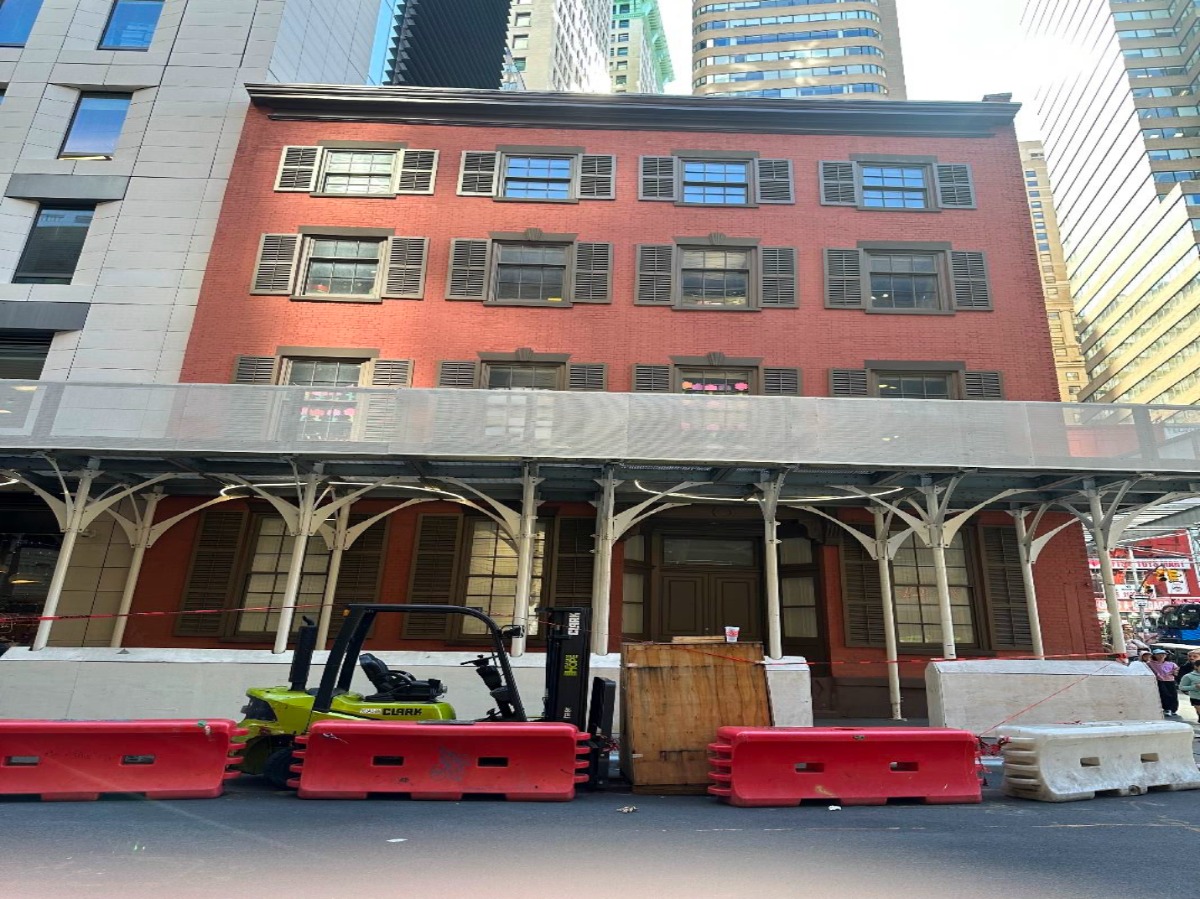
This nicely restored early 19th Century building is now an elementary school and is visible on the map. This would be building 444 Greenwich Street because Edgar St has been moved slightly north to make the triangle (now a park with a subway entrance) larger. It has a distinct bow shaped section on the back (Trinity Place side) that corresponds to the image on the map. To the right in this photo you can glimpse the other surviving buildings.
I did find another surviving building on Greenwich Street at Edgar Street very near the other survivors that predated the EL. This very early 19th Century building was built as a private home. It is now a private elementary school. The current scaffolding is an echo of the years the EL towered over it. Even the pattern of this “fancy” scaffolding looks a lot like the shape of early elevated risers. I know it is a stretch, but I thought it was funny.
Finally we get to the former site of yard itself. There are late 19th and early 20th century buildings that fill most of the block the yard was sited on. Fittingly the actual space that once had the yard is another transportation themed tenant. The space where the yard sat on Greenwich St is now home to the NY DMV.
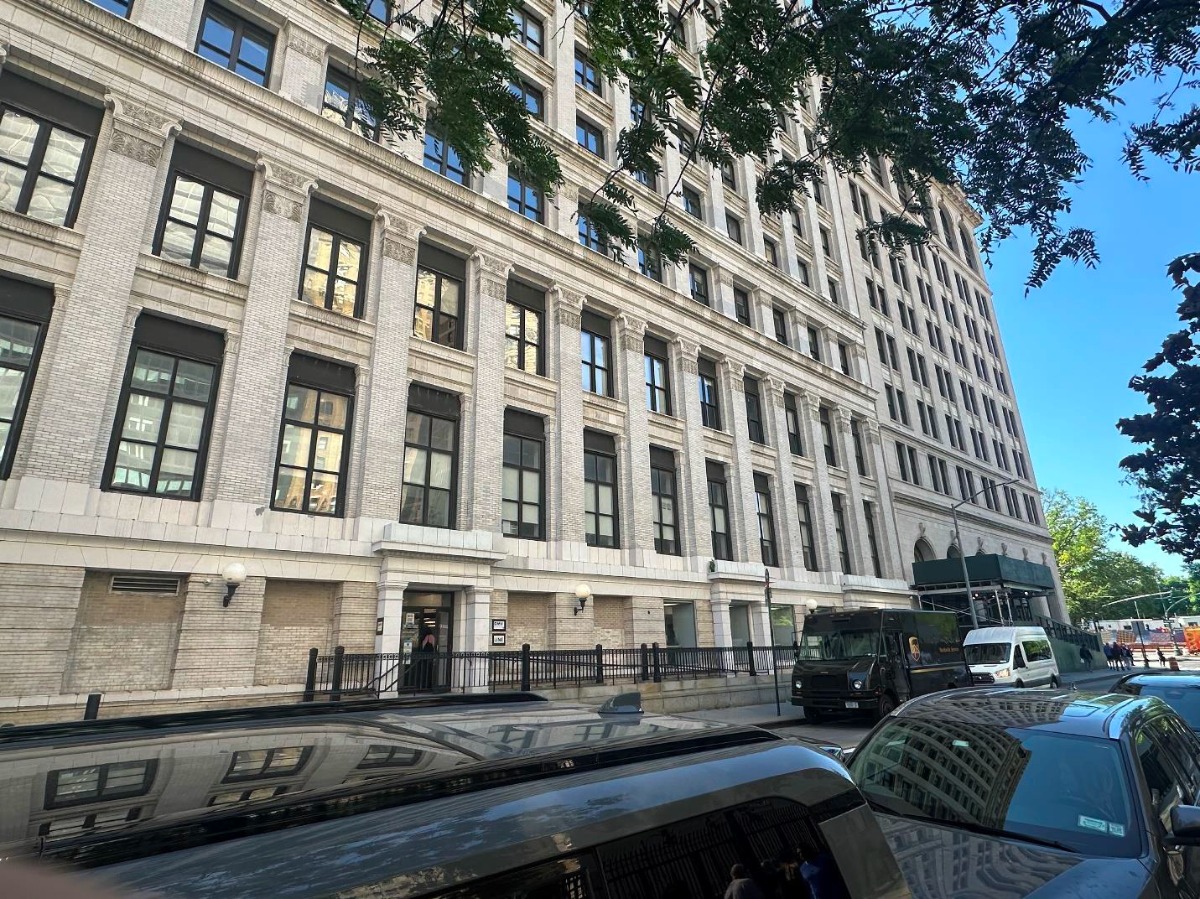
This picture is as close to the angle of the stereograph of the elevated yard as I was able to take. I am standing on a planter for height, and we are on Greenwich Street looking at the former location of the yard. This very large building takes several lot widths and was built around 1910. The switch into the yard is about at the location of the center door. The steam dummy “Yonkers” would have been around where the right-side globe lamp is. The farthest track of the yard would have been at the party wall for the next building. To the right is the 1882 building that replaced the McCombs building it now occupies what was two adjacent lot widths (all the buildings to the right side of the stereograph). Not so exciting but this is where it was.
Going to the immediate south end of the block in the time of the EL was McComb Mansion an 18th Century home that was once home to George Washington after he became president. It was the White House before the White House. The building later became a well-known hotel.
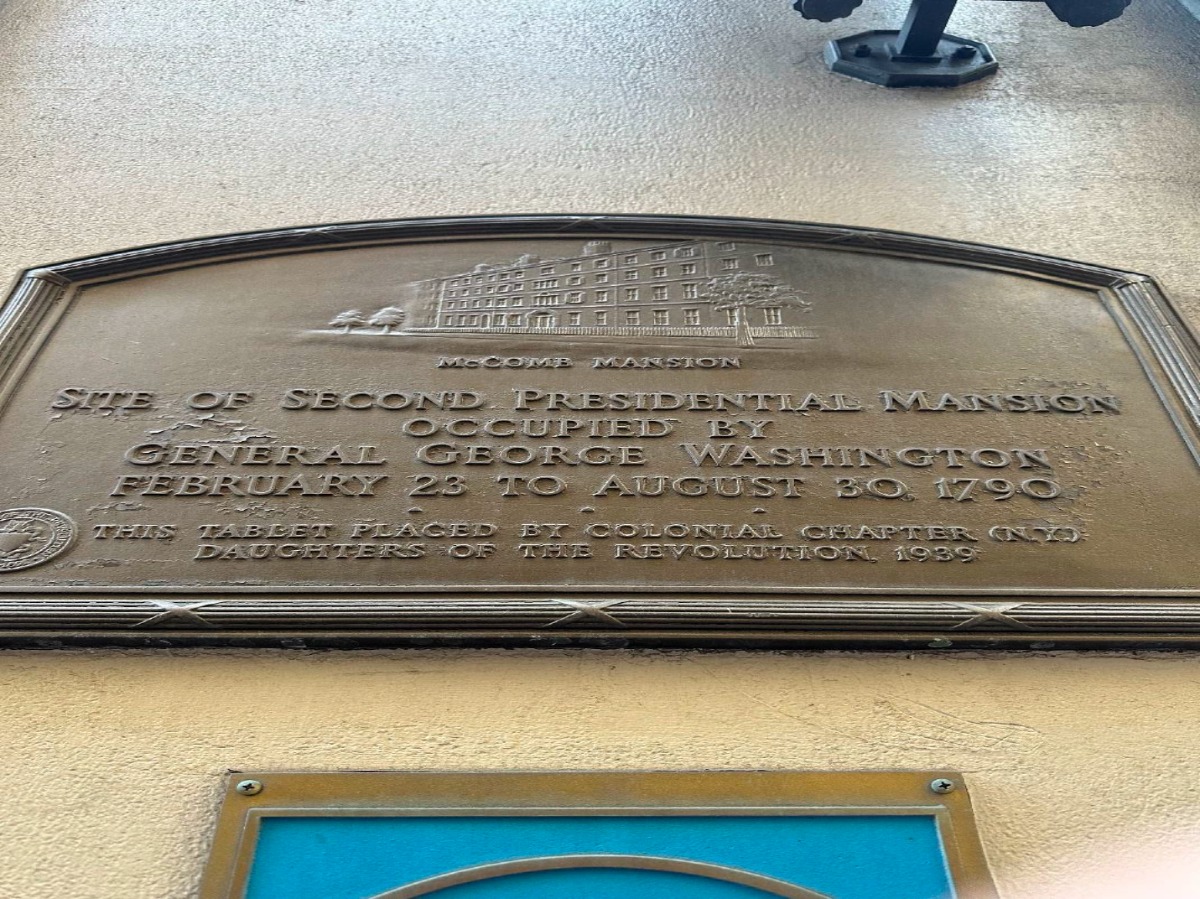
The McComb Mansion building on this plaque is just visible in the yard image. The back side is visible to the top right of the stereograph. The building served as the second Presidential mansion and survived as a hotel until 1882. The plaque is on the building that replaced it, now a bank at ground level.
In the 1880s it was replaced by the current building, One Broadway the Cunard Building. American home of the former cruise ship company. There is a nice bronze plaque with local history on the Broadway corner.
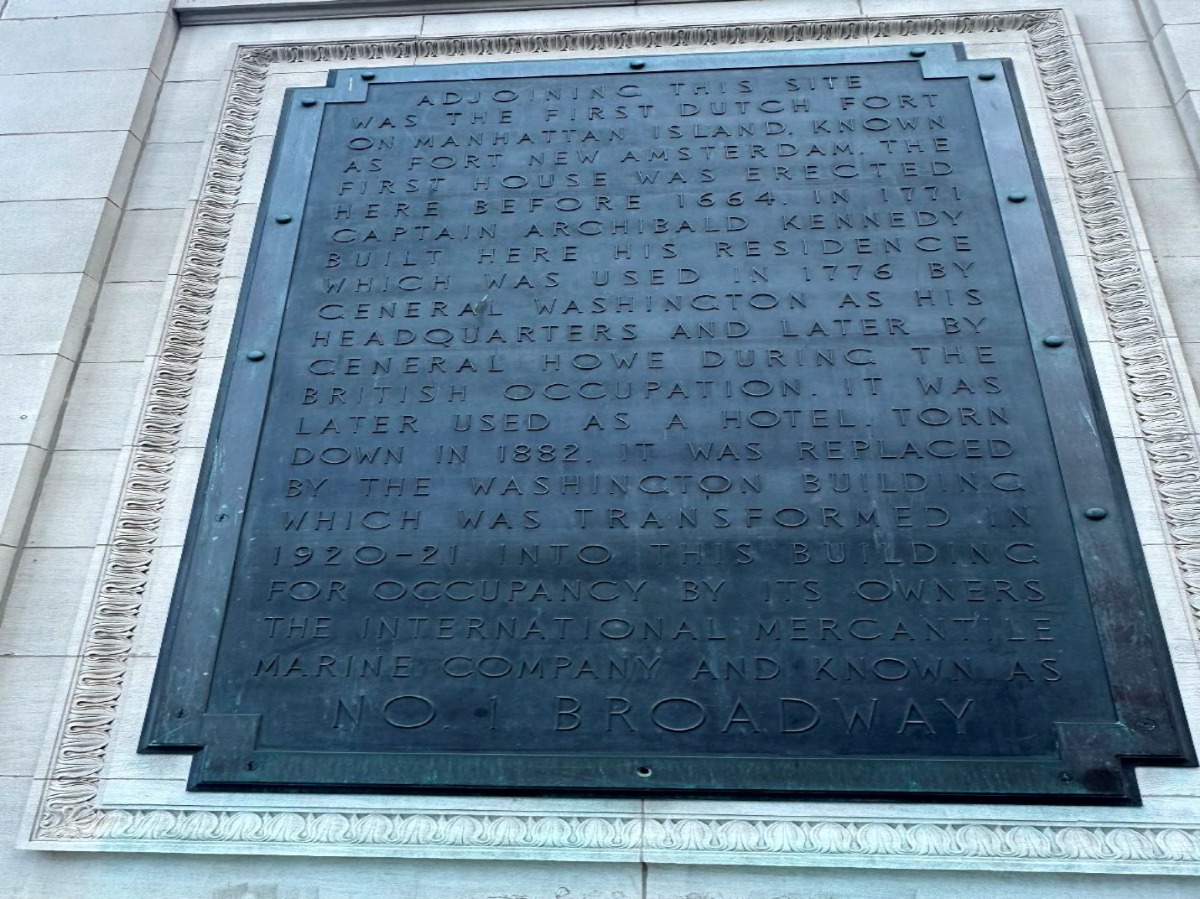
A useful, 10-foot-high giant bronze history marker at the bottom of Broadway.
Thank you for indulging me for sharing a personal victory in finding a lost bit of information about this long-gone Manhattan railroad terminal. This was an interesting little field trip to see what, if anything was left from 150 years ago. I was surprised to find as much as I did, considering how much time has passed as well as how changed the area is.
Relevant Model Addendum
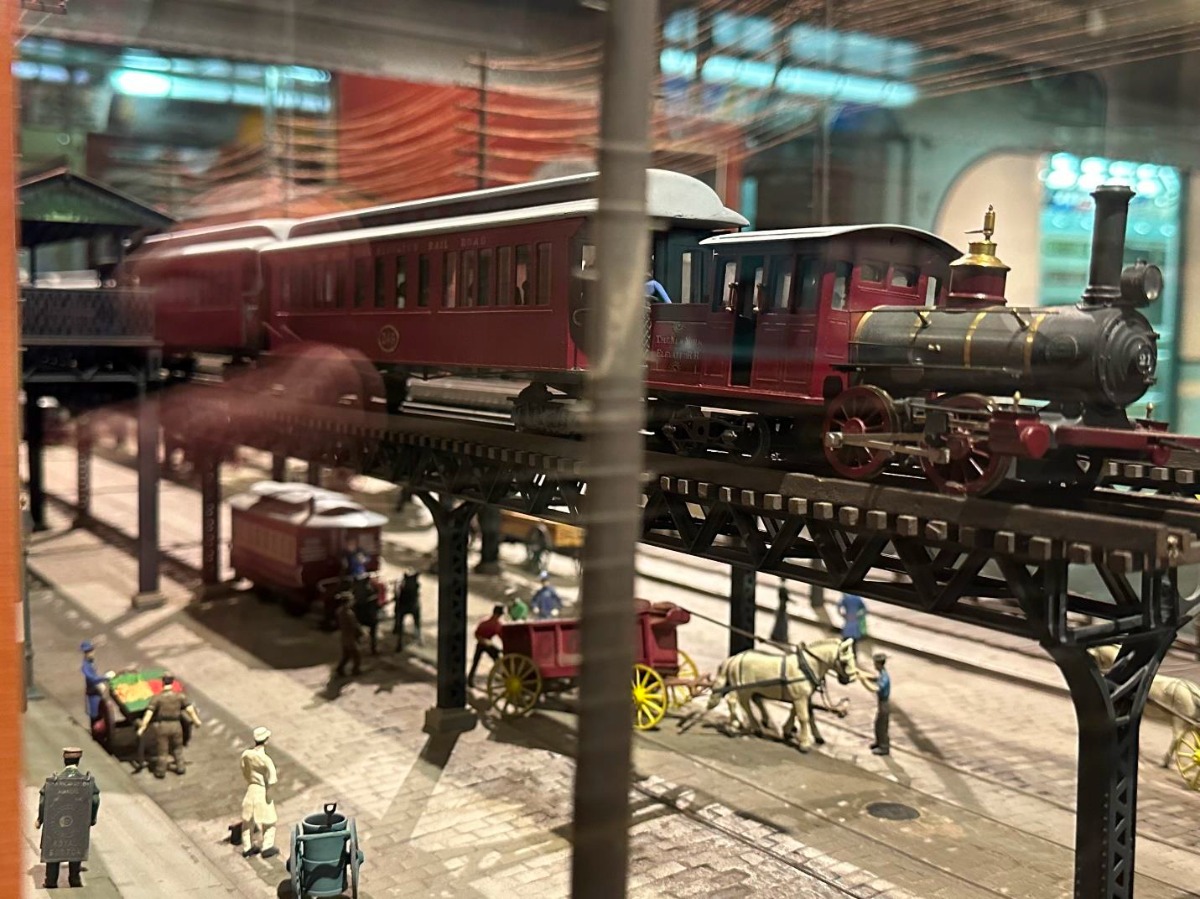
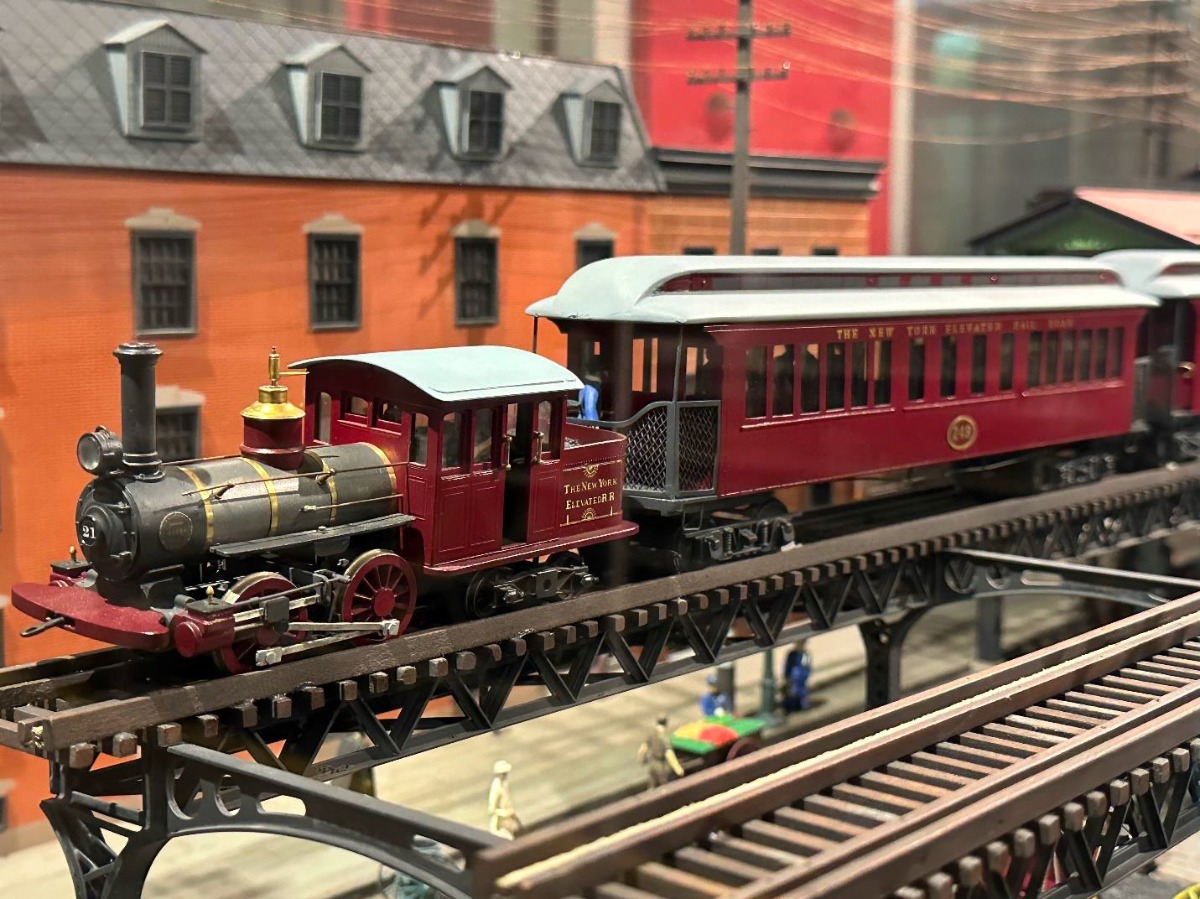
Here are a few pictures of an O scale New York Elevated diorama that is now in the New Tork Transit Museum in Brooklyn. The model depicts the Elevated in the 1880’s and 90’s. By that time the primary motive power were 0-4-4F forneys painted crimson lake with russia iron boiler jackets and pulling the third style of passenger cars. The track depicts a style used along the Bowery with track located near the curb that connected in a support beam across the road. Later this center area was filled with express tracks.
This model was probably made in the 1960’s and a bit generic but the detail is nice for the time. I do like that they included the many above ground lines. This was before the bad ice storm that forced the city to required all lines be buried.
Originally this model was housed in the Smithsonian Transportation Hall where I used to visit it when I was growing up in the DC area. I appeciate that the model has followed me to New York.

Riverhead Railroad Festival
This yearly event is held at the Riverhead campus of the Railroad Museum of Long Island. Most of the Long Island based railroad historical groups and model railroad groups attend and a few modular groups bringing their layouts. The very active Oyster Bay Railroad Museum will attend with updates and documentation of their various projects. The normal Riverhead displays will be open like their Hobby Shop, the former Lionel Michigan Factory layout will be running, The 1964 Worlds Fair LIRR ride on train will give rides and the rolling stock will be open for tours including the ex BEDT 0-6-0t #16.
I attended last year, and I will be attending this event on Saturday the 24th as part of the Sunrise Trail Division of the NMRA. I will be running the Time Saver and refreshing some of the scenery.
The museum is across the street from the Riverhead LIRR stop at 416 Griffing Ave, Riverhead, NY
I would be happy to see you if you decide to attend. Aug 24-25 10am-4pm $15
Call for Submissions.
Please consider contributing to our newsletter.
Email to [email protected]

NMRAx
Live and prerecorded lectures and clinics hosted on YouTube and Facebook. A short aside about this series. When I discovered this series over COVID it reignited my interest in becoming a better model maker. Also, in the live chat was where I first found other modelers who lived in the city. In a roundabout way it was the spark of starting this group. It is a great resource that the NMRA sponsors. The subjects are often very interesting, and the presentations are well done. They do need to do a better job to get the word out and raise more interest in the series. I am going to try to help promote it. I do feel like it qualifies as a local event because it broadcasts straight to your computer desktop.
Remaining 2025 Dates
August 30 -5PM EST
September 27 -5PM EST
October 25 -5PM EST
November 22 -5PM EST
December 13 -5PM EST
The Sunrise Trail Division Lecture Series
The Sunrise Trail Division of the NMRA had a weekly Wednesday night lecture series. This has wrapped up and there will be a new replacement series. It will probably not be Wednesday nights and going to a once a month schedule it will have a different more conversational format focusing on local NYC and Long Island model railroaders.

Greenburg Great Train & Toy Show
www.trainshow.com
New Jersey Expo Center 97 Sunfield Ave, Edison, NJ 08837
August 9-10
November 29-30
2026 March 28-29
Riverhead Railroad Festival (see small article above)
416 Griffing Ave, Riverhead, NY
Aug 24-25 10am-4pm $15
“Let’s Talk Trains!” sponsored by Sunrise Trail Div NMRA. Conversational chat about trains and modeling. Community building and model sharing.
Long Island Welcome Center, Long Island Expressway 495 exit 54
8/23 and 10/04 10:30am-2:00pm
Sunrise Trail NMRA Division Fall Meet
Knights of Columbus Hall 49-18 Queens Blvd, Flushing NY 11377
5 min walk from 52nd station of the #7 train
Oct 4, 2025 11am-4pm $5
Clinics: Gordon Hope will demonstrate hand laying an HO #4 turnout
Steve Perry MMR will show how to make a 3D model of a small home.
Central Operating Lines All Gauge Swap Meet ( www.coltrains.com )
50 A Carlough Rd. Bohemia, NY 11716
Oct 26 8-12
Nov 9 8-12
Dec 14 8-12

Train events a little further afield
Concord Flyer: NMRA NER Convention
Clinics, Model Room, Operating Sessions, Prototype tours, Layout Tours
www.conventions.nernmra.org
Concord, New Hampshire
Sept 11-14 2025
Eastern Division Train Collectors Association Train Meet (York)
York Fairgrounds 334 Carlise Ave York, PA 17404
Oct 16-18th 2025
April16-18th 2026
Oct 15-17th 2026


We have setup a Manhattan Modelers Discord as a place to share projects & ideas, post events, ask and answer questions and make connections.
We have chosen Discord because it is organized around specific interests instead of providing a unified newsfeed. Discord is focused on real-time interactions between people, whereas other social media options function as internet message boards.
Discord also has a Zoom like video conferencing feature, but without the limits of the free Zoom.
Click on this link which will ask you to either create an account or login to your existing account.

Once you join, you will see the logo for the Manhattan Modelers "server" on the left and the various "channel" topics on listed to their right.

Please take a moment to introduce yourself in the #introduce-yourself channel


Please consider sharing this newsletter with your favorite modelers.
 The Manhattan Modelers and NMRA are independent, non-profit organizations who have chosen to affilliate for the mutual benefit of our membership, and each is not responsible for the publications, actions or omissions of the other.