Mabrouk/Mazal tov to our friends and partners, the Mimouna Association, who were honored this week in New York City with the International Center For MultiGenerational Legacies Of Trauma’s (ICMGLT) 2025 Repairer Heritage Preservation Award for “...preserving and celebrating Morocco’s rich Jewish heritage while fostering intercultural dialogue, mutual respect and understanding between Muslim and Jewish communities”
Click here to dedicate a future issue in honor or memory of a loved one
Subscribe ◊ Upcoming Events ◊ ASF Sephardi Shop ◊ Donate ◊ Sephardi Ideas Monthly ◊ ASF IJE ◊ ASF Sephardi House ◊ Archive
The Sephardi World Weekly is made possible by Daniel Yifrach, Rachel Sally, Professor Rifka Cook, Maria Gabriela Borrego Medina, Rachel Amar, Deborah Arellano, & ASF VP Gwen Zuares!
Don’t miss the latest Sephardi Ideas Monthly: “Two Jewish Songs, Ancient and Israeli”
~~~~~
“David Ricardo, the British Political Economist from a Sephardi Jewish Family”
By The History of Economic Thought

David Ricardo
(Drawing courtesy of BBC Radio 4 “In Our Time”)
With trade and tariffs in the news, the economic insights of an 18th-century Sephardi-born British economist are being rediscovered, sometimes with attribution (as in Matt Ridley’s comment on Dave Chapelle’s stand-up set) and sometimes without (as in Rep. Ritchie Torres’ tweet). Who was Ricardo and how has his discovery of Comparative Advantage contributed to centuries of free trade-created prosperity for America, the UK, and the world?
David Ricardo (1772 - 1823), was born into a family of 17 children. His pious father, Abraham, was a Sephardi Dutch-born stockbroker who transplanted to London and raised six of his nine sons to be stockbrokers. David was one of them.
At 21, David Ricardo rebelled against his family by marrying a Quaker. Cut off from his father’s support, Ricardo quickly became independently wealthy, retiring to the life of an English country gentleman at age 41.
Ricardo preferred conversation over the drudgery of writing economic texts, but James Mill (John Stuart Mill’s father) urged his friend to write a book. Ricardo’s Principles of Political Economy and Taxation was published to critical acclaim in 1817 and became a foundational text of the Classical School of economics. Mill then pushed his friend to run for Parliament, which he entered in 1819. Ricardo was a radical who advocated for free trade, the abolition of slavery, and freedom of conscience before passing away four years later, at the age of 51.
Ricardo championed free trade as mutually beneficial rather than zero-sum because there are always comparative advantages to be found and opportunity costs to be considered even when individuals, companies, or nations produce the same products or provide the same services. That said, Ricardo wrote that specialization is best, which explains why even though the US is the second largest manufacturing economy in the world, many products are not produced here. US manufacturing is focused on some of the world’s most technologically sophisticated and expensive production lines, whereas Americans trade for ordinary, less expensive products more advantageously produced elsewhere and then imported.
Is there anything “Sephardi” about Ricardo’s legacy? Generations of cosmopolitan entrepreneurship, tolerant sentiments, and political and economic liberalization are all part of a cultural Sephardi inheritance that shaped his perspective, were central to Ricardo’s financial and scholarly success, as well as tools for his integration into British society. But this only deepens the tragedy: intellectual-cultural influences aside, Ricardo’s disconnection from his family, community, and people transgressed the most fundamental commitment and commandment of Sephardi Jewish life.
Feature: Albert Hemsi’s Classical Dance “In Honor of the Mother-in-Law”

Hemsi serving in the Italian army during WWI
(Screenshot from “Alberto Hemsi, a composer serving Sephardic culture” by L’Institut Européen des Musiques Juives (IEMJ))
Albert Hemsi was a classical composer born in 1898 to a Sephardic Jewish family in the Greek Jewish community of Western Anatolia, now Turkey. His Greek Nuptial Dances for cello and piano extend and elaborate folk Sephardic musical traditions that Hemsi researched while studying composition at the Milan Conservatoire.
After the Greco-Turkish War of 1919-22 and the Greek and Turkish population exchange, Hemsi’s family settled in Alexandria, Egypt, where Hemsi served as music director of the city’s main synagogue and conducted the Alexandria Philharmonic Orchestra.
After the 1956 war between France/Israel/UK and Egypt, Hemsi moved to Paris, where he lived for the remainder of his life.
In this week’s featured recording, the ARC ensemble (Artists of the Royal Conservatory) perform Hemsi’s “Greek Nuptial Dances, Op. 37: In Honor of the Mother-in-law.”
~~~~~~~

Foundations of Sephardic Spirituality: The Inner Life of Jews of the Ottoman Empire
By Rabbi Dr. Marc D. Angel
In this groundbreaking work, Rabbi Marc Angel explores the teachings, values, attitudes, and cultural patterns that characterized Judeo-Spanish life over the generations and how the Sephardim maintained a strong sense of pride and dignity, even when they lived in difficult political, economic, and social conditions. Along with presenting the historical framework and folklore of Jewish life in the Ottoman Empire, Rabbi Angel focuses on what you can learn from the Sephardic sages and from their folk wisdom that can help you live a stronger, deeper spiritual life.
Voices in Exile: A Study in Sephardic Intellectual History
By Rabbi Dr. Marc D. Angel
Rabbi Angel explores the teachings of the Sephardi sages and thinkers who flourished around the Mediterranean and in the New World in the centuries after the Expulsion.
~~~~~~~

We are thrilled to announce the much anticipated 27th New York Sephardic Jewish Film Festival with the participation of Michel Boujenah, Fortuna, Roya Hakakian, Enrico Macias, and Yael Naim.
Please mark your calendar for Sunday, June 8th, as we kick off a week-long cinematic journey of untold stories celebrating the diversity, poignancy, and humor of the Greater Sephardic world.
Join us for unforgettable experiences filled with exclusive screenings, insightful discussions, and captivating performances.
Stay tuned for the full calendar and ticket information!
~~~~~~~
The American Sephardi Federation’s Sephardi House Fellowship is a unique learning, community-building, and leadership development program that infuses the diversity, creativity, and vibrancy of the Sephardic spirit into Jewish student life—while also advancing Jewish unity and vitality on campus.
Bringing together a select cohort of Jewish students from colleges across the United States, our program is the only national yearlong fellowship dedicated to deepening a sense of Jewish belonging through an immersion in the multifaceted history, cultures, and wisdom of the Sephardic and Mizrahi world.
For more information about ASF’s Sephardi House Fellowship, visit: www.sephardi.house
Apply Now!
Deadline: 1 August 2025, 11:59pm ET
For questions email the National Director of Sephardi House, Ruben Shimonov (rub[email protected]) and CC Sephardi House Engagement Associate, Stella Salmon ([email protected]).
~~~~~~~
Upcoming Events or Opportunities
March with the American Sephardi Community at the Celebrate Israel 2025 Parade!
Join the Sephardic Jewish Brotherhood of America, Kehila Kedosha Janina, the American Sephardi Federation, and other partners as we proudly march in this year’s Israel Day Parade on Fifth Avenue in New York City on Sunday May 18, 2025!
The Sephardic Jewish Brotherhood of America has a specially designed float and as a group of multiple partner Greek Jewish and Sephardic organizations in the NYC-Metro area, who represent the American Sephardi community’s support for the State of Israel!
Sign-up Now!
In order to join us on the day of the parade, you must complete the registration form. You must be prepared to arrive early Sunday morning on Fifth Avenue at a designated gathering point that will be sent out via email after registration. You MUST arrive on time.

~~~~~~~
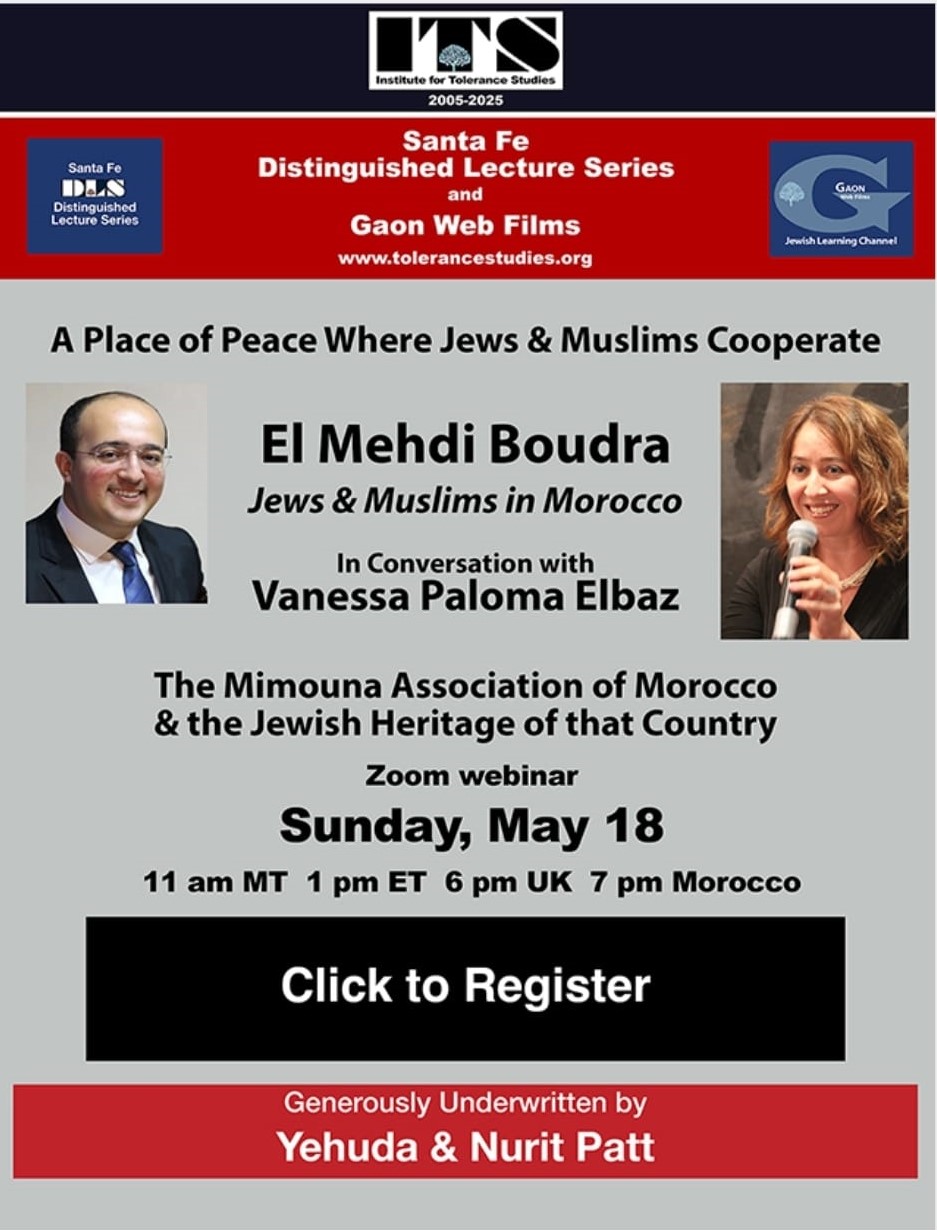
Our Friends at Santa Fe Distinguished Lecture Series and Gaon Web Films present:
A Place of Peace Where Jews & Muslims Cooperate
El Mehdi Boudra is the head of the Mimouna Assocation in Morocco, which has worked with the Jewish community for more than a decade to establish links and celebrate the Jewish history of that country. He will be interviewed by Vanessa Paloma Elbaz of Cambridge University in the UK.
Sunday, 18 May at 1:00PM EST
Sign-up Now!
Tickets: Complimentary RSVP; Registration Required
~~~~~~~
Our friends at Qesher present:
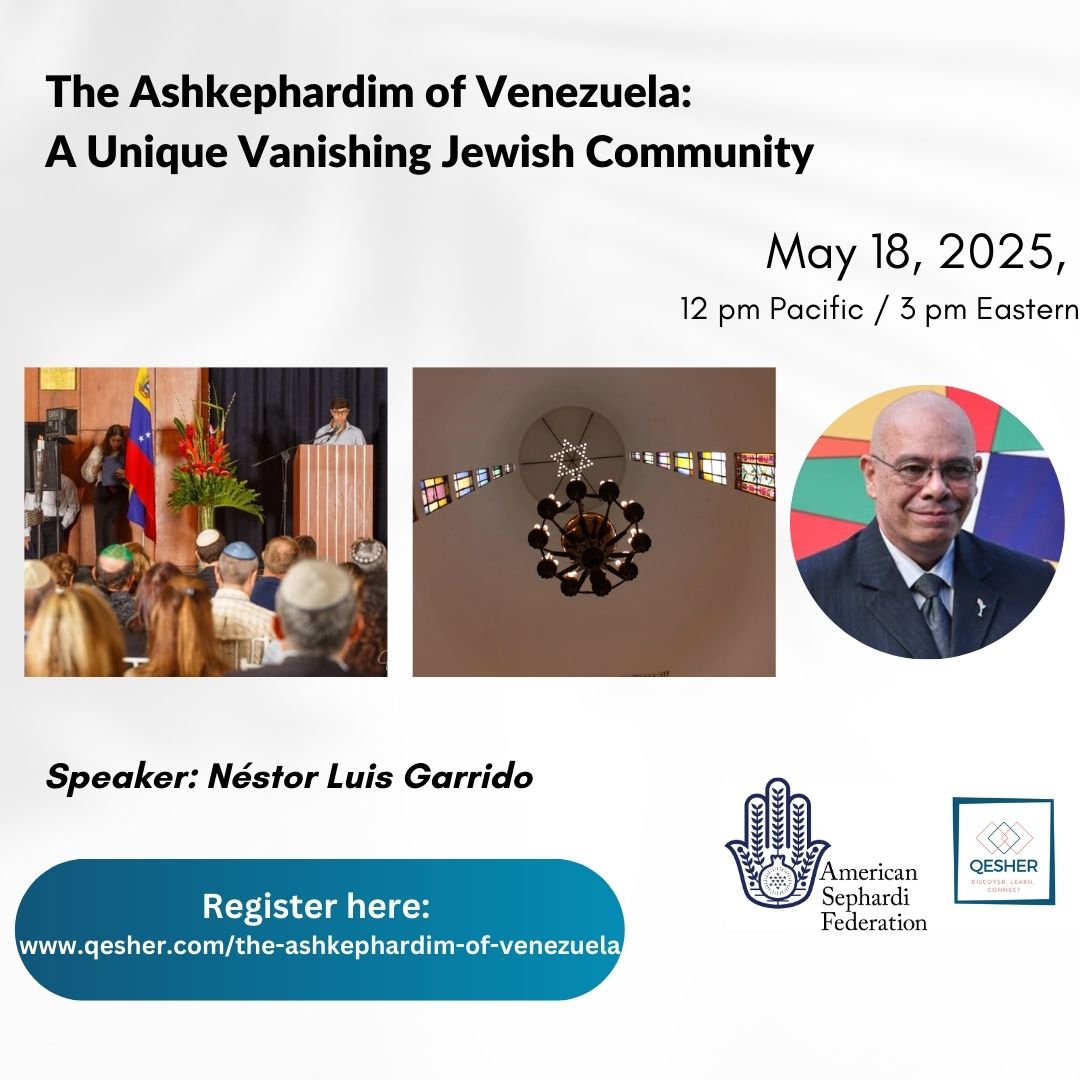
The Ashkephardim of Venezuela: A Unique Vanishing Jewish Community
“Do Jewish communities in the Diaspora end up resembling their host countries? In the racially mixed Venezuela of the 20th century, this seems to be true, as the local kehila, mainly from Romania and Morocco, followed the example set by the broader Venezuelan society. Ashkenazi and Sephardic Jews intermarried and established common institutions that laid the foundations of a brotherhood that distinguishes the Venezuelan Jewish community—an identity where gefilte fish and adafina are shared at the same table. However, the current times have forced many to leave, and this community is trying to hold on to the splendor it enjoyed in past decades.”
Sunday, 18 May 3:00PM EST
Sign-up Now!
Tickets: $18
About the speaker:
Néstor Luis Garrido is a Venezuelan writer, professor, journalist, columnist, and scriptwriter. He has given several seminars on Jewish Literature, Sephardic Literature, and Judaism as a way of life.
Within the Venezuelan Jewish community, he has served as director of the weekly* Nuevo Mundo Israelita (1990), the short-lived weekly Itón, and the magazine Hebraica. He is also the founder and director of the magazines Recuerda-Zajor (since 2001) and Maguén-Escudo (since 2009). Additionally, he has been involved with the Venezuelan Committee of Yad Vashem and the Centro de Estudios Sefardíes de Caracas, *a cultural institution of the Asociación Israelita de Venezuela.
Between 2012 and 2016, he was responsible for the Annual Report on Antisemitism in Venezuela, published annually by the Confederation of Israelite Associations of Venezuela.
He has also written the scripts for the documentaries* Valió la Pena (2001) and Una Llama Encendida (2011), which explore the history of the Ashkenazi community in Venezuela.
~~~~~~~
Bookhouse
American Sephardi Federation’s cooperative initiative with Centro Primo Levi, and Dan Wyman Books presents:
A Renaissance Story: David Reubeni, Diplomat and Spy
Zvi Ben-Dor Benite will speak about the story of David Reubeni. R
Arriving in Rome in 1523, a Yemeni Jew proclaimed himself the “Prince of the Lost Tribes” and leader of their 300,000-strong army. Pope Clement VII met with the enigmatic David Ha-Reuveni, who proposed an alliance against the Muslim Turks in exchange for the Holy Land, financial support, and a navy for the Jewish people. Why did so many Italians believe him, what transpired in Italy, and how did the events conclude?
Monday, 19 May at 7:00PM
ASF-Center for Jewish History
15 W 16th Street, NYC
Reservation required: [email protected]
Bookhouse, American Sephardi Federation’s corporate initiative with Centro Primo Levi (CPL) and Dan Wyman Books, is a small space for study, discussion, and creativity connected to Jewish book culture: from manuscripts to pulps, from Talmud to Yiddish Socialism, from Printers to Bookshops to Readers.
Dan Wyman Books will be exhibiting a rotating collection of approximately 300 rare and important books related to these topics, all of which will be available for browsing and purchase.
~~~~~~~
Our friends at American Ladino League in partnership with the American Sephardi Federation present:
An ALL Authors Presentation
With Albert S. Maimon
Join the American Ladino League for an in-depth conversation with Albert S. Maimon, Seattle-based Sephardic educator and community leader par excellence.
Al will be interviewed by Rachel Amado Bortnick, co-director of the American Ladino League–and Al’s student for regular classes on subjects of Ladino interest, including Me’am Lo’ez!
ALL Authors is a public program that engages with authors, editors, educators, and creators who work with Ladino in the American cultural sphere. The conversations are held in English with Ladino references throughout. This free Zoom event will last 75 minutes and will include time for Q&A with the featured guest as well as on-air book giveaways and prizes.
Monday, 19 May at 7:00PM EST
(On Zoom)
Sign-up Now!
Tickets: Complimentary RSVP, registration required
Tickets include an option to add a discounted copy of the newly published Zemirot HaMizraḥ Siddur for Shabbat Evening
(due to retail at $29.95 but available at the event for $25).
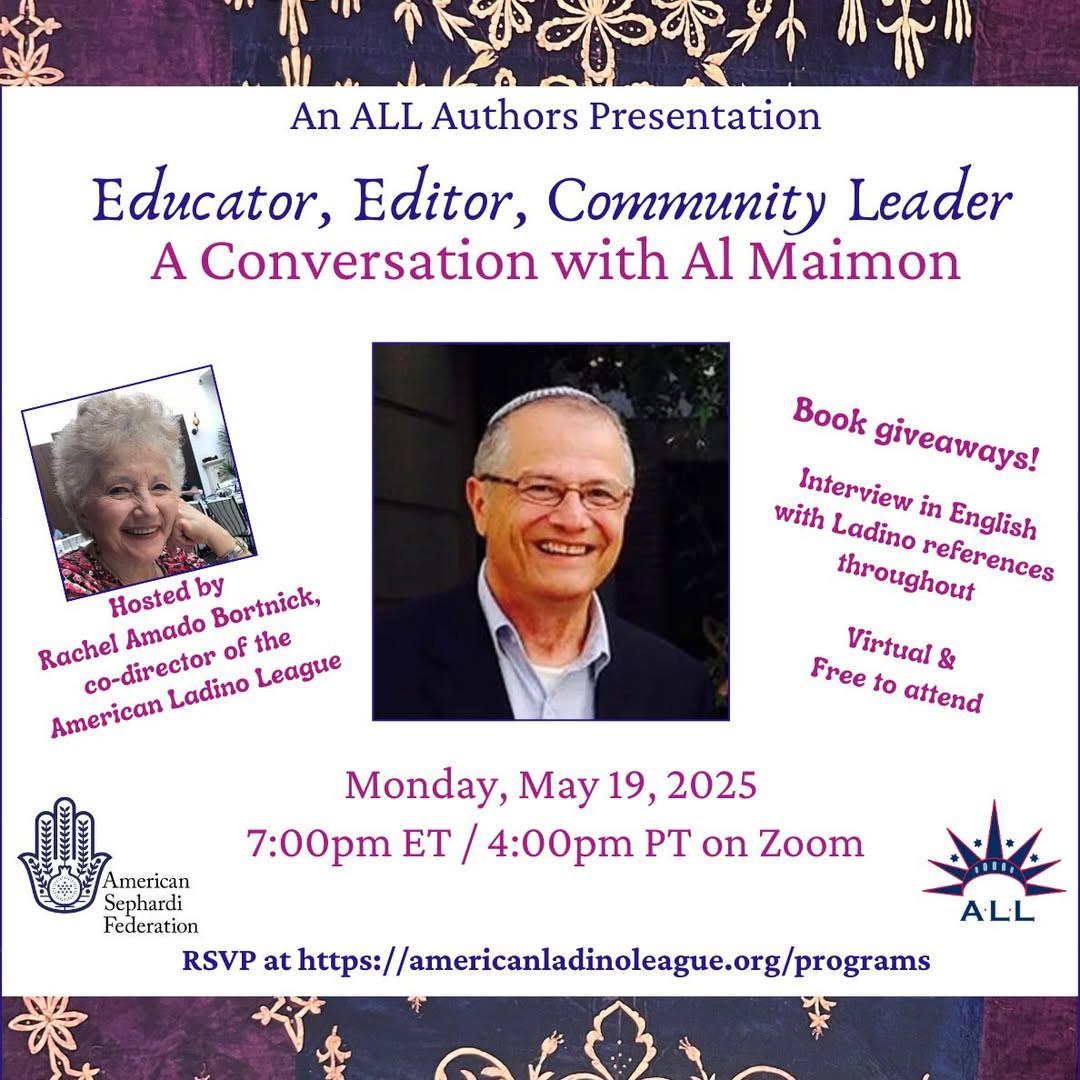
Descended from Rhodesli and Turkish families, Al Maimon grew up in Seattle with Sephardic Bikur Holim Synagogue as the focal point of his life. He worked as a counselor at a predecessor of Sephardic Adventure Camp, which was founded by his uncle, Rabbi Solomon Maimon. Al co-edited The Beauty of Sephardic Life: Scholarly, Humorous and Personal Reflections (1993), a treasury of his father’s articles that uniquely conveys Ladino and Sephardic customs. Al Maimon attended Yeshiva University, earned a master’s degree in math, and worked in operation research and large-scale information systems at The Boeing Co. He has taught extensively for local and national Sephardic organizations, devoting his time, leadership, and expertise to boards for organizations like Jewish Federation of Greater Seattle, Sephardic Bikur Holim, the Seattle Sephardic Network, the Seattle Hebrew Academy, the American Ladino League, and many more.
~~~~~~~
Our friends at the NY Andalus Ensemble present:
An evening of music and song from al-Andalus and North Africa
Spring 2025 “Ya’alat Ḥen”(Graceful Beloved)
Artistic Director, Samuel Torjman Thomas, Ph.D., an ASF Broome & Allen Fellow
Wednesday, 21 May at 7:30PM EST
@La Nacional-Spanish Benevolent Society
239 West 14th Street NYC
Sign-up Now!
Tickets: $21.05-$27.45 (Including Fees)
*Special 10% discount for ASF readers — use promo code ASF at checkout.
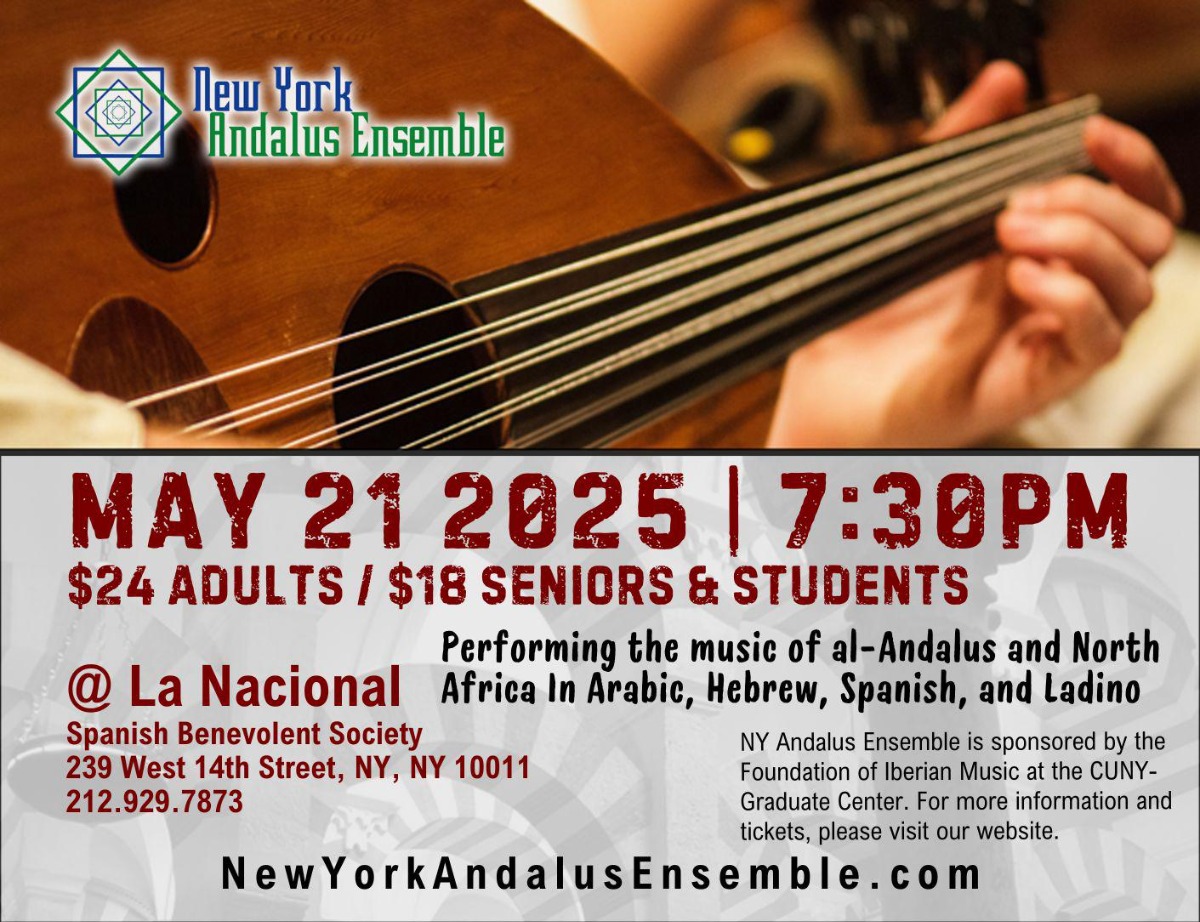
For five hundred years, Christians, Jews, and Muslims lived side by side in medieval Iberia, sharing their arts and sciences to create a scintillating, multicultural tradition of music and poetry. Singing in Arabic, Hebrew, and Ladino to reflect this cultural pluralism, the New York Andalus Ensemble presents spiritual texts and songs of love and everyday life in Al-Andalus, emphasizing the expressive quality of the region’s shared tradition even as it respects the individual cultures that comprise it. Meticulous attention is paid to authenticity of style and pronunciation as ensemble members, hailing from Algeria, Syria, Israel, Morocco, and the United States, pool their linguistic and musical expertise.
~~~~~~~
The Habura in partnership with the American Sephardi Federation present:
Hakham Uziel’s Hegyonei Uziel
Join us for a two-part series exploring the Introduction and first section of Hegyonei Uziel, the deeply traditional but original work of Jewish thought written by Rabbi Ben Sion Meir Hai Uziel, the first Chief Sephardic Rabbi of Israel. In this book, R’ Uziel connects the soul, and the soul’s connection to God, to a robustly Jewish active life inspired by a vision of human excellence.
On Wednesdays, 21 and 28 May at 3:30PM EST
On Zoom (Room: 557 873 7802)
Join Live Zoom!
Tickets: Complimentary
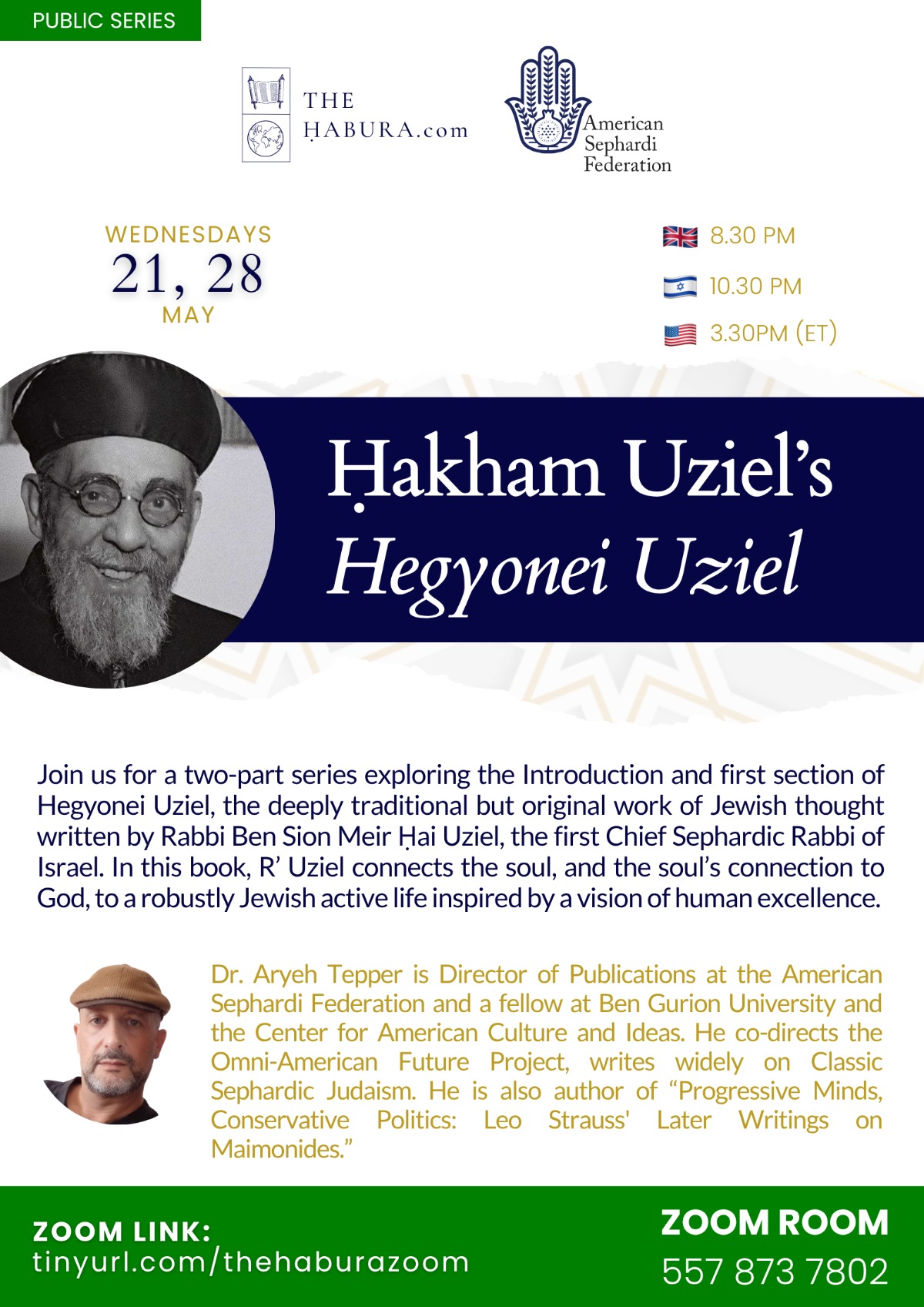
Dr. Aryeh Tepper is Director of Publications at the American Sephardi Federation and a fellow at Ben Gurion University and the Center for American Culture and Ideas. He co-directs the Omni-American Future Project writes widely on Classic Sephardic Judaism. He is also author of “Progressive Minds,
Conservative Politics: Leo Strauss’ Later Writings on Maimonides.”
~~~~~~~
Our friends at Qesher present:
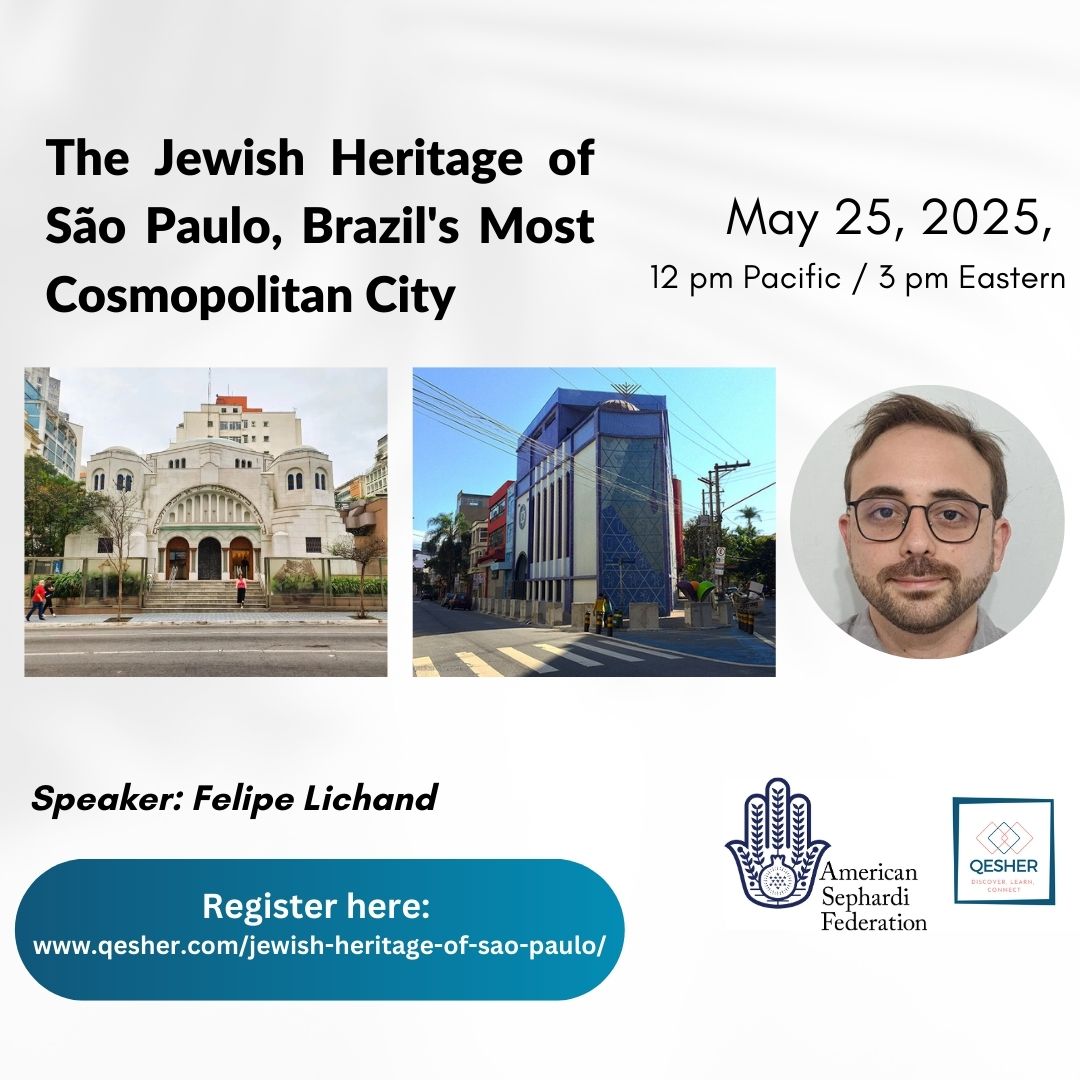
The Jewish Heritage of São Paulo, Brazil's Most Cosmopolitan City
“São Paulo is home to the largest Jewish community in Brazil and one of the most vibrant in Latin America. The Jewish presence in the city dates back to the late 19th and early 20th centuries, when waves of immigrants from Europe and the Middle East arrived, shaping São Paulo’s cultural, economic, and social landscape.
In this talk, we will explore the fascinating history of São Paulo's Jewish community, from its early days to the present.
Discover the city’s most significant Jewish landmarks, synagogues, institutions, and neighborhoods—each of which has played a crucial role in shaping Jewish life in Brazil.
Join us for an insightful journey through São Paulo's Jewish past and present!”
Sunday, 25 May 3:00PM EST
Sign-up Now!
Tickets: $18
About the speaker:
Felipe Lichand is a historian and a licensed tour guide. He is an active member of the Jewish community in São Paulo and studied at both the Talmud Torah School and Renascença, the first Jewish school in São Paulo. His strongest connection to Judaism came through his involvement with the Jewish youth movement Hashomer Hatzair, where he was part of the leadership. It was through Hashomer Hatzair that he had the opportunity to spend a year in Israel.
After returning to Brazil, Felipe worked on an exhibition in São Paulo, organized by the Holocaust Museum of Curitiba, which sparked his interest in Jewish history and heritage and led him to receive a research scholarship in the field. In June 2019, he joined the Judaic Tourism project, becoming its coordinator in São Paulo and Santos. He is also a member of LAZOS and is passionate about sharing his knowledge of Jewish history in Brazil and connecting with Jewish communities around the world.
~~~~~~~
Our friends at Kanisse in partnership with the American Sephardi Federation present:
Ancient Aleppo Shabbat
Join us as we revive these ancient prayers for Shabbat — for the first time in centuries in their original form as preserved in the Maḥzor Aram Ṣoba — and glimpse into the liturgical world of our Levantine ancestors. This immersive service will include historical insights into the elements that distinguish the ancient Aleppo rite from its modern counterpart, now featured in our newly published Zemirot HaMizraḥ Siddur for Shabbat Evening.
Don’t miss this rare opportunity to experience a lost tradition come to life and reconnect with our ancient liturgical heritage!
Friday, 30 May, 6:00pm - 10:00pm
@The Jewish Theological Seminary
3080 Broadway (at W 122nd Street), New York, NY 10027
Sign-up Now!
Tickets: $36
Tickets include an option to add a discounted copy of the newly published Zemirot HaMizraḥ Siddur for Shabbat Evening
(due to retail at $29.95 but available at the event for $25).
Space is limited and registration is on a first-come, first-served basis.
Ticket sales help cover a portion of our costs for this event. If you are unable to purchase a ticket but would like to attend, please email us at [email protected].
~~~~~~~
The Museum of the Bible, the American Sephardi Federation, and Jewish Theological Seminary (JTS) present:
Sacred Words: Revealing the Earliest Hebrew Book
Explore the new Library exhibit, featuring the remarkable story of the earliest Hebrew book.
On View through 17 July 2025
@Jewish Theological Seminary
3080 Broadway (at 122nd Street)
New York City
The exhibit is open to the public during Library Hours.
Group tours are available.
Please contact Dr. David Kraemer, Joseph J. and Dora Abbell Librarian and Professor of Talmud and Rabbinics, for more information.

About the Exhibit:
After 1,300 years of untold travels along the Silk Roads, the oldest Hebrew book reveals its extraordinary story. In Sacred Words, guests will behold the oldest-known Hebrew book, containing Sabbath-morning prayers, liturgical poems, and the world’s oldest Haggadah, which was mysteriously written upside down. Learn about the book’s content, its origins on the Silk Roads, and the multicultural cooperation that brought it first to Museum of the Bible in Washington, DC. This sacred book has a story to tell. Come discover it.
This exhibition was created in partnership with the American Sephardi Federation and the Museum of the Bible.
