In Memory of of US Army SPC Daniel J. Agami, A”H, “a fearless, patriotic soldier who never hesitated risking his life for his fellow soldiers.” Dubbed “GI Jew” by his compatriots for proudly keeping kosher, Agami earned a Purple Heart, Bronze Star, Army Commendation Medal, and had been chosen to serve as a “poster boy” for Army promotional materials before being killed in the line of duty at Baghdad on 21 June 2007. Agami continues the American Sephardic tradition of service and sacrifice on behalf of American liberty rooted in law.
Click here to dedicate a future issue in honor or memory of a loved one

Subscribe ◊ Upcoming Events ◊ ASF Sephardi Shop ◊ Donate ◊ Sephardi Ideas Monthly ◊ ASF IJE ◊ ASF Sephardi House ◊ Archive
The Sephardi World Weekly is made possible by Daniel Yifrach, Rachel Sally, Professor Rifka Cook, Maria Gabriela Borrego Medina, Rachel Amar, Deborah Arellano, & ASF VP Gwen Zuares!
Don’t miss the latest Sephardi Ideas Monthly: “Deep Listening: Exploring Music with Dan Asia”
“Enrico Macias Returns: A Timeless Voice for the Sephardic Soul”
By Meyer Harroch, New York Jewish Travel Guide

Enrico Macias' full house, Closing Night of the 27th NY Sephardic Jewish Film Festival - Inaugural Festival Sefarad, 15 June 2025
(Photo courtesy of Zak Siraj)
The ASF closed the 27th Annual New York Sephardic Jewish Film Festival by hosting Enrico Macias for a rousing live performance. The Constantine-born French Jewish superstar had fans young and old and from around the globe dancing in the aisles:
Performing to a sold-out theater at El Museo del Barrio, Macias didn’t just close the week-long celebration; he set the city’s cultural heart ablaze with a performance that was at once deeply personal and universally uplifting.
With cosmopolitan Mediterranean grace, Macias’ music flowed through languages and musical traditions, tracing the trajectory of the migrations that form the background to his sound:
From the opening chords of “Adieu Mon Pays”—the bittersweet anthem written aboard the ship that carried him into exile from Algeria—Macias transported the audience through time, memory, and geography. He moved seamlessly… singing in French, Arabic, Hebrew, and Spanish, each transition met with bursts of applause and emotional gasps.
The show concluded with “El Porompompero”
the Spanish hit that turned the evening into a cultural explosion. The crowd leapt to their feet, clapping in unison, stomping, singing at full volume, and dancing without inhibition. The theater felt alive with pure energy. It was no longer a concert—it was a Sephardic simcha, a wedding without a bride, a festival without borders.
Macias thanked ASF President David Dangoor for bringing him to New York, “I am here every year thanks to David, and I hope to be back for many more.” Macias’ many fans share that hope, including writer Meyer Harroch, who concluded his report by declaring that “Enrico Macias’s 2025 New York performance will be remembered as one of the greatest moments in the history of the NY Sephardic Jewish Film Festival.”
~~~~~~~
FEATURE: How Lady Liberty became a beacon for immigrants
CBS NEWS “Sunday Morning”
By Mo Rocca

Immigrants greeting the Statue of Liberty en route to Ellis Island, circa 1905 (Photo courtesy of CBS News)
When Lady Liberty, aka, the Statue of Liberty, was proposed in 1865, the vision had nothing to do with immigration. Instead, following a brutal war that ended slavery in America, the statue was intended to celebrate freedom, simply. That’s why the 46-inch-tall terra cotta and tin mini-model that arrived in 1883 (on display today at the Smithsonian American Art Museum) is standing on—stomping—chains and shackles.
The four-foot version of Lady Liberty was displayed in the Capitol Rotunda for three years, but Congress declined to foot the bill. That’s when Emma Lazarus stepped in and, for a public fundraising campaign, penned her now-classic poem “The New Colossus," calling out to “huddled masses yearning to breathe free.” Thanks to the efforts of Lazarus and others, the funds were raised, and the Statue of Liberty was dedicated in 1886. When the Ellis Island Immigrant Center opened in 1892 within eyeshot of Lady Liberty, both the statue and Lazarus’ poem resonated with new meanings.
With immigration a super-charged issue in present-day American politics, CBS Sunday Morning’s Mo Rocca retraces the Statue of Liberty’s rich and evolving legacy and the various ways in which the challenge and promise of immigration have been framed throughout American history. Incorporating Senator John F. Kennedy’s 1958 book A Nation of Immigrants and President Lyndon Johnson’s 1965 Immigration and Nationality Act, signed with Lady Liberty as a symbolic backdrop, Rocca’s story reminds us that America’s identity as a nation of immigrants unfolded over time and remains open-ended.
~~~~~~~
“11 fascinating facts about Emma Lazarus, the Jewish writer who gave voice to the Statue of Liberty”
By Lisa Keys, JTA

The Statue of Liberty and Emma Lazarus
(Image courtesy of JTA)
July 22nd was Emma Lazarus’ birthday. Lazarus is most famous for her poem “The New Colossus,” inscribed at the base of the Statue of Liberty, “Give me your tired, your poor/Your huddled masses yearning to breathe free...”
A poet and translator from a distinguished Sephardi Jewish family whose “ancestors were among the 23 Sephardic Jews who arrived in New York on Sept. 13, 1654, creating the first organized Jewish community in the city,” Lazarus also excelled as an activist and writer of prose and drama. She advocated for Jewish and immigrant rights, founded organizations for social improvement, authored novels and verse dramas, and made significant contributions as an essayist, critic, and educator.
In Lazarus’ honor, the JTA published “11 fascinating facts about Emma Lazarus.” In the words of Esther Schorr, author of a biography on the multi-talented born-and-raised New Yorker: “‘She was a woman so far ahead of her time that we are still scrambling to catch up with her — a feminist, a Zionist and an internationally famous Jewish American writer before these categories even existed.’”
Among the fascinating facts:
Lazarus was an early advocate for a Jewish homeland. [In] 1882—some 15 years before the First Zionist Congress, and before the word ‘Zionism’ was coined—Lazarus became ‘the first well-known American publicly to make the case for a Jewish state,’ according to Schorr.
Note: The ASF’s Executive Director Jason Guberman asks: Must the Mother of Exiles be exiled? Should Lady Liberty’s light be snuffed out? What would George Washington make of populists like Matt Walsh’s disdain for the symbol of American patriotism? Read some enlightening thoughts on Emma Lazarus’ 176 birthday!
~~~~~~~
Antwerp-New York: Eugeen Van Mieghem (1875-1930) and the Emigrants of theRed Star Line
By Eugene Van Mieghem
Growing up in the docklands of Antwerp in the late nineteenth century, Eugene Van Mieghem watched the comings and goings on the Red Star Line from his parents’ cafa across Montevideo Street. His early years coincided with the expansion of Antwerp Harbor and an increasing exodus to the New World. As a child and then a young adult, he spent as much time as he could sketching harbor views and portraits of the people around him, often in the midst of those historic departures. Antwerp-New York intermixes that work with historical material to create a moving profile of the massive movement of humanity that brought 3 million people past Van Mieghem’s doorstep and over the Atlantic to New York.
A Short and Remarkable History of New York City
by Jane Mushabac and, Angela Wigan
New Yorkers love to watch the building of a new skyscraper―particularly the digging of a foundation―through small holes cut into a wooden construction fence. It’s one of the great lunch-hour pastimes. Over the years the ubiquitous observer has watched the City grown and change―sometimes with disapproval, sometimes with elation, always with a fond curiosity.
This short book, with its events and anecdotes, is a peephole for spying on the history of the City from its foundations up to the present. New York was always destined to be a place of migrants and immigrants. People have come to this mercantile center to work, to build, to learn, to play, and to settle down in a neighborhood. Its people give the City the energy that makes living here a heightened experience.
A Short and Remarkable History of New York City is a timeline of five hundred years of New York City history. It can be read as a story, used for reference, or browsed through for fun.
Selected by the American Association of University Presses as one of “The Best of the Best from the University Presses.” (2000)
~~~~~~~
Upcoming Events or Opportunities
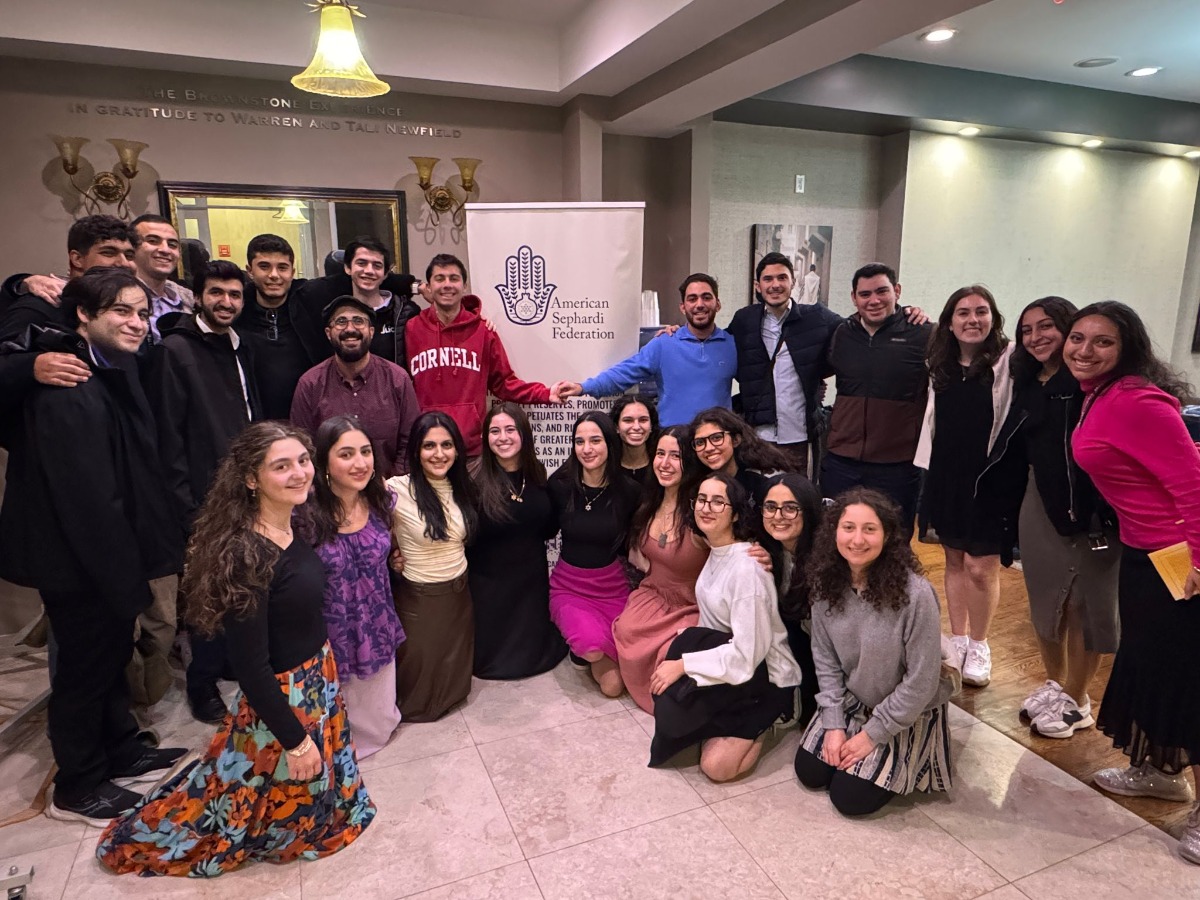
The American Sephardi Federation’s Sephardi House Fellowship is a unique learning, community-building, and leadership development program that infuses the diversity, creativity, and vibrancy of the Sephardic spirit into Jewish student life—while also advancing Jewish unity and vitality on campus.
Bringing together a select cohort of Jewish students from colleges across the United States, our program is the only national yearlong fellowship dedicated to deepening a sense of Jewish belonging through an immersion in the multifaceted history, cultures, and wisdom of the Sephardic and Mizrahi world.
For more information about ASF’s Sephardi House Fellowship, visit: www.sephardi.house
Apply Now!
Deadline: 1 August 2025, 11:59pm ET
For questions email the National Director of Sephardi House, Ruben Shimonov (rub[email protected]) and CC Sephardi House Engagement Associate, Stella Salmon ([email protected]).
~~~~~~~
Our friends at Qesher in partnership with the American Sephardi Federation present:
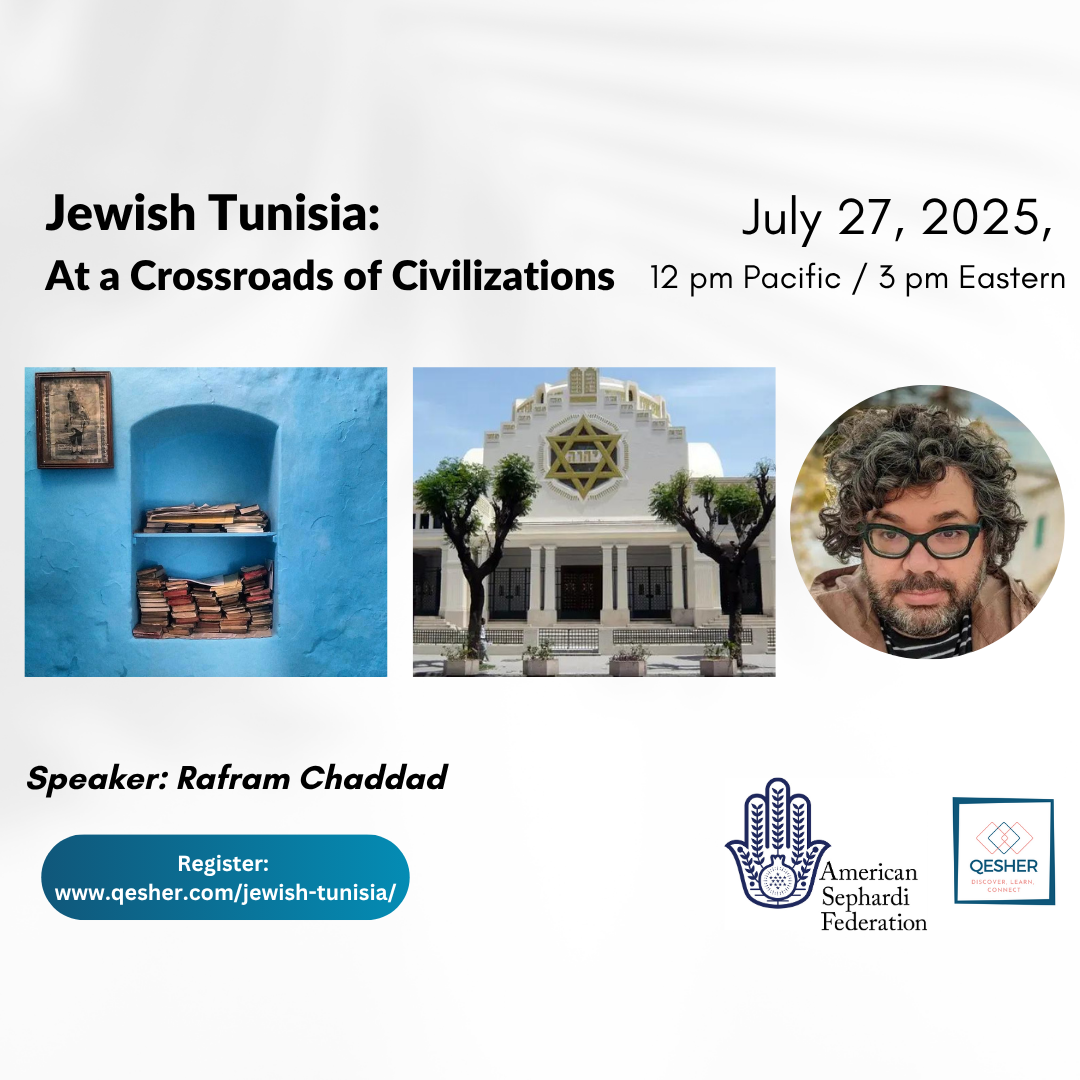
Jewish Tunisia: at a crossroads of civilizations
“Tunisia, the former seat of Cartaghe’s empire, has been home to different Jewish communities for more than 2000 years. Its central location at a crossroads of civilizations led to multiple influences in food, culture, language and identity. Rafram will take us through the different elements of the complex Jewish layer of Tunisia, which took a fateful turn in 1967 after the Six-Day War. Rafram will talk about how Jewish life looks today in Tunisia and about his work as a visual artist, which blends biography and Jewish identity in contemporary Tunisia.”
Sunday, 27 July at 3:00PM EST
Sign-up Now!
Tickets: $9-$18
About the speaker:
“Born on the island of Djerba off the coast of Tunisia, Rafram Chaddad is an artist whose photographs, films, and multi-media installations rethink the archive, migration narratives, and what it means to belong.
Working between Tunis and New York, Rafram’s work reflects on his personal life experiences and comments on broader socio-political issues including migration and displacement, identity and belonging. Over the past twenty years, he’s created dozens of short films and installations, which have been exhibited worldwide in cultural institutions, galleries, and museums, including:
Kunst im Tunnel, Dusseldorf; Kunstraum, New York; Kayu Lucie Fontaine Gallery, Bali; Lucie Fontaine, Milan; ArteEast foundation, New York; Halle 14, Leipzig; and Zalatimo, east Jerusalem. Chaddad has held solo shows at the Mucem Museum in Marseilles and the Maximilian Forum in Munich, among others.”
~~~~~~
Our friends at Qesher in partnership with the American Sephardi Federation present:
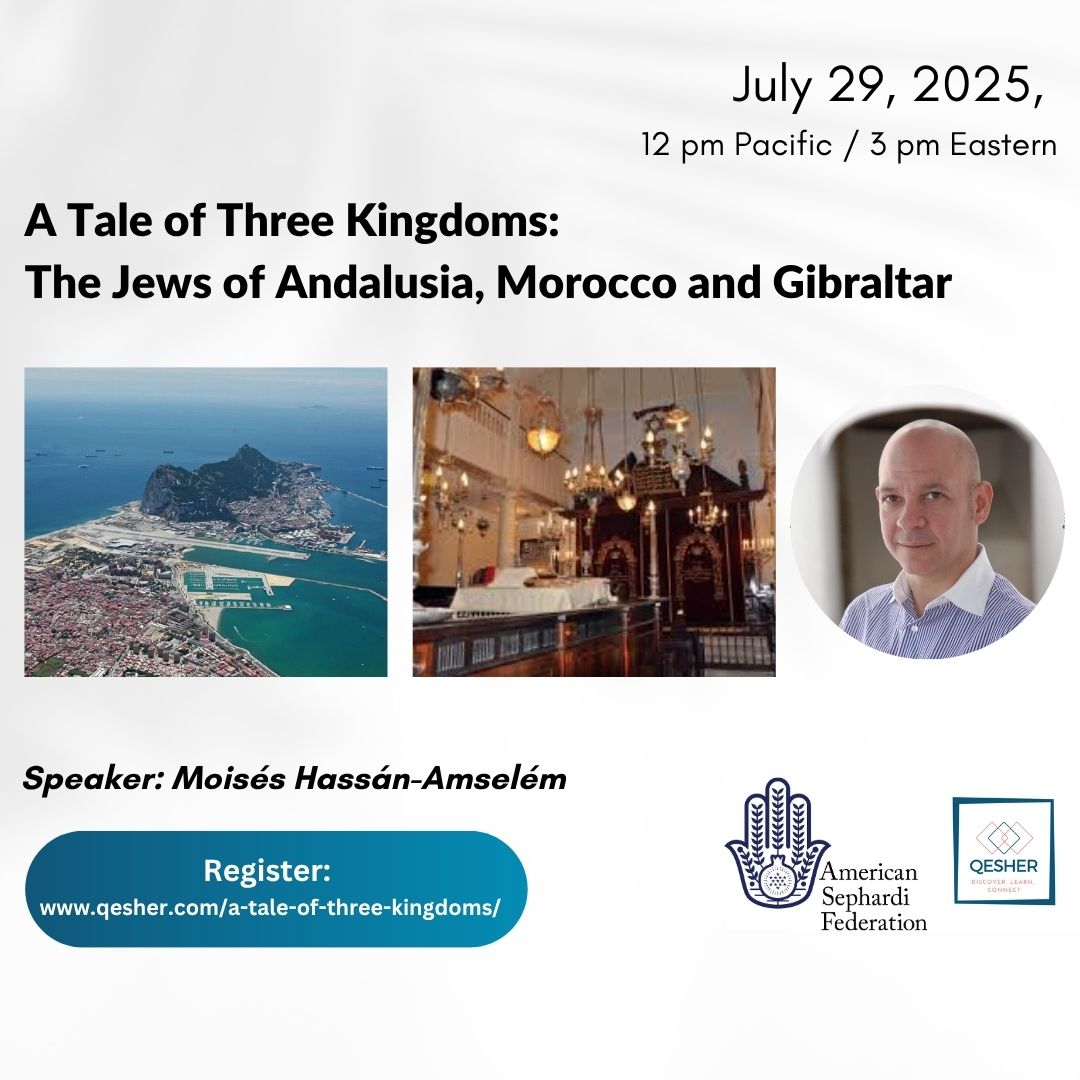
A Tale of Three Kingdoms: The Jews of Andalusia, Morocco, and Gibraltar
Tuesday, 29 July at 3:00PM EST
Sign-up Now!
Tickets: $9-$18
About the talk:
“...while the Jerusalemite exile community of Sepharad shall possess the towns of the Negev” (Obadiah 1:20)
“Andalusía (Andalucía) -the southern region of Spain once considered the most advanced and educated society in the western world, and where Judaism developed profusely and reached great heights of excellence, is the same land where all of this came to an abrupt end. This is the land where, on an unfortunate day of heart-breaking memory, an infamous decree was published -within the walls of the most beautiful palace anyone could ever imagine- and forced into exile a group of Spaniards whose only sin had been to think differently about their relationship with God.
Some of these Jews went south crossing the Strait of Gibraltar and settled down in the land of the Wattasid Sultan Abu Zakariya Muhammad al-Saih al-Mahdi. There they became a scholarly mercantile elite and quickly dominated Jewish communal life in the land already known as Morocco. Two hundred years later, some descendants of these Jews from Morocco returned -mostly as traders- to Gibraltar, a rock of less than two square miles located at the very bottom of the Iberian Peninsula that had just become part of the British Empire after the Spanish Succession war. They were given the right of permanent settlement in 1749 and since then, there has been a significant Jewish presence in the Rock.”
About the speaker:
“Moisés Hassán-Amselém, born in Seville of Moroccan heritage, is an honorary lecturer on ~Holocaust-Shoa Studies and Antisemitism at the University “Pablo de Olavide” in Seville, Spain.
He was an Exchange student in California during his senior year in High School. After his graduation, Moises returned to Spain and attended the University of Seville, where he obtained a law degree in 1995. However, he decided to make a completely career change and focus on the Jewish history of Spain. Therefore he set out to found Jewish Spain Tour, a fully licensed Tour Operator specializing in Jewish travel inside the Iberian Peninsula as well as in Morocco.
In addition to his role at the University “Pablo de Olavide”, Moisés is also involved in informal Jewish education.”
~~~~~~
Our friends at LESJC in partnership with the American Sephardi Federation, and Congregation Mickve Israel present:
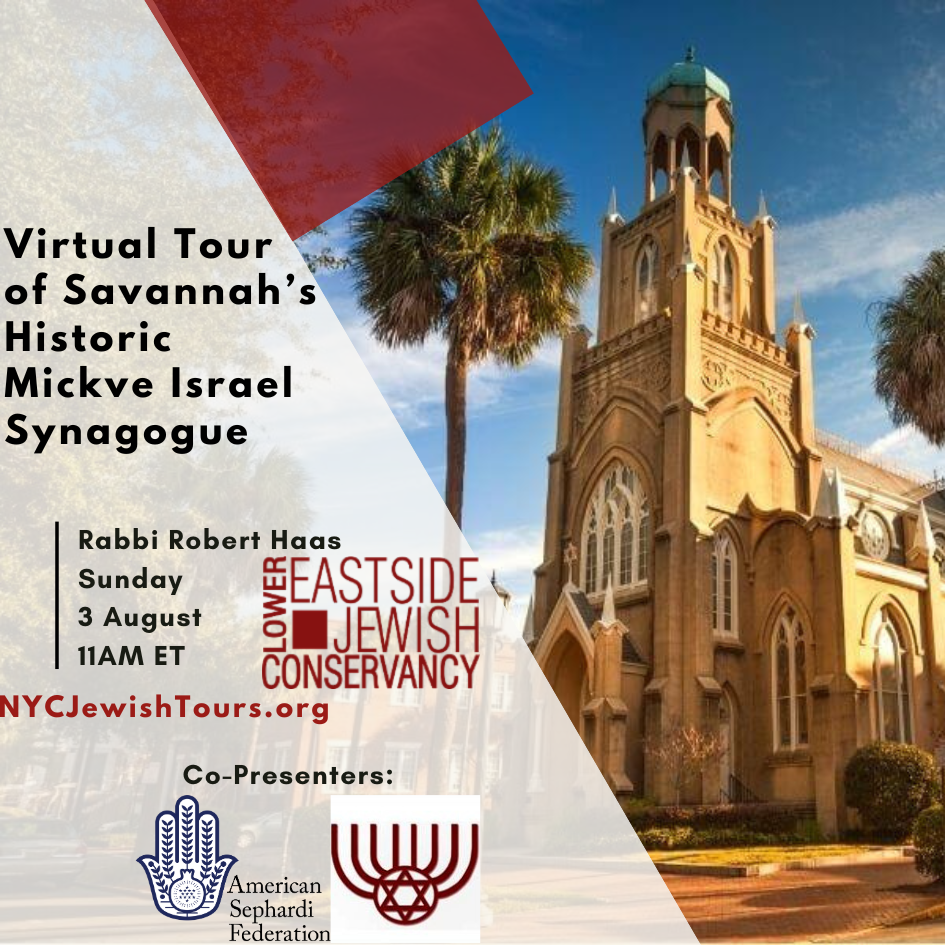
Virtual Tour of Savannah’s Historic Mickve Israel Synagogue
Shalom y’all! Join us for an exclusive virtual tour of America’s third oldest Jewish Congregation and the only neo-Gothic synagogue in the United States. In 1733, a group of mostly Spanish & Portuguese Sephardic Jewish immigrants arrived in Georgia from England, where they had found refuge from the horrors of the Inquisition. Bringing with them a Torah scroll from London’s Bevis Marks, the group settled in Savannah and founded Mickve Israel, the state’s first synagogue, in July 1735. Construction of the sanctuary began in 1876 and was completed in 1878. New York architect Henry G. Harrison pure neo-Gothic design reflected the fashionable architecture of the Victorian era. Congregation Mickve Israel was named one of the “15 Most Beautiful Synagogues in the World” by Condé Nast Traveler and rated among the “15 BEST Things to Do in Savannah” by Trip Advisor.
Sunday, 3 August, 11:00 AM 12:30 PM
Sign-up Now!
Tickets: $10
About the guide:
Your guide for this tour will be Rabbi Robert Haas, a native of McAllen, Texas, who became the 14th spiritual leader of Congregation Mickve Israel in Savannah, Georgia, in 2012. After receiving his B.S. from the University of Texas at Austin, he began his first career as an elementary school teacher before matriculating at Hebrew Union College in Jerusalem and Los Angeles, where he earned his Master’s Degree and Rabbinical Ordination. After graduation, he served as an associate rabbi in Dallas and in Houston, Texas. He then spent a year volunteering in Africa with American Jewish World Service before moving to Savannah. Rabbi Haas is a sought-after comedian, lecturer, preacher, and interfaith leader, regularly speaking and performing for organizations, radio shows, colleges, theaters, houses of worship, and institutions.
~~~~~~
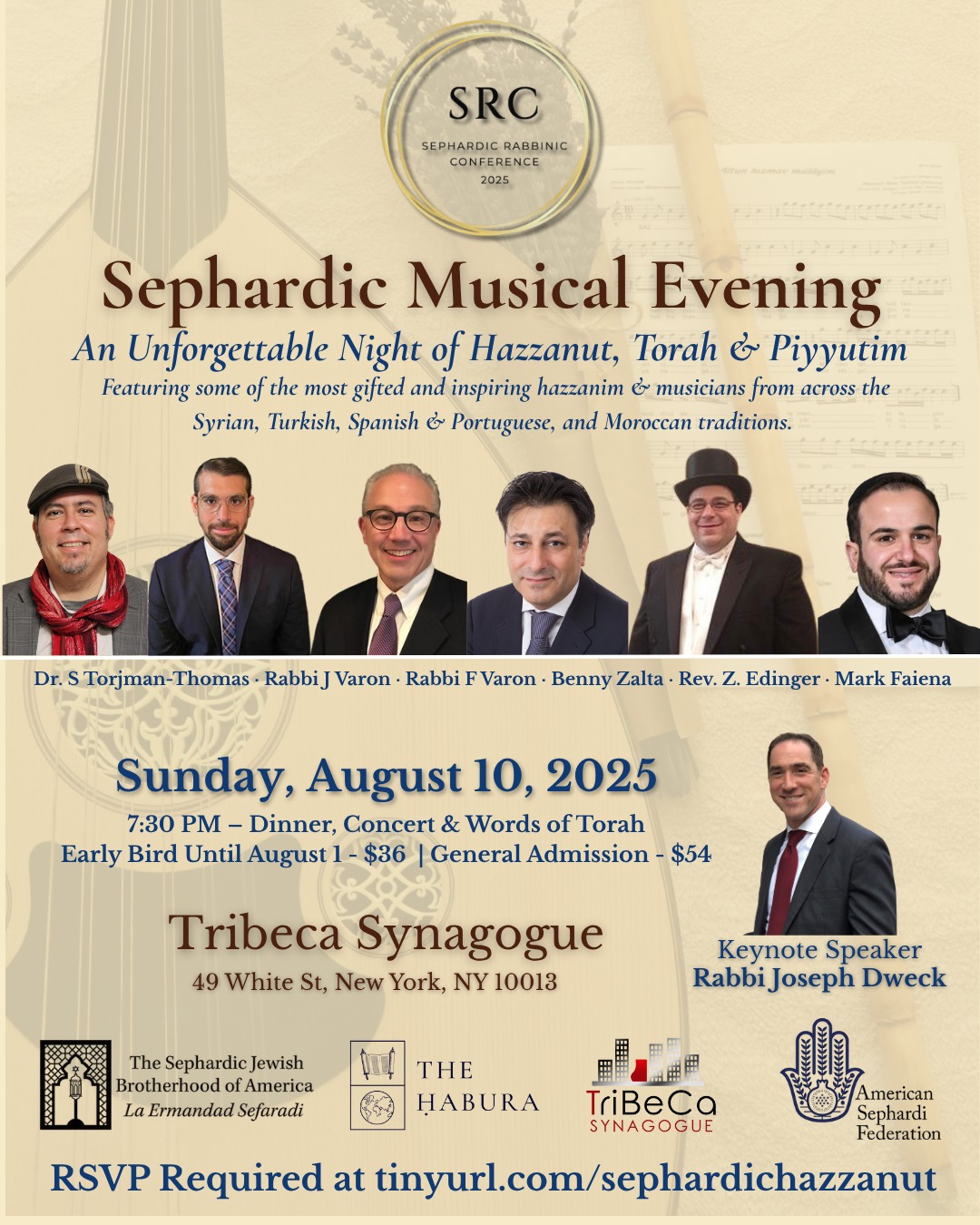
The Sephardic Rabbinic Conference in partnership with the American Sephardi Federation, Habura, Sephardic Jewish Bortherhood of America, and TriBeCa Synagogue present:
An Evening of Sephardic Music & Celebration
Join us for an unforgettable evening of Sephardic hazzanut, Torah, and Piyyutim with visiting Sephardic hazzanim and Hahamim from around the world!
This special evening is a part of the Sephardic Rabbinic Conference, a new and exciting gathering of Sephardic community Rabbis in New York with partners from across the globe. Featuring keynote speaker Rabbi Joseph Dweck, Senior Rabbi of the S&P Sephardi Community of the United Kingdom, and six local and visiting Sephardic community Hazzanim of Syrian, Turkish, Moroccan, Spanish & Portuguese, and Persian heritage.
Sunday, 10 August, at 7:30 PM
Sign-up Now!
@Tribeca Synagogue - 49 White Street, NYC
Tickets: $36 Early Bird; $54 General Admission
~~~~~~
Our friends at Qesher in partnership with Nora Kaplan Learn-in-trips presents:
Jewish History Tours to Spain
BARCELONA-CORDOBA-GRANADA
SEVILLA-TOLEDO-MADRID
Embark on a 12-day journey this October and November 2025 to experience the history of Jews in Sepharad: explore museums and world heritage sites, walk through the old cobbled lanes of Jewish quarters, take in the splendid architecture, and enjoy delicious food and Spanish wine.
Learn about the Golden Age of Jewish life in Spain on this unique, family-run Jewish Heritage Tour.
26 October - 6 November, 2025
Early Bird Price: EUR 5,700 if booked by 26 July, 2025
For questions or more information, please visit www.norakaplan.com or email [email protected].
Note: While this is not an ASF program, the American Sephardi Federation is proud to serve as a promotional partner for this unique educational experience.