In Memoriam: Former Chair in Mediterranean History at Cambridge, Professor David Samuel Harvard Abulafia, CBE, A”H, a scion of an illustrious Sephardi family that post-expulsion settled in the Land of Israel and Essaouira (then-Mogador), Morocco and later Britian; author of masterly works on the Mediterranean, Atlantic, as well as oceans in general; winner of the Wolfson Prize; a Fellow of the British Academy; a Commendatore dell’Ordine della Stella; defender of academic freedom; and champion of scholarly excellence.
Click here to dedicate a future issue in honor or memory of a loved one

Subscribe ◊ Upcoming Events ◊ ASF Sephardi Shop ◊ Donate ◊ Sephardi Ideas Monthly ◊ ASF Sephardi House ◊ Archive
The Sephardi World Weekly is made possible by Daniel Yifrach, Rachel Sally, Professor Rifka Cook, Maria Gabriela Borrego Medina, Rachel Amar, Deborah Arellano, & ASF VP Gwen Zuares!
~~~~~~~

The 28th New York Sephardic Jewish Film Festival - Festival Sefarad
Dedicated to Ike, Molly and Steven Elias
31 May - 7 June 2026
Honoring Avi Issacharoff, Bernard-Henri Lévy, Murray Perahia, and Jeannette Sorrell
Celebrating Sephardi Creativity in the Spirit of America 250!
Presented in partnership with the Museum of Jewish Heritage - A Living Memorial to the Holocaust and made possible by additional support from the UJA-Federation of New York
~~~~~~~
“David Abulafia obituary: Author of epic maritime histories”
By The Times
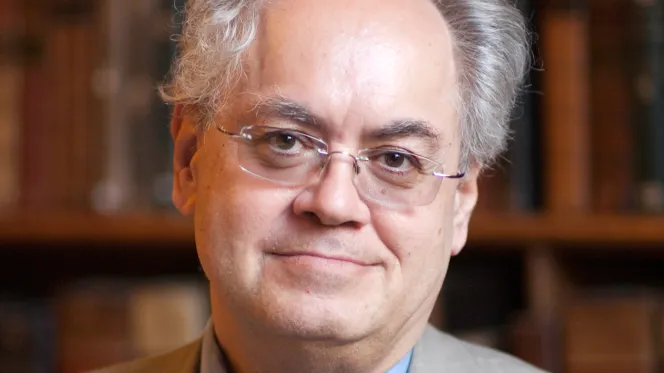
David Abulafia at Cambridge
(Photo courtesy of British Academy)
David Abulafia died suddenly on 24 January 2026, at 76, leaving behind epic maritime histories that helped to reshape how readers think about the seas. A Cambridge historian of medieval Mediterranean Europe, Abulafia combined rigorous scholarship with narrative wit and ambition, and his works strongly influenced historians such as Tom Holland and Dominic Sandbrook.
Born in Twickenham, England, in 1949, Abulafia traced his Sephardi roots back to medieval Spain, where an ancestor, Samuel Abulafia, was burnt at the stake during the Spanish Inquisition. After the expulsion of Jews from Spain in 1492, one branch of the family settled in the Land of Israel; his paternal grandparents were traders in Morocco before his parents moved to Britain. Growing up a Sephardi Jew in Ashkenazi religious settings, he recalled feeling like “a minority within a minority.” This liminal sensibility informed Abulafia’s sensitivity to maritime encounters across borders, affiliations and allegiances.
Abulafia first made his name in medieval economic history. His book The Two Italies (1977) argued that the rapid economic development of Italy’s northern communities in the Middle Ages was based on harnessing the economic potential of the agrarian south, and it established his command of sources ranging from trade contracts and diaries to ship logs. Penguin commissioned him to write Frederick II: A Medieval Emperor (1988), a work described as unflinchingly revisionist that reframed the emperor, long regarded as a progressive “wonder of the world,” as a more conservative figure.
Abulafia’s wider fame rested on his sweeping maritime histories. The Great Sea: A Human History of the Mediterranean (2011) became a bestseller, won the Mountbatten Literary Award and was translated into 12 languages. Holland and Sandbrook called The Great Sea “magnificent,” praising its epic sweep, eye for detail and lucid style; they delighted in touches such as the anecdote about Roger I of Sicily responding to a request to attack Mahdia by lifting his thigh and letting out “a great fart.” Abulafia’s even more ambitious The Boundless Sea: A Human History of the Oceans (2019), a 1,000-page work that won the Wolfson History Prize, ranged from Polynesian seafarers and Vikings to conquistadors, Caribbean pirates and modern freight, and reviewers highlighted its “supreme storytelling” and “seamless melding of the personal and the universal.” The Guardian noted how in The Boundless Sea
one moment the reader is riveted by an account of the Viking pillagers who struck terror into northern Europe throughout the first centuries AD; the next, Abulafia is describing, with lyrical vibrancy, how the Irish saint Brendan had his adventures immortalised in the text the Navigatio Brendani.
In later years Abulafia, who described himself as a “modern Orthodox Jew,” participated in the “woke wars” out of fear that the integrity of history was under threat. He criticized how the teaching of history in schools and universities had become an exercise in “moral disapproval” at “dangerous” levels, warning that treating everyone as having his or her own valid version of the past opened the door to Holocaust denial.
An ardent Brexiteer and member of “Historians for Britain,” Abulafia argued that Britain’s common-law tradition marked it off from continental legal systems, and he defended a merit-based approach to admissions at universities against “positive discrimination.” He fought over ideas, undergraduates, and members of the public found him approachable, affable, and lacking in pomposity, while colleagues recall a warm, bespectacled scholar. May David Abulafia’s memory be for a blessing.
Feature: Conversation with David Abulafia, Z”L, Master of Mediterranean History at the University of Cambridge
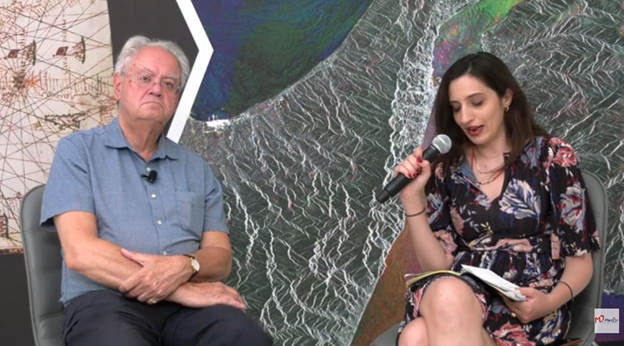
Interview with David Abulafia by journalist Ginevra Leganza
(Screenshot courtesy of Med-Or Italian Foundation/YouTube)
Professor David Abulafia, the distinguished Cambridge historian of the Mediterranean and the oceans, was widely admired for the ambition and narrative verve of books, such as The Great Sea and The Boundless Sea. Abulafia reshaped maritime history by focusing on the people, motives, and cultures that moved across the water. This conversation with journalist Ginevra Leganza showcases Abulafia’s mastery, moving easily between large structural claims and concrete examples to explaining how seas and oceans became the main corridors of global interaction.
A central thread of the conversation is the primacy of maritime routes over land routes in world history. Abulafia stresses that about 70 percent of the earth’s surface is covered by water and that, for centuries, moving goods by sea has generally been easier and cheaper than over land; today, some 80–85 percent of world trade by volume still travels by sea. In this light, even the famed Silk Road appears less dominant than the often safer and more efficient sea lanes that merchants preferred, despite the real but tolerable risks of shipwreck.
The interview then narrows to the Mediterranean as a uniquely dense space of interaction and to Europe’s changing relationship with it. Abulafia explains how the Med’s geography—small, enclosed, with limited entry points yet dotted with islands and ports—made it exceptionally suited to north–south and east–west movement. At the same time, he argues that contemporary Europe, shaped by the EU, NATO, and postcolonial suspicion, has partially turned its back on its Mediterranean identity, contributing to current tensions around migration and borders.
Finally, reflecting on the aspirational myth of “convivencia”—shared life enabling the peaceful exchange of goods and ideas—Abulafia notes how modern mechanised ports no longer function as intimate sites of coexistence. He evokes the lost worlds of ports such as Smyrna, Alexandria, and Salonika, where Jews, Christians, and Muslims once lived and traded in close, everyday proximity. In those cities, the rhythms of commerce depended on multilingual brokers, mixed neighbourhoods, and a dense web of face‑to‑face interactions along the waterfront. By contrast, modern mechanised ports, shaped by massive containers, security regulations, and the relative invisibility of dockside labor, no longer function as intimate sites of coexistence. The infrastructure that once fostered the possibility of convivencia has migrated into global logistics networks and anonymous suburbs, leaving contemporary ports highly efficient but socially thinned-out spaces.
~~~~~~~

Matzah and Flour: Recipes from the History of the Sephardic Jews
by Dr. Hélène Jawhara Piñer
A collection of 125 meticulously crafted recipes showcasing the enduring flavors that define Sephardic culinary heritage.
Matzah and Flour: Recipes from the History of the Sephardic Jews offers a tantalizing exploration of the central role of matzah and flour in Sephardic cuisine. Journey through centuries of tradition as flour, from various grains like chickpea, corn, and barley, intertwines with cultural narratives and religious observance. Delve into the symbolism of matzah, from its origins in the Exodus story to its embodiment of resilience and identity. Each of this cookbook’s thoughtfully prepared recipes is a testament to the transformative power of flour in Sephardic culinary heritage. From savory delicacies to sweet delights, these timeless flavors have sustained Sephardic families through history. Matzah and Flour is a celebration of tradition, history, and the enduring legacy of Sephardic Jewish cuisine.
Jews, Food, and Spain: The Oldest Medieval Spanish Cookbook and the Sephardic Culinary Heritage
by Dr. Hélène Jawhara Piñer
2023 Gourmand World Cookbook Awards Best Jewish Food Culture Book; 2022 National Jewish Book Award Finalist
A fascinating study that will appeal to both culinarians and readers interested in the intersecting histories of food, Sephardic Jewish culture, and the Mediterranean world of Iberia and northern Africa.
In the absence of any Jewish cookbook from the pre-1492 era, it requires arduous research and a creative but disciplined imagination to reconstruct Sephardic tastes from the past and their survival and transmission in communities around the Mediterranean in the early modern period, followed by the even more extensive diaspora in the New World. In this intricate and absorbing study, Hélène Jawhara Piñer presents readers with the dishes, ingredients, techniques, and aesthetic principles that make up a sophisticated and attractive cuisine, one that has had a mostly unremarked influence on modern Spanish and Portuguese recipes.
~~~~~~~
Upcoming Events or Opportunities
Our friends at The Neighborhood at TBSP Studio in partnership with the American Sephardi Federation present:
The Central Asian Jewish Kitchen with Dahlia Abraham-Klein
“Join The Neighborhood at TBSP Studio for a flavorful evening with acclaimed food writer and storyteller Dahlia Abraham-Klein as she brings the rich culinary traditions of Central Asian Jewish cuisine to life!
This evening will feature a live demonstration of vegetable pilau, offering a behind-the-scenes look at Dahlia’s signature meatless interpretation of this beloved Bukharan dish. Upon arrival, guests will be welcomed with a selection of appetizers inspired by the flavors of Dahlia’s Afghan-Bukharan heritage. Following the demonstration and an intimate conversation exploring Dahlia’s remarkable family history, guests will gather to enjoy the vegetable pilau together, accompanied by wine and a selection of non-alcoholic beverages.
Limited copies of Dahlia’s books, Silk Road Vegetarian, Caravan of Hope: A Bukharan Woman’s Journey to Freedom, and The Stateless Central Asian Merchant, will be available for purchase and signing at the event.
Please note that this venue does not have an elevator and is up one flight of stairs. All food will be vegetarian, but will not be certified kosher.”
Thursday, 7 May at 5:30PM EST
@TBSP Studio, 48 Dobbin St, Brooklyn, NY 11222
Sign-up Now!
Tickets: $36

About the speaker:
“Dahlia Abraham-Klein is a writer on Central Asian Jewish history and Jewish values. Her articles have appeared on Tablet, Chabad, Jewish Journal, and The Times of Israel. She is a teacher at Partners in Torah offering a personalized learning experience on the system of life through Jewish wisdom.”
~~~~~~~
Our friends at Qesher in partnership with the American Sephardi Federation present:
Get to know: Project Diaspora - Journeys to the Last Jewish Frontiers in the Islamic World
“We are running out of time. Today, we are witnessing the final days of 2,500-year-old Jewish civilizations. In many corners of the globe, ancient populations have declined by 90%, leaving only a handful of remaining members to carry the weight of millennia.
These are living libraries of human history, with lineages dating back to the destruction of the Temple of Solomon. From Iraq, where a community of 150,000 has dwindled to fewer than five people, to the vanished heritage of Libya, these cultures face total extinction in our lifetime.
Adam Heffez and Dan Brotman have traveled to over 100 countries—from Afghanistan to Yemen — searching for these last remnants. We started Project Diaspora Expeditions to bring others along on immersive journeys to “bottle up” these last moments before they vanish forever. Join us as we explore the map's furthest edges, documenting these stories before living history transitions into memory.
In this talk, we'll share with you what Jewish heritage we found in our journeys in countries such as Libya, Iraq, Syria, Tunisia, Azerbaijan, and more.”
Sunday, 10 May at 3:00PM EST
Live on Zoom
Sign-up Now!
Tickets: Complimentary RSVP

About the speaker:
“Dan Brotman is a global migration expert and journalist who has documented lesser-known Jewish communities across Iraq, Iran, Syria, and Tunisia. He holds a Master's degree in International Migration and Public Policy from the London School of Economics and has over a decade of experience managing travel and leadership programs in South Africa and Canada.
Adam Heffez is an Egyptian Jew and fluent Arabic speaker. He has documented some of the last remaining Jewish sites in Iraq, Yemen and Libya. Prior to his current career in tech, he worked in Middle East foreign policy and conflict resolution. Adam holds an MBA from Stanford University and a degree in International Affairs from Georgetown University’s School of Foreign Service.
Together, they founded Project Diaspora. They lead small group tours to the world's most isolated and unique Jewish communities, some of which are nearing their final days. From Azerbaijan to Zimbabwe, they bear witness to ancient cultures long separated from the mainstream Jewish world, some down to their final members.”
~~~~~~~
Our friends at Qesher in partnership with the American Sephardi Federation present:
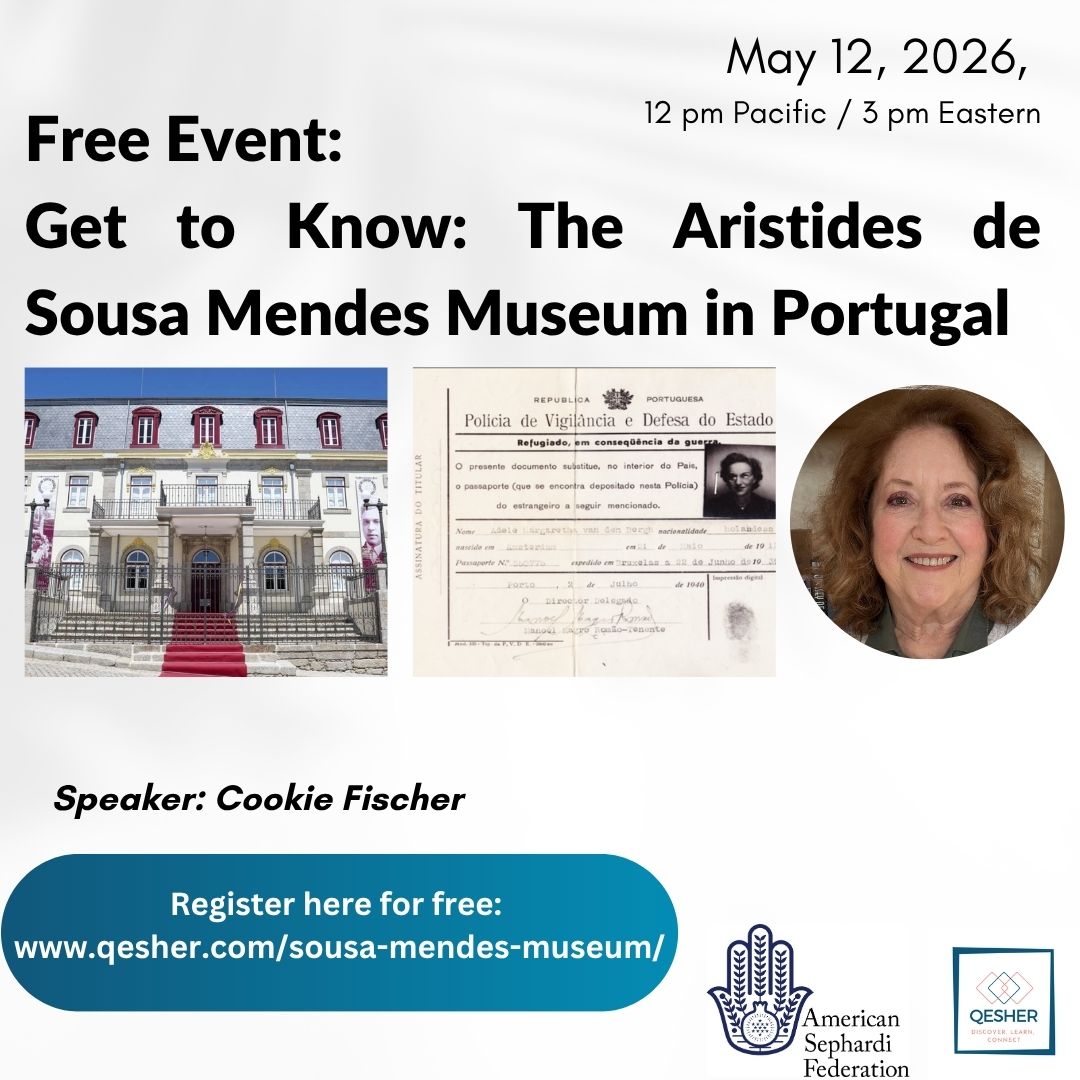
Get to know: The Aristides de Sousa Mendes Museum
“This talk will introduce the Aristides de Sousa Mendes Museum, founded recently in the restored Casa do Passal in Portugal to preserve the legacy of Aristides de Sousa Mendes. Once a 19th-century family home, the mansion fell into ruin after Sousa Mendes was punished for defying his government's orders during World War II. Its rebirth as a museum reflects decades of effort to honor his acts of conscience and the lives he saved. Since its inauguration in July 2024, the museum has welcomed more than 46,000 visitors.
Sousa Mendes, the Portuguese Consul General in Bordeaux, issued thousands of visas in 1940, enabling refugees—many of them Jewish—to escape Nazi persecution via Portugal. For Cookie, this history is deeply personal: a visa signed by Sousa Mendes in June 1940 saved her mother's life, a discovery only made decades later through family documents.
The talk will explore the museum’s exhibitions, library, and educational activities, highlighting its impact on visitors and students, and its role in preserving the memory of a Righteous Gentile in the International Jewish community and far beyond.
It also reflects on how this story of moral courage continues to inspire ethical responsibility today.
You can see the museum’s website here.”
Tuesday, 12 May at 3:00PM EST
Live on Zoom
Sign-up Now!
Tickets: Complimentary RSVP
About the speaker:
“Jeannette V. “Cookie” Fischer has built an international career spanning over 35 years as an intercultural trainer, coach, and consultant across four continents. Raised between the United States, Europe, and Latin America, she worked globally in different industries, while developing expertise in multilingual communication and intercultural training for multinational companies.
Cookie Fischer’s mother, Adele Margaretha van den Bergh, escaped from Bayonne on June 22, 1940, on a sardine schooner with a visa issued by Aristides de Sousa Mendes.
Since 2017, Cookie has been actively involved with the US Sousa Mendes Foundation. Based in Lisbon, she serves as a liaison to Jewish and American communities in Portugal and Europe. She regularly works with visitors, students, and institutions to share this history and its enduring moral significance.”
~~~~~~~
Our friends at Habura in partnership with the American Sephardi Federation present:
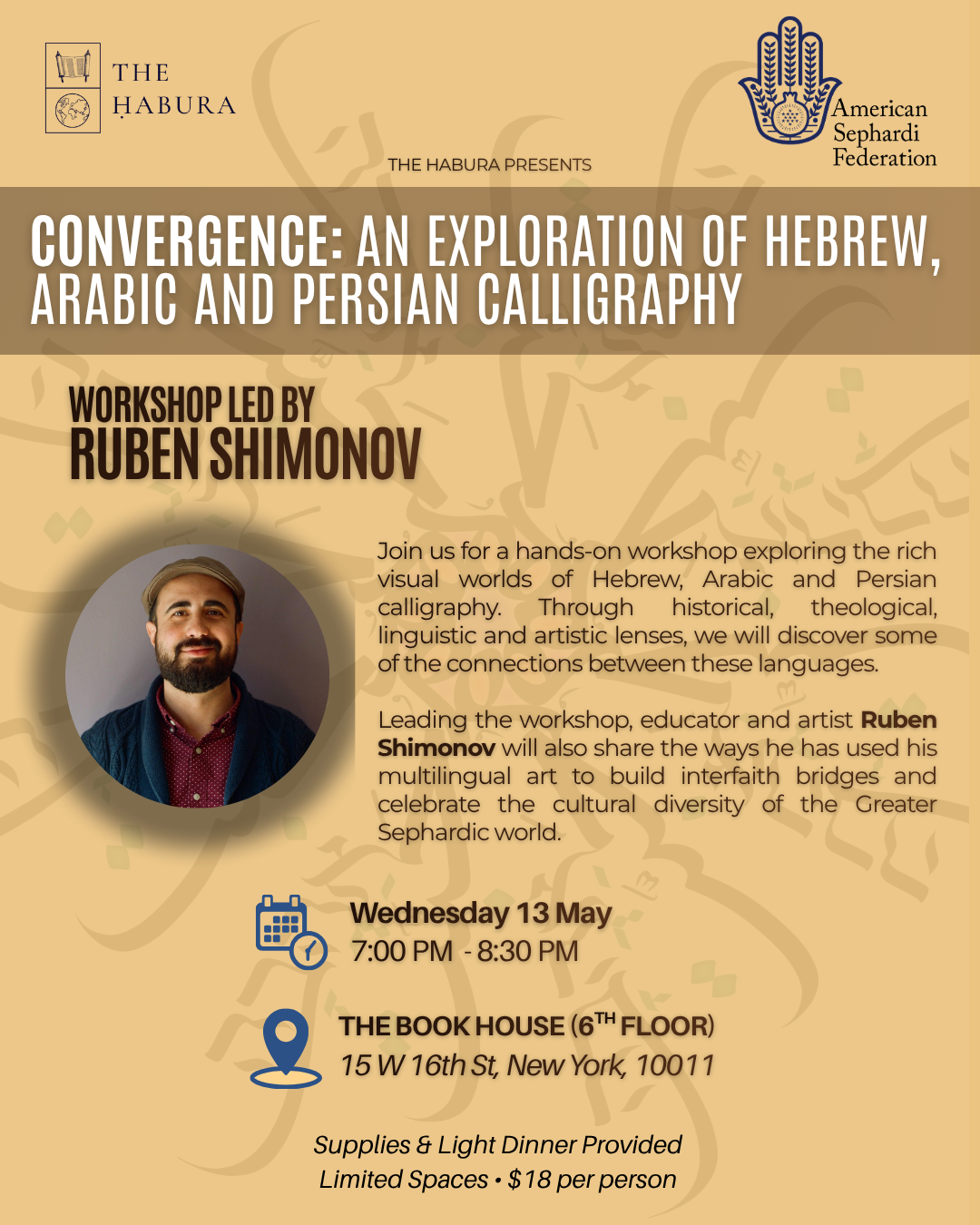
Convergence: An Exploration of Hebrew, Arabic and Persian Calligraphy
with Ruben Shimonov
“Join us as we explore the rich visual worlds of Arabic, Hebrew and Persian calligraphy.
Through historical, theological, linguistic and artistic lenses, we will discover the connections between these beautiful languages.
Educator and artist Ruben Shimonov will also share the ways he has used his multilingual art to build interfaith bridges and celebrate the cultural diversity of the Greater Sephardi world.
Participants will then have the opportunity to engage through a hands-on calligraphy workshop.”
Wednesday, 13 May at 7:00PM EST
@Bookhouse
ASF Sixth Floor - Center for Jewish History, 15 West 16th Street, NYC
Sign-up Now!
Tickets: $18
~~~~~~~
Our friends at Kehila Kedosha Janina Synagogue and Museum presents:
Greek Jewish Festival
“Join the Greek Jewish Festival as we celebrate the unique Romaniote and Sephardic heritage of the Jews of Greece. Experience a feast for the senses including authentic kosher Greek foods and homemade Greek pastries, traditional dance performances with live Greek and Sephardic music, an outdoor marketplace full of vendors, arts and educational activities for kids, and much more!”
Sunday, 17 May 12:00-6:00PM EST
(280 Broome Street, Lower East Side, NYC)
The ASF is once again proud to be a Festival Sponsor.
Learn more at www.GreekJewishFestival.com

~~~~~~~
Our friends at 14th Street Y in partnership with the American Sephardi Federation present:
Kedmah Song Circle
“Join Yosef Goldman and Josh Kaye for an immersive evening of Middle Eastern Jewish poetry and song. Each month from January to May, we’ll delve into a single piyyut - a sacred Jewish poem - learn its melodies, and discover the stories and contexts that shaped it. Come sing, learn, and connect in community. All are welcome.”
Monday, 18 May at 7:00PM EST
In-Person @ 14th Street Y
344 East 14th Street, NYC
Sign-up Now!
Tickets: $18
About the Event:
“Kedmah is a musical and educational collective devoted to Mizrahi Jewish poetry and song. Through teaching, performance, and communal singing, Kedmah invites participants to experience the vitality of sacred poetry that has shaped Jewish life across generations.
Yosef Goldman is a composer, vocalist, and spiritual artist drawing on Mizrahi and Ashkenazi devotional traditions to create transformative musical experiences. He co-founded Kedmah and serves as senior advisor to Hadar’s Rising Song Institute. His work has been featured at the Kennedy Center and Kimmel Center. As a rabbi and ritual artist, Yosef leads prayer and teaches sacred music across the spectrum of Jewish life.
Josh Kaye is a guitarist, oud player, and award-winning composer. He performs across the U.S. as a member of the Stephane Wrembel band and leads the Middle Eastern fusion project, Baklava Express. Josh has performed at venues such as The Town Hall, Dizzy’s Club, Blue Note, Symphony Space, and Lincoln Center.”
~~~~~~~
Our friends at the NY Andalus Ensemble present:
An evening of music and song from al-Andalus and North Africa
Spring 2026 “Ya’alat Ḥen”(Graceful Beloved)
Artistic Director, Samuel Torjman Thomas, Ph.D., an ASF Broome & Allen Fellow
Wednesday, 20 May at 7:30PM EST
@La Nacional-Spanish Benevolent Society
239 West 14th Street NYC
Sign-up Now!
Tickets: $23.18-$30.65 (Including Fees)
*Special 10% discount for ASF readers — use promo code ASF at checkout.

For five hundred years, Christians, Jews, and Muslims lived side by side in medieval Iberia, sharing their arts and sciences to create a scintillating, multicultural tradition of music and poetry. Singing in Arabic, Hebrew, and Ladino to reflect this cultural pluralism, the New York Andalus Ensemble presents spiritual texts and songs of love and everyday life in Al-Andalus, emphasizing the expressive quality of the region’s shared tradition even as it respects the individual cultures that comprise it. Meticulous attention is paid to authenticity of style and pronunciation as ensemble members, hailing from Algeria, Syria, Israel, Morocco, and the United States, pool their linguistic and musical expertise.