Market Update: Oil Surges Above $110 Amid Iran Conflict
Mar 09, 2026 6:54 am
Dear ,
Today, Brent crude oil prices jumped roughly 25% to above $110 per barrel, as markets reacted to escalating tensions involving Iran and concerns over potential disruptions to oil supply routes.
A key concern is the Strait of Hormuz, a passage where roughly 20% of global oil supply flows. Any disruption in this region can quickly affect global energy markets.
This issue is particularly relevant for Asia, where many economies depend heavily on energy imports from the Middle East. Estimates suggest that around 60% of Asia’s crude oil imports come from the region, with countries such as Japan, South Korea, China and India relying significantly on Middle Eastern supply.
In fact, roughly 84% of the oil that passes through the Strait of Hormuz is destined for Asian markets, meaning disruptions in the region can create greater price volatility across Asia compared with the U.S. or Europe.
That said, governments are not completely exposed to sudden supply shocks. Many countries maintain strategic petroleum reserves emergency stockpiles of crude oil that can be released to stabilise supply if disruptions occur.
The United States, China, Japan, South Korea and members of the International Energy Agency collectively hold hundreds of millions of barrels of reserve oil, which can help cushion short-term supply disruptions and reduce extreme price spikes during geopolitical crises.
History also provides some useful perspective.
During the Russian invasion of Ukraine in 2022, oil prices surged to around $120 per barrel, while the S&P 500 experienced a temporary decline as investors worried about inflation and economic disruption. As oil prices gradually normalised, markets stabilised and eventually recovered.
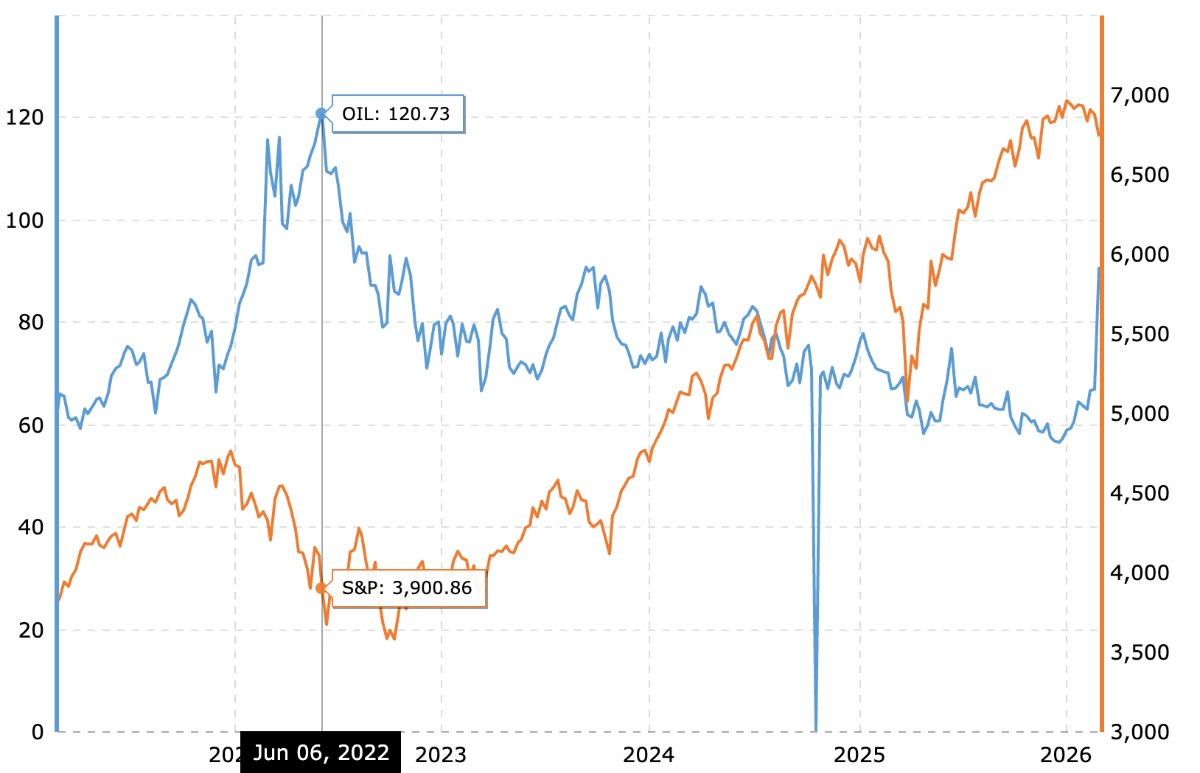
Source: Macrotrends
The key lesson is that geopolitical shocks often create short-term volatility, but long-term market outcomes are usually driven by broader economic conditions rather than the headlines themselves.
Rather than reacting to headlines, I rely on a framework of six macro indicators to monitor whether developments like this are likely to remain a temporary shock or evolve into something that could affect the broader financial system.
These indicators help guide portfolio decisions in a structured way rather than reacting out of panic.
I will continue to monitor these signals closely, including energy prices, credit markets, and interest rates, to assess whether the current tensions remain contained.
Market volatility can sometimes create opportunities for long-term investors. If you would like to review your portfolio or explore potential opportunities during this period, I would be happy to arrange a short discussion.
Warm regards,
Zest
Executive Wealth Consultant
Infinity Financial Advisory