Coach -
Charlie Weis Jr. has been breaking down defenses since he was a kid holding up personnel cards on the Notre Dame sideline.
He started coaching at 18. He was an analyst for the Crimson Tide at 22. Now, he’s the Offensive Coordinator at Ole Miss and on his way to the LSU Tigers, after orchestrating one of the most explosive offenses in college football.
But here is the thing about Weis Jr.: He doesn’t believe in complexity for complexity’s sake.
He believes in organization.
When it comes to the RPO game, it’s easy for a quarterback to get "paralysis by analysis." There are too many moving parts.
To fix this, Weis Jr. categorizes their entire RPO inventory into three distinct buckets: Level A, Level B, and Level C.
Here is the blueprint.
Level A: The Line of Scrimmage
This is the foundation. On "A-Level" RPOs, the quarterback is reading the first level of the defense: the Defensive End.
The Read: If the end is in a "surf" or "feather" technique, the QB reads his eyes.
The Decision: If the DE’s eyes are on the running back, the QB pulls it and runs.
The Footwork: If the read isn't there immediately, keep the ball coming; the pull might come late, or the QB transitions into a runner.
The goal here is simple: neutralize the edge defender and gain a numbers advantage in the run game.
Level B: The Second Level
Now we move to the linebackers. On "B-Level" RPOs, the read shifts to the Backside Linebacker or Overhang player.
The Concept: This often pairs an inside run with a quick slant or hitch.
The Adjustment: If the linebacker is a blitzer from depth, the QB takes a slide shuffle to buy time to rip the slant. If the defender is an "imminent threat" right on the line, it becomes a "read now" scenario to hand off or keep.
The Footwork: This requires quick hands and feet. Weis teaches a "Turn Two" mechanic—like a shortstop turning a double play—to get the ball out fast.
Level C: The Third Level (The Glance)
This is where you hit the home runs. "C-Level" RPOs are designed to attack the Safety.
The Route: The receiver runs a "Glance" route. He pushes to his third outside step and breaks at a 45-degree angle (or wraps flat if the corner is sitting inside).
The Read: The QB keys the safety. If the safety fits aggressively into the run, the QB rips the glance right behind him.
The Footwork: Unlike the quick "Turn Two" on Level B, this is a deeper throw. The QB uses a "Mesh, Gather, Ball" technique. He meshes with the back, gathers his feet for balance, and then delivers the strike.
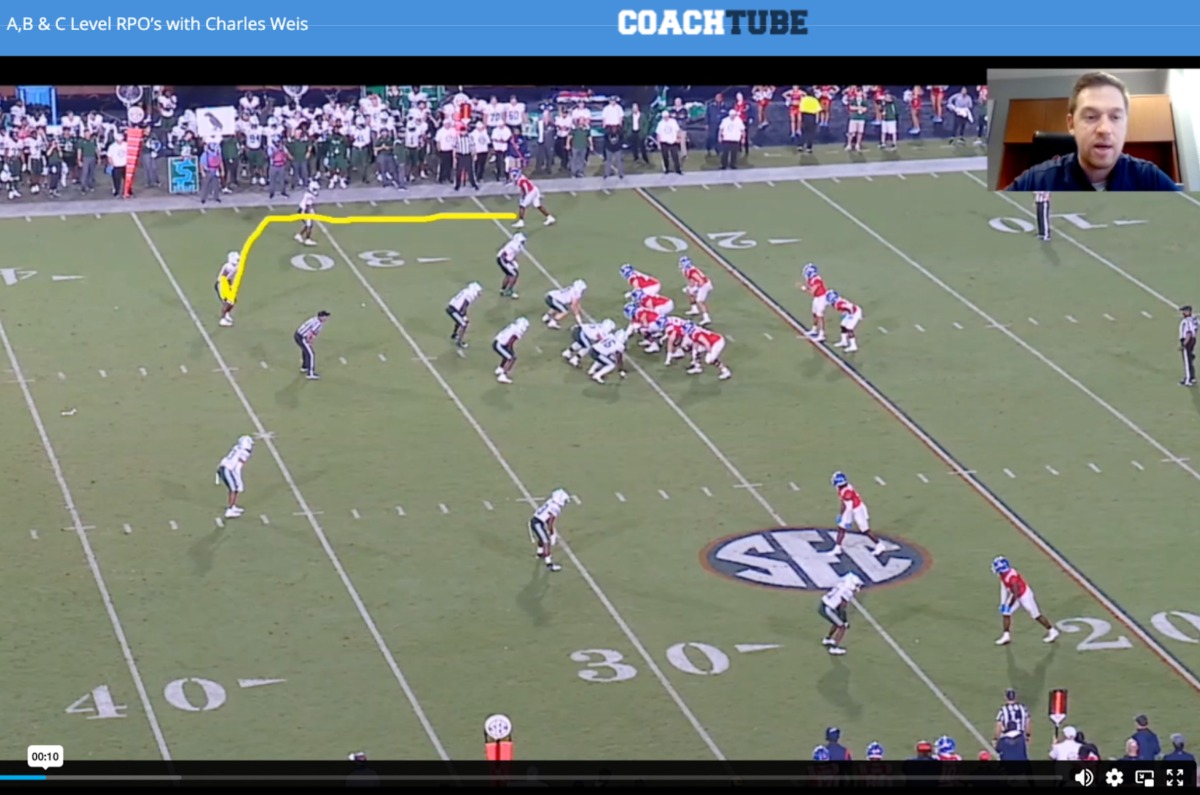
Coach Weis goes over all the details in this video:
The "Happy Hour" Adjustment
What happens when teams stop playing zone and lock you up in Man Coverage?
Weis has an answer for that, too. He calls it "Happy Hour" or "Take Two".
If the Tight End recognizes Man Coverage, he changes his assignment. Instead of blocking the man over him, he runs a slant to "crack" the defender chasing the motion man in the flat.
He stares at the defender's eyes, sticks his foot, and cracks him. It effectively picks the defender legally and springs the flat runner for a touchdown.
The Takeaway:
Coach Weis' approach shows that your RPO game doesn't need 100 different plays. It needs clear definitions. By grouping concepts into A (DE), B (LB), and C (Safety), you give your quarterback a specific problem to solve on every snap, rather than asking him to scan the whole field.
Simplify the read. Speed up the feet. Score more points.
Always be growing!
Coaches Clinic Community of Coaches helping Coaches
P.S. If you want to dive deeper into the specific footwork and drills Weis uses to teach this, you can check out the full breakdown HERE.
0 comments