Coach -
The triple option isn't complicated. But if you skip the fundamentals, it falls apart in a hurry.
A fullback who steps wrong kills the mesh. A quarterback who rides too long creates fumbles. A pitch back who isn't in position turns a triple option into a double option at best.
Coach Jake Campbell, offensive coach at Air Force, calls the fullback pathway the "vertebrae" of the veer triple. That's accurate. The scheme doesn't hold without it. He covers the core mechanics here: what makes the play go, what kills it, and where most teams get into trouble.
Video: Jake Campbell on Air Force Triple Option Basics
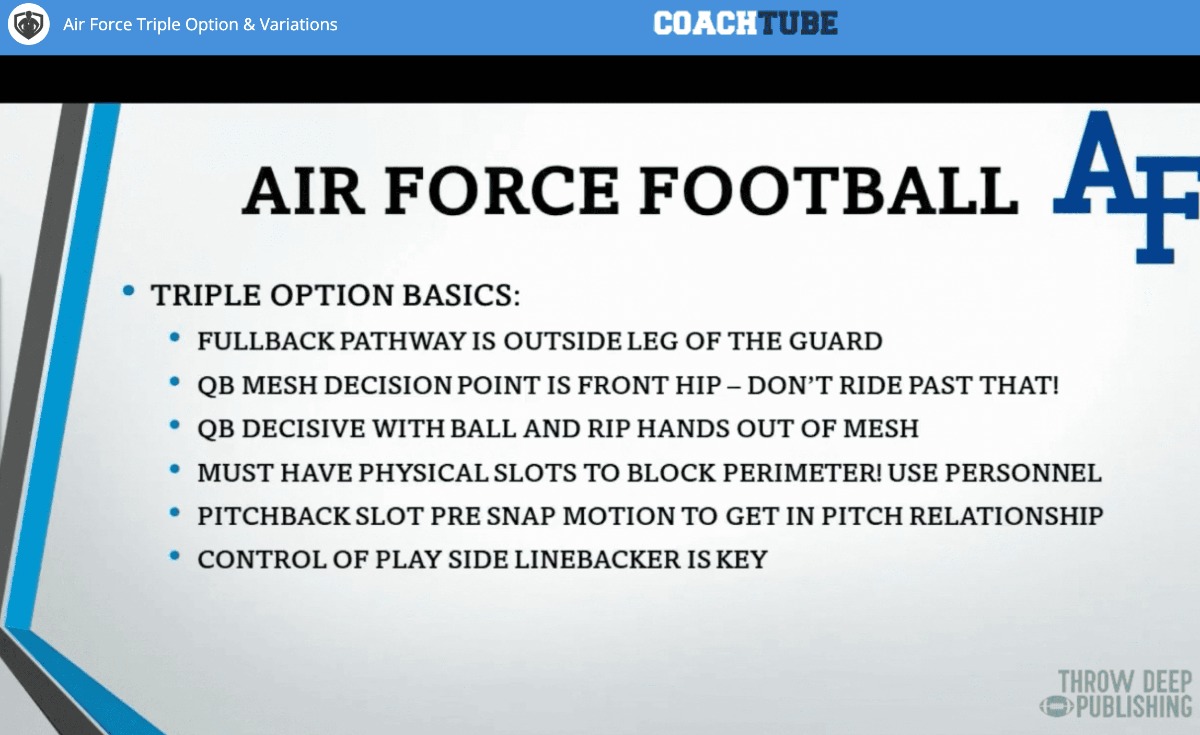
The Fullback Pathway: Aim Point and First Step
The fullback's aim point is the outside leg of the guard. That's fixed. The geometry of the whole play is built around it.
The technique rule is non-negotiable: the playside leg moves first.
Campbell is direct about what happens when it doesn't. When fullbacks start with their backside leg, it shifts the entire track. The pathway is off, the mesh point is off, and the quarterback is sorting things out in real time with a back who isn't where the play expected him to be.
It's a small footwork error with a big chain reaction. Campbell works the pathway mechanics constantly in practice, and the clip shows exactly why that repetition matters.
The QB Mesh: One Rule, No Exceptions
Ball security in the triple option doesn't live at the end of the play. It lives at the mesh.
The rule: make your decision before the ball reaches the front hip of the quarterback. Not a half second after. At the front hip.
Campbell on where mesh fumbles come from:
"A lot of ball security things happen when a quarterback tries to ride in there too long and make a last-second decision, where the fullback doesn't know what's happening."
The fix isn't reading faster. It's committing faster. Campbell's direction to his quarterbacks: "You're not going to be 100% correct every time, but if you're decisive and you rip your hands out of the mesh, the fullback knows -- as soon as that quarterback rips his hands, if the ball's still there, it's his. If the ball's gone, the quarterback's taking it."
Both players have to operate on that same understanding. The fullback trusts the rip. The quarterback trusts the rule. That shared clarity is what makes clean exchanges possible at full speed. Campbell demonstrates the reps and what decisive technique looks like in the clip above.
Pitch Relationship and Controlling the Linebacker
The third piece is everything happening on the perimeter.
On pitch relationship, Campbell is specific. Your pitch back (slot) may need a quick pre-snap motion to get into proper pitch relationship, and that motion runs off the quarterback's cadence. It's not improvised. When you're running veer triple with the fullback track heading toward the guard, the pitch back has to get into position quickly. Late relationship takes the option away.
Perimeter blocking has gotten more physical since rule changes eliminated the ability for slots to cut on the perimeter. Campbell's answer is straightforward: recruit kids who will put their shoulder pads on somebody and move them. Personnel helps too. A bigger tight end or heavier personnel groupings on the perimeter can give you a blocking advantage when your slots have to play physical.
The play-side linebacker is the central problem. Well-coached linebackers have studied the triple option. They know how to play it. Campbell says controlling him is what makes the offense go. You can block him. You can read him. You can pitch off him. You can hit him schematically with something he hasn't prepared for. He goes into detail on each of those options in the clip.
Start with the vertebrae. Get the fullback's first step right. Get the quarterback decisive at the front hip. Get the pitch back in relationship. Everything else builds from there.
Always be growing,
Coaches Clinic Community of Coaches Helping Coaches
P.S. Campbell's full clinic goes well beyond the basics in this email.
He covers base Triple Option principles along with Veer-Arc concepts, Slot Pin and TE Pin variations, surface adjustments to create leverage advantages, 3-man surface Triple Action, and Slot Insert variations.
If you run the triple option or are thinking about installing it, the complete breakdown is worth your time.
0 comments